
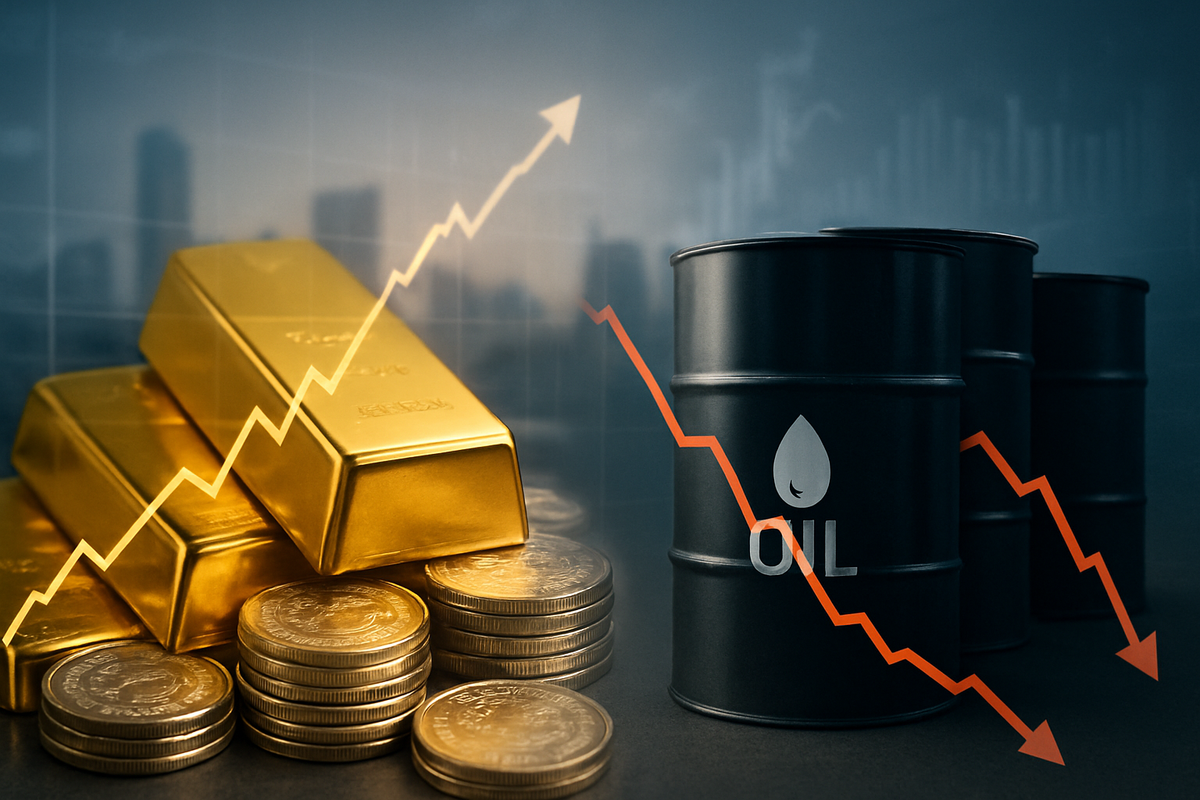
Global financial markets are witnessing a significant shift as precious metals, particularly gold and silver, experience a temporary retreat following an extraordinary rally, while oil prices continue to struggle with persistent oversupply fears. This dual dynamic, largely fueled by rising US Treasury yields and a recalibration of investor sentiment, signals a cautious turn in commodity markets, prompting aggressive profit-taking and a re-evaluation of positions in these traditionally volatile assets. The immediate implications include a "risk-off" sentiment across equities and a strengthening US dollar, as investors seek stability amidst evolving economic and geopolitical landscapes.
This retreat comes after a period of robust performance for precious metals, driven by expectations of Federal Reserve interest rate cuts and safe-haven demand. However, the upward trajectory of US Treasury yields, making fixed-income investments more attractive, has increased the opportunity cost of holding non-interest-bearing assets like gold and silver. Simultaneously, the oil market is battling a projected global surplus, with increased output from non-OPEC+ producers and a more moderate demand outlook, keeping prices subdued despite occasional geopolitical flare-ups.
Detailed Market Movements and Underlying Forces
The early days of December 2025 saw a noticeable pullback in precious metals. Spot gold fell by $45.17, or 1.07%, to $4,187 per ounce on December 2, with US gold futures also declining. Silver, after a spectacular surge to nearly $59 per troy ounce on December 1st, retreated by 1.77% to $56.97 per ounce. This profit-taking followed a powerful November, where gold climbed over 5.5% and silver surged an impressive 21.71%, both showing significant year-to-date gains in 2025, driven by expectations of a December Fed rate cut and robust safe-haven demand. Central bank gold purchases and strong industrial demand for silver, especially from solar panel manufacturing, were also key catalysts for the prior rally.
Oil prices also faced downward pressure around December 2, 2025. Brent crude futures were down 0.28% at $60.84 per barrel, while U.S. West Texas Intermediate (WTI) fell 0.52% to $57.22. This largely reflected persistent oversupply concerns, with projections for 2025 and 2026 indicating a substantial increase in global oil output, potentially leading to a global surplus of almost 4 million barrels a day in 2026. Despite a temporary rally on December 1st due to geopolitical risks like drone strikes on Russian infrastructure, the underlying "glut narrative" continues to dominate. OPEC+ (Organization of the Petroleum Exporting Countries and its allies) confirmed a modest production increase for December, followed by a three-month pause, a decision largely anticipated by the market.
The primary drivers behind these market movements are multifaceted. For precious metals, the slight retreat was a natural correction after an intense rally, exacerbated by rising US Treasury yields. The yield on the benchmark 10-year U.S. Treasury note rose to 4.09% on December 2, 2025, making bonds more appealing. For oil, the dominant factor remains the anticipated global oversupply, with record U.S. oil production and OPEC+'s cautious approach to managing supply increases. This environment of ample supply largely outweighs geopolitical tensions that might otherwise provide significant price support.
Initial market reactions extended beyond just price changes. Major U.S. stock indices, including the Dow Jones Industrial Average, S&P 500, and Nasdaq Composite, saw declines on December 1st, reflecting widespread selling pressure. Investor sentiment shifted towards caution, with the VIX volatility index indicating rising nervousness. The US dollar, after a brief retreat, saw a "bid return" on December 2nd, further impacting dollar-denominated commodities.
Corporate Fortunes: Winners and Losers
The current environment of retreating precious metals and oil, coupled with rising US yields and oversupply fears, creates a challenging landscape for companies across these sectors, distinguishing resilient players from vulnerable ones.
In the precious metals mining sector, companies with low "all-in sustaining costs" (AISC) per ounce are best positioned to "win." These efficient producers, often benefiting from high-grade deposits or advanced mining techniques, can maintain profitability even with declining prices. For instance, Kirkland Lake Gold Ltd. (TSX: KL) (NYSE: KL), known for its Fosterville mine, and Nord Gold (LSE: NORD) with its Gross mine, exemplify low-cost operations. Royalty and streaming companies like Royal Gold (NASDAQ: RGLD) are also well-insulated, as their capital-light, high-margin business models provide more stable cash flows compared to direct miners. Conversely, high-cost producers and heavily leveraged companies face significant headwinds. Mines with high AISC will see profit margins squeezed, potentially leading to operational cutbacks or closures. Smaller, junior miners dependent on new capital for exploration and development will struggle to secure financing amidst higher interest rates and reduced investor appetite for risk.
The oil and gas sector faces similar dichotomies. Integrated oil majors with robust downstream (refining and marketing) operations are better equipped to navigate lower crude prices. While upstream profits may suffer, lower input costs can boost refining margins, assuming demand for refined products remains stable. Companies like ExxonMobil (NYSE: XOM), Chevron (NYSE: CVX), and BP plc (LSE: BP) have focused on reducing debt and improving operational efficiencies, lowering their breakeven points. ExxonMobil, for example, has reportedly lowered its breakeven to around $40-$42 per barrel. Low-cost producers, particularly in efficient shale basins and offshore projects, will also maintain competitiveness. However, pure-play Exploration and Production (E&P) companies with high breakeven costs and significant debt are highly vulnerable. Many US shale producers, for instance, face profitability challenges below $60 a barrel. Oilfield services companies, dependent on E&P spending, will also experience reduced demand and pricing pressure, potentially leading to consolidation.
Wider Significance and Historical Context
The retreat in precious metals and oil, while distinct in their drivers, collectively signals a complex and evolving global economic landscape. For oil, the persistent oversupply reflects broader industry trends of robust non-OPEC+ production, particularly from the U.S. shale industry, and a gradual moderation in global demand due to efficiency gains and the accelerating energy transition towards renewables and electric vehicles. This fits into a historical pattern where periods of oversupply have led to sustained price declines, reminiscent of earlier commodity busts. Regulatory and policy implications include OPEC+'s ongoing efforts to balance the market through production quotas and the increasing influence of environmental regulations on long-term investment in fossil fuels.
Precious metals, on the other hand, are experiencing a short-term correction within a broader bullish trend. The significant rally throughout 2025, driven by expectations of Federal Reserve interest rate cuts, geopolitical tensions, and central bank buying, underscores their traditional role as safe-haven assets. This aligns with historical precedents where gold, in particular, has performed strongly during periods of economic uncertainty and monetary easing. The surge in silver, partly due to its increasing industrial demand in green technologies, highlights a newer trend of metals being critical for the energy transition. The U.S. Geological Survey adding silver to its list of critical minerals in November 2025 could lead to policy support for domestic production, impacting global supply chains.
The current situation fits into a larger economic narrative of slowing global growth (projected at 2.9% for 2025 and 2026) and persistent, though moderating, inflationary pressures. Lower oil prices contribute to easing global inflation, offering a temporary respite for commodity-importing nations. However, the divergent paths of oil and precious metals suggest that while traditional energy sources face structural headwinds, certain metals are benefiting from both their safe-haven characteristics and their indispensable role in the emerging green economy. This could signal the early stages of a selective commodity supercycle, driven by the green energy transition, AI's energy demands, and supply chain realignments.
What Comes Next: Navigating the Commodity Crossroads
Looking ahead, the short-term and long-term possibilities for precious metals and oil diverge significantly, requiring distinct strategic pivots from market participants and companies.
For precious metals, the recent retreat is largely seen as a healthy technical correction within a broader bullish trend. As of early December 2025, gold has already rebounded to a six-week high, and silver has hit an all-time record. The mounting expectations of U.S. Federal Reserve interest rate cuts in early 2026, coupled with a weaker U.S. dollar and persistent geopolitical uncertainties, are expected to sustain this bullish momentum. Long-term forecasts from major investment banks project gold prices ranging from $4,400 to $5,300 per ounce by late 2026, with some suggesting a "bullish supercycle." Silver is also anticipated to continue its strong performance, potentially reaching $60-$70 per ounce by mid-to-end 2026, driven by both its precious metal status and increasing industrial demand from the electronics and renewable energy sectors. Mining companies should strategically invest in exploration and development to capitalize on these sustained high prices, while managing profitability.
The oil market, conversely, faces a more challenging outlook. The short-term forecast for early 2026 points to further price declines, with the U.S. Energy Information Administration (EIA) forecasting Brent crude to average $54 per barrel in Q1 2026 and $55 for the entire year. This is primarily due to a substantial global oversupply from non-OPEC+ producers and lower seasonal demand. Long-term projections suggest persistent oversupply and the accelerating impact of the energy transition, with global oil demand potentially peaking around 2030. Oil and gas companies are forced to adapt through stringent financial discipline, structural cost reductions, and portfolio management. This includes prioritizing base dividends, potentially suspending share buybacks, and exploring opportunistic mergers and acquisitions. Some are cautiously diversifying into Carbon Capture, Utilization, and Storage (CCUS) technologies to maintain their "social license to operate."
Emerging market opportunities and challenges will also play a crucial role. Emerging economies, particularly in Asia, are expected to drive much of the global petroleum demand growth, even as overall growth moderates. Lower oil prices offer a window for developing economies to advance fiscal reforms. For precious metals, central banks in emerging markets are likely to continue accumulating gold for reserve diversification. Overall, the global economy faces weak growth prospects and heightened policy uncertainty, making the commodity markets a key barometer for investor confidence and inflation trends.
Comprehensive Wrap-up and Investor Watchpoints
The late 2025 market movements underscore a significant divergence between precious metals and oil. Precious metals have demonstrated remarkable resilience and growth, driven by fundamental shifts in monetary policy expectations and geopolitical risk, positioning them as a strategic asset class for wealth preservation and growth. Oil, however, is grappling with a structural oversupply that is likely to depress prices for the foreseeable future, despite intermittent geopolitical support.
Moving forward into 2026, the market assessment suggests continued bullish momentum for precious metals, with potential for new record highs for gold and silver. This is predicated on anticipated U.S. Federal Reserve interest rate cuts, a softer U.S. dollar, and sustained safe-haven demand. For oil, the outlook is less sanguine, with forecasts pointing to a significant global surplus and lower average prices. This will necessitate ongoing strategic adaptations by oil and gas companies, focusing on financial discipline, cost efficiency, and cautious diversification.
The lasting impact of these trends includes a recalibration of investment portfolios, with increased institutional allocation to precious metals reflecting deep-seated concerns about inflation and systemic risks. For the oil sector, the anticipated glut highlights the accelerating energy transition and the challenges for traditional fossil fuel producers, potentially leading to further industry consolidation.
Investors should closely monitor several key factors in the coming months (Q1 2026):
- Federal Reserve Monetary Policy: The timing and magnitude of interest rate cuts will be crucial for precious metals.
- U.S. Dollar Strength: A weaker dollar generally supports dollar-denominated commodities.
- Geopolitical Developments: Any escalation of conflicts or new flashpoints will impact both safe-haven demand for precious metals and supply risks for oil.
- OPEC+ Production Decisions: Future OPEC+ meetings and adherence to quotas will be vital for the oil market balance.
- Global Economic Growth Data: Particularly from major consumers like China, this will influence industrial demand for silver and overall oil consumption.
- Oil Inventory Levels: Monitoring global crude inventories will provide insight into the supply-demand balance for oil.
This content is intended for informational purposes only and is not financial advice