Adhesive manufacturing company Avery Dennison (NYSE: AVY) met Wall Street’s revenue expectations in Q3 CY2025, with sales up 1.5% year on year to $2.22 billion. Its non-GAAP profit of $2.37 per share was 1.9% above analysts’ consensus estimates.
Is now the time to buy Avery Dennison? Find out by accessing our full research report, it’s free for active Edge members.
Avery Dennison (AVY) Q3 CY2025 Highlights:
- Revenue: $2.22 billion vs analyst estimates of $2.22 billion (1.5% year-on-year growth, in line)
- Adjusted EPS: $2.37 vs analyst estimates of $2.33 (1.9% beat)
- Adjusted EBITDA: $365.1 million vs analyst estimates of $355.5 million (16.5% margin, 2.7% beat)
- Adjusted EPS guidance for Q4 CY2025 is $2.40 at the midpoint, below analyst estimates of $2.44
- Operating Margin: 11.9%, in line with the same quarter last year
- Free Cash Flow Margin: 12.1%, up from 10% in the same quarter last year
- Organic Revenue was flat year on year vs analyst estimates of flat growth (70.1 basis point miss)
- Market Capitalization: $12.75 billion
“We delivered a solid third quarter, with earnings above expectations in a continued dynamic environment, reflecting the strength and durability of our overall portfolio,” said Deon Stander, president and CEO.
Company Overview
Founded as Kum Kleen Products, Avery Dennison (NYSE: AVY) is a manufacturer of adhesive materials, display graphics, and packaging products, serving various industries.
Revenue Growth
A company’s long-term sales performance is one signal of its overall quality. Even a bad business can shine for one or two quarters, but a top-tier one grows for years. Unfortunately, Avery Dennison’s 5.4% annualized revenue growth over the last five years was tepid. This was below our standard for the industrials sector and is a rough starting point for our analysis.
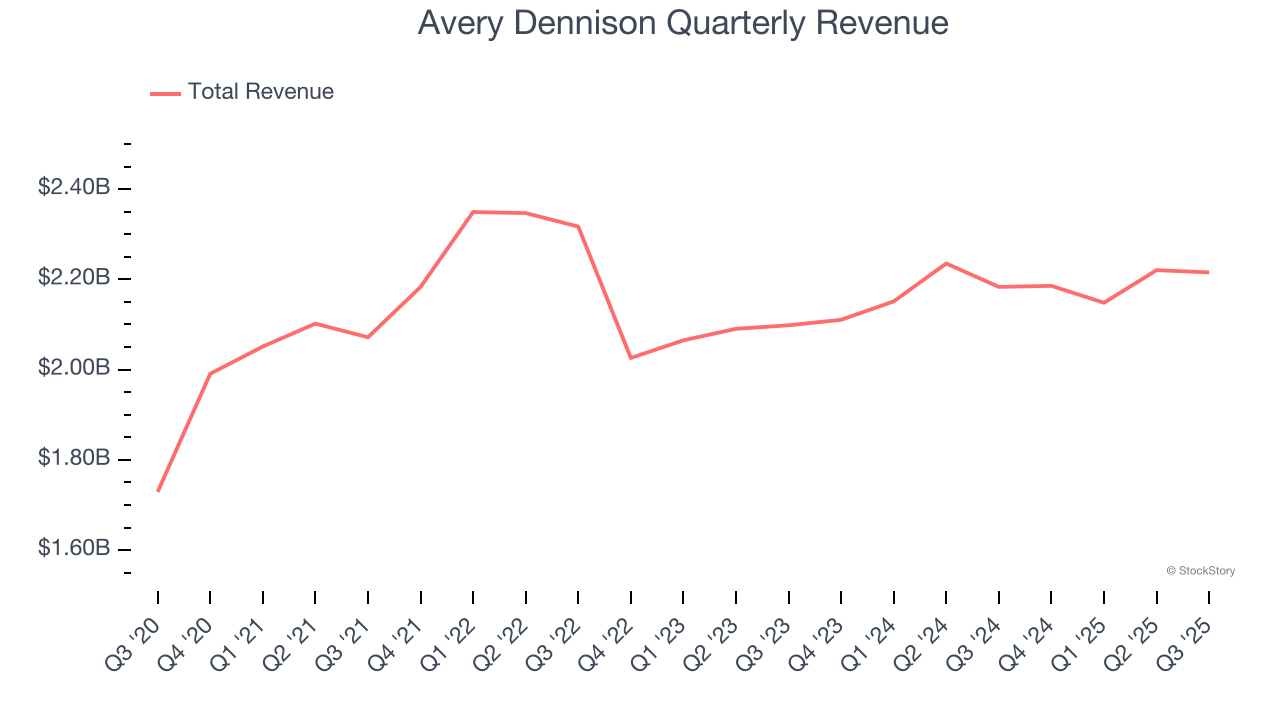
Long-term growth is the most important, but within industrials, a half-decade historical view may miss new industry trends or demand cycles. Avery Dennison’s recent performance shows its demand has slowed as its annualized revenue growth of 2.9% over the last two years was below its five-year trend. 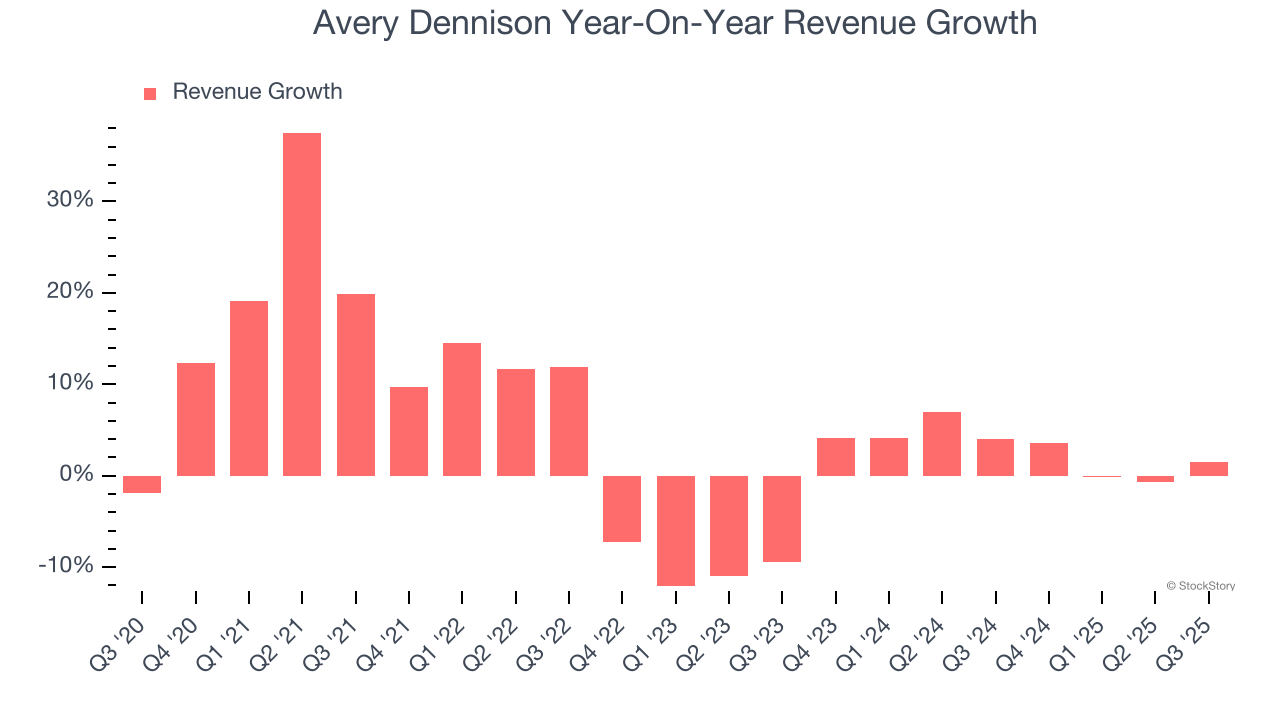
We can dig further into the company’s sales dynamics by analyzing its organic revenue, which strips out one-time events like acquisitions and currency fluctuations that don’t accurately reflect its fundamentals. Over the last two years, Avery Dennison’s organic revenue averaged 2.5% year-on-year growth. Because this number aligns with its two-year revenue growth, we can see the company’s core operations (not acquisitions and divestitures) drove most of its results. 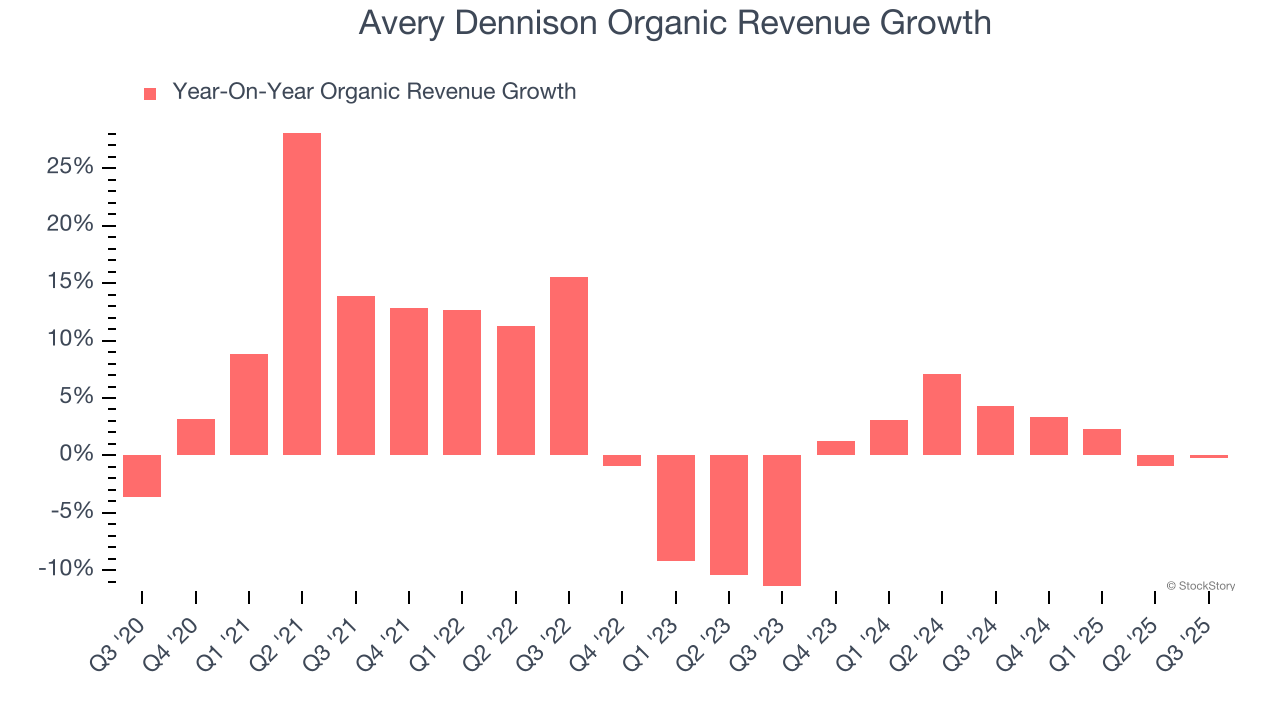
This quarter, Avery Dennison grew its revenue by 1.5% year on year, and its $2.22 billion of revenue was in line with Wall Street’s estimates.
Looking ahead, sell-side analysts expect revenue to grow 4.4% over the next 12 months, similar to its two-year rate. Although this projection implies its newer products and services will fuel better top-line performance, it is still below average for the sector.
Software is eating the world and there is virtually no industry left that has been untouched by it. That drives increasing demand for tools helping software developers do their jobs, whether it be monitoring critical cloud infrastructure, integrating audio and video functionality, or ensuring smooth content streaming. Click here to access a free report on our 3 favorite stocks to play this generational megatrend.
Operating Margin
Operating margin is an important measure of profitability as it shows the portion of revenue left after accounting for all core expenses – everything from the cost of goods sold to advertising and wages. It’s also useful for comparing profitability across companies with different levels of debt and tax rates because it excludes interest and taxes.
Avery Dennison’s operating margin might fluctuated slightly over the last 12 months but has remained more or less the same, averaging 11.7% over the last five years. This profitability was solid for an industrials business and shows it’s an efficient company that manages its expenses well. This result was particularly impressive because of its low gross margin, which is mostly a factor of what it sells and takes huge shifts to move meaningfully. Companies have more control over their operating margins, and it’s a show of well-managed operations if they’re high when gross margins are low.
Looking at the trend in its profitability, Avery Dennison’s operating margin might fluctuated slightly but has generally stayed the same over the last five years. We like to see margin expansion, but we’re still happy with Avery Dennison’s performance considering most Industrial Packaging companies saw their margins plummet.
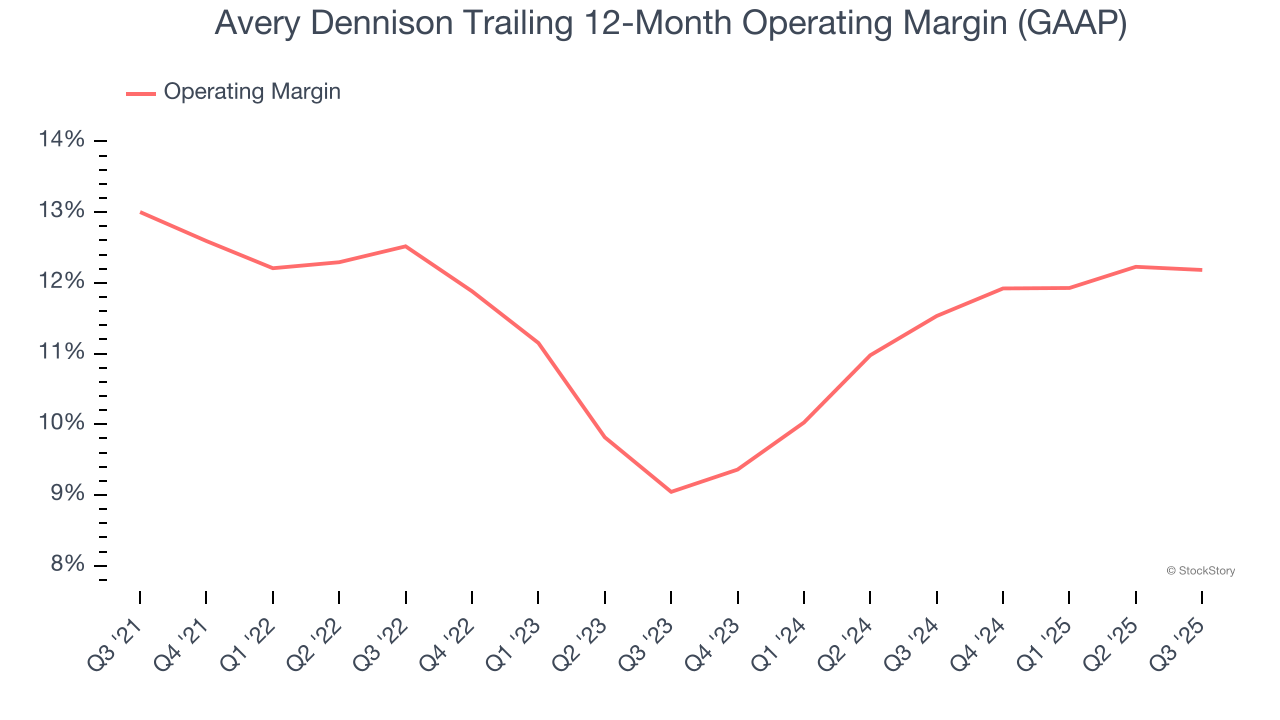
In Q3, Avery Dennison generated an operating margin profit margin of 11.9%, in line with the same quarter last year. This indicates the company’s cost structure has recently been stable.
Earnings Per Share
Revenue trends explain a company’s historical growth, but the long-term change in earnings per share (EPS) points to the profitability of that growth – for example, a company could inflate its sales through excessive spending on advertising and promotions.
Avery Dennison’s EPS grew at an unimpressive 7.6% compounded annual growth rate over the last five years. This performance was better than its flat revenue but doesn’t tell us much about its business quality because its operating margin didn’t improve.
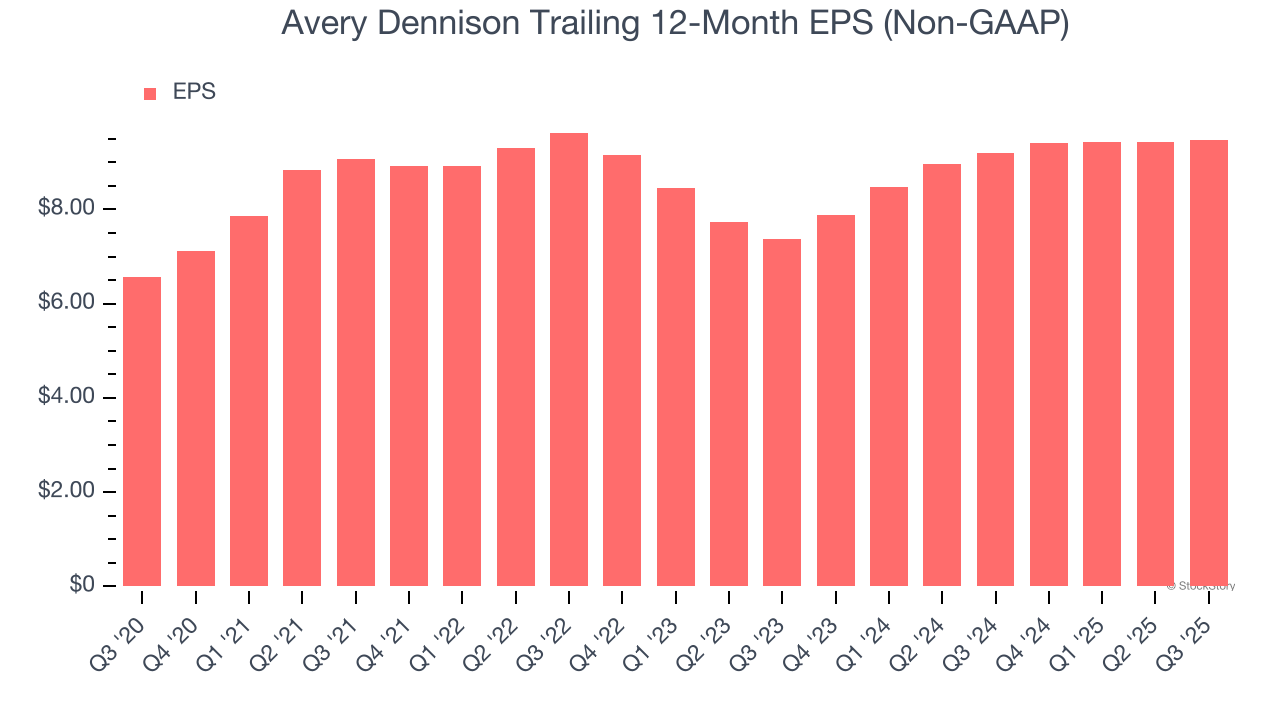
Diving into the nuances of Avery Dennison’s earnings can give us a better understanding of its performance. A five-year view shows that Avery Dennison has repurchased its stock, shrinking its share count by 7.1%. This tells us its EPS outperformed its revenue not because of increased operational efficiency but financial engineering, as buybacks boost per share earnings. 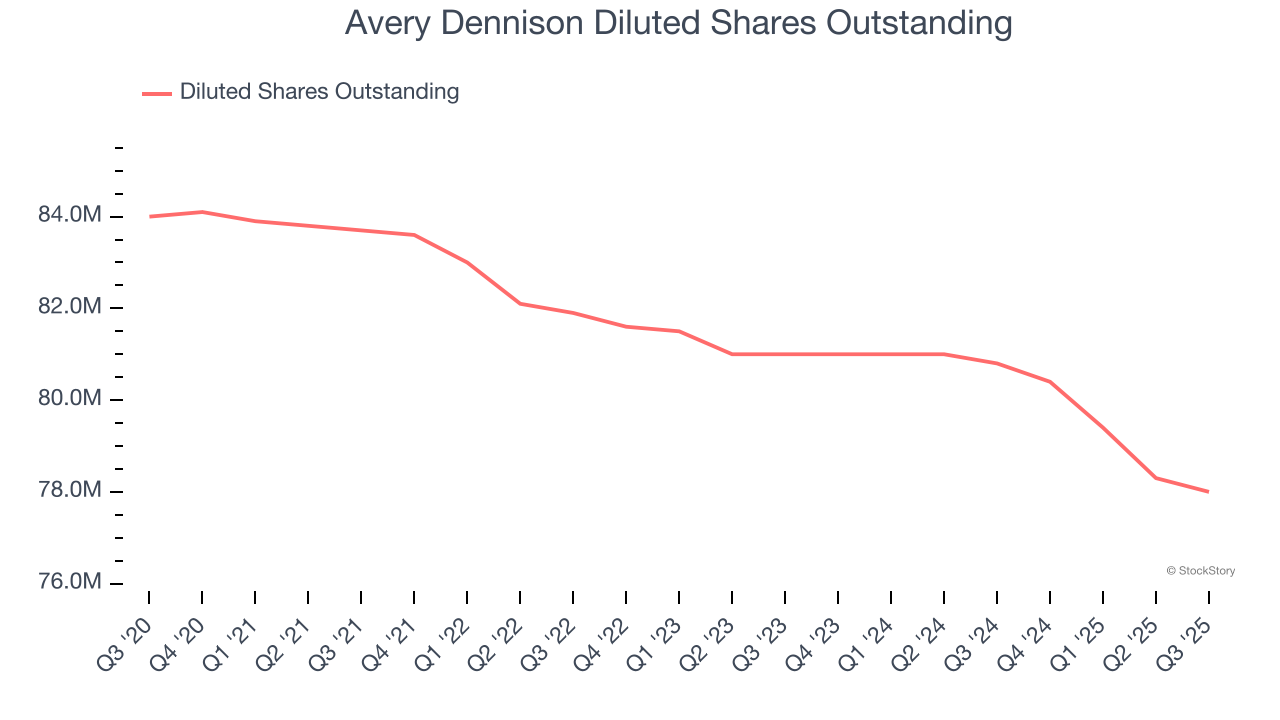
Like with revenue, we analyze EPS over a shorter period to see if we are missing a change in the business.
For Avery Dennison, its two-year annual EPS growth of 13.4% was higher than its five-year trend. This acceleration made it one of the faster-growing industrials companies in recent history.
In Q3, Avery Dennison reported adjusted EPS of $2.37, up from $2.33 in the same quarter last year. This print beat analysts’ estimates by 1.9%. Over the next 12 months, Wall Street expects Avery Dennison’s full-year EPS of $9.47 to grow 7.1%.
Key Takeaways from Avery Dennison’s Q3 Results
It was encouraging to see Avery Dennison beat analysts’ EPS expectations this quarter. On the other hand, its EPS guidance for next quarter missed and its organic revenue fell slightly short of Wall Street’s estimates. Overall, this quarter could have been better. The stock remained flat at $164 immediately following the results.
Big picture, is Avery Dennison a buy here and now? If you’re making that decision, you should consider the bigger picture of valuation, business qualities, as well as the latest earnings. We cover that in our actionable full research report which you can read here, it’s free for active Edge members.