USDA Navigates Complex Landscape: Billions in Farmer Aid Amidst Shifting Trade Winds and Farm Bill Debates
By:
MarketMinute
November 18, 2025 at 15:19 PM EST
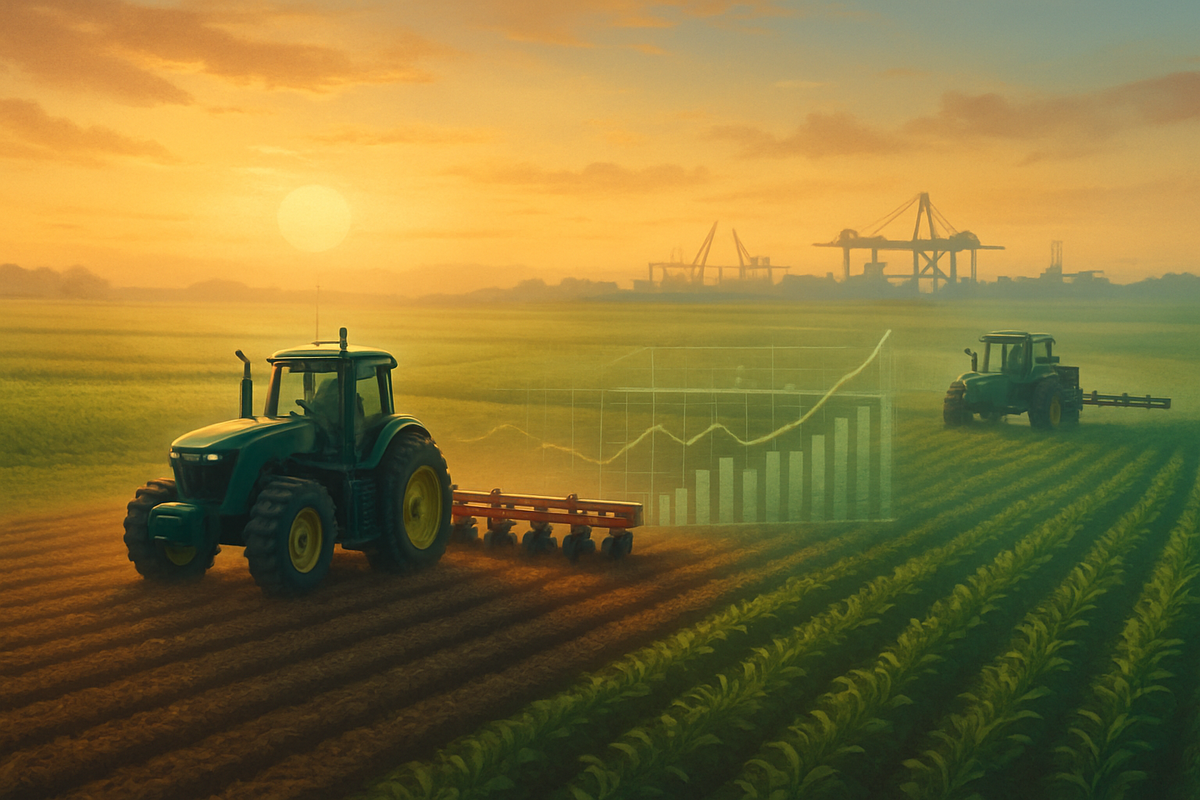
The U.S. Department of Agriculture (USDA) is currently navigating a multifaceted environment, balancing significant farmer assistance initiatives with the intricate dynamics of ongoing trade deal negotiations. As of November 2025, the USDA's outlook is heavily influenced by the need to support American producers facing natural disasters and high input costs, evidenced by billions disbursed through various relief programs. Concurrently, the agency is actively engaged in shaping agricultural trade policy, aiming to expand market access for U.S. commodities while also contending with a widening agricultural trade deficit and the implications of new executive orders affecting food imports. This complex interplay sets the stage for critical discussions within the 2025 Farm Bill debates, which will ultimately define the long-term trajectory of farmer support and the competitiveness of the American agricultural sector. The current financial health of American agriculture is a top priority for the USDA, as evidenced by its robust response to recent challenges. The agency's strategic focus on both domestic relief and international trade underscores a comprehensive approach to bolstering the resilience and profitability of the nation's farmers and ranchers in an increasingly volatile global market. Comprehensive Relief and Strategic Trade Offensives Define USDA's 2025 AgendaThe USDA has rolled out a series of substantial farmer assistance programs and aggressive trade initiatives to stabilize the agricultural sector. These efforts come amidst ongoing debates surrounding the 2025 Farm Bill and a complex global trade environment. Central to the USDA's domestic support strategy is the Supplemental Disaster Relief Program (SDRP) Stage Two, which opened applications on November 24, 2025, and will run until April 30, 2026. This program, part of approximately $16 billion authorized by Congress for disaster relief, specifically targets eligible crop, tree, bush, and vine losses from 2023 and 2024 that were not covered by earlier assistance. It aims to address non-indemnified, shallow, uncovered, and quality losses, providing crucial financial lifelines to producers. Payments are based on a 35% factor and cannot exceed 90% of the loss, with producers required to maintain at least 60% federal crop insurance or Noninsured Crop Disaster Assistance Program (NAP) coverage for the subsequent two crop years. This follows over $9.3 billion disbursed through the Emergency Commodity Assistance Program (ECAP), which concluded its application period on August 15, 2025, providing flat per-acre payments for 22 eligible commodities, and approximately $1 billion allocated for the Emergency Livestock Relief Program (ELRP) for 2023 and 2024 flood and wildfire losses, with an application deadline extended to November 21, 2025. On the trade front, the USDA is actively pursuing an "America First Trade Promotion Program" (AFTPP), launched a year early with $285 million in FY26, as part of a three-point plan unveiled in September 2025 by USDA Secretary Brooke L. Rollins. This program is designed to share marketing and promotion costs with eligible agricultural organizations to expand U.S. agricultural exports. Complementing this are "T.R.U.M.P. Missions" (Trade Reciprocity for U.S. Manufacturers and Producers), which represent a new model for USDA trade missions, focusing on countries with reciprocal trade deals and new market access opportunities. Secretary Rollins recently led the largest USDA agribusiness trade mission to Mexico, emphasizing the importance of expanding market access with the top market for U.S. agricultural exports. Key players driving these initiatives include USDA Secretary Brooke L. Rollins, who was sworn in on February 13, 2025, and is focused on expanding market access and enforcing trade commitments. She is supported by Deputy Secretary Stephen Alexander Vaden, appointed on July 7, 2025, who brings expertise in agricultural policy and law. Recent trade developments include a framework agreement with China in October 2025, expected to lead to substantial purchases of U.S. agricultural products, particularly soybeans, and "Agreements on Reciprocal Trade" with Southeast Asian nations like Malaysia and Cambodia, with Thailand and Vietnam reaching "Frameworks for Agreements." These Southeast Asian deals aim to lower tariffs and remove non-tariff barriers, with Vietnam and Thailand agreeing to purchase a combined $5.5 billion in agricultural goods. A trade deal with Japan in July 2025 primarily focused on tariff reductions for auto imports, with Japan committing to significant U.S.-bound investment. Initial market and industry reactions have been largely positive regarding the disaster relief, which is seen as crucial for stabilizing farm incomes and preventing widespread bankruptcies. Farmer groups have expressed gratitude for the USDA's responsiveness. The trade framework with China brought optimism to commodity markets, anticipating a boost in soybean prices. The new trade deals with Southeast Asia have been lauded by American farmers and industry leaders for expanding market access and diversifying supply chains. However, there's also an acknowledgment that while short-term aid helps, it might mask underlying price pressures and cost challenges in commodity markets. Agricultural Giants Poised for Gains, Others Face Shifting SandsThe USDA's substantial farmer assistance programs and aggressive trade deal negotiations are creating distinct opportunities and challenges for public companies across the agricultural supply chain. From equipment manufacturers to commodity traders and food processors, the impact of these policies will ripple through their revenues, market share, and stock performance. Potential Winners from USDA Farmer Assistance Programs: The direct financial injection into the agricultural sector through programs like SDRP, ECAP, and ELRP significantly improves farmers' purchasing power and financial stability. This directly benefits companies supplying essential agricultural inputs.
Potential Winners from Trade Deal Negotiations: The "America First Trade Promotion Program" and "T.R.U.M.P. Missions" are designed to expand U.S. agricultural exports, directly benefiting companies involved in global commodity trade and food processing.
Potential Losers or Those Facing Challenges: While the overall intent is positive, certain companies or sectors might face headwinds.
In essence, the USDA's current policies are injecting vital capital into the agricultural economy, largely benefiting the input supply chain. Concurrently, its trade strategies are opening new avenues for U.S. agricultural exports, which will primarily reward large-scale commodity traders and globally integrated food processors. However, the dynamics of "reciprocal trade" and tariff adjustments could create winners and losers among specific commodity producers and those operating primarily in domestic markets. A Shifting Agricultural Paradigm: Resilience, Climate, and Global InterdependenceThe USDA's current farmer assistance programs and trade negotiations are not isolated events; rather, they are deeply embedded within broader, transformative trends shaping the agricultural industry. These initiatives reflect a growing recognition of agriculture's role in climate change, the critical need for supply chain resilience, and the persistent challenge of food inflation, all while navigating a complex regulatory and policy landscape. The emphasis on climate-smart agriculture is a defining trend. While conservation has been a component of U.S. farm policy for decades, the explicit focus on "climate-smart practices" and greenhouse gas emissions is a more recent and significant development. Bolstered by the Inflation Reduction Act's substantial funding (an additional $19.5 billion over five years, with $5.7 billion for climate-smart practices in FY 2025), USDA programs now actively promote practices like cover cropping, no-till farming, and precision agriculture. This reflects a policy shift towards integrating climate change mitigation and adaptation directly into agricultural operations, moving beyond mere conservation to active environmental stewardship. This trend has ripple effects, incentivizing agricultural technology firms and research institutions to innovate in areas like drought-tolerant crops, carbon sequestration, and sustainable resource management. Supply chain resilience has also emerged as a paramount concern, amplified by recent global disruptions. USDA policies aim to strengthen these chains by investing in independent meat and poultry processing capacity, promoting fair competition, and fostering local and regional food systems. The drive for trade diversification through "America First Trade Promotion Program" and "T.R.U.M.P. Missions" also contributes to resilience by reducing reliance on single markets and mitigating geopolitical risks. This focus on domestic capacity and diversified trade partners helps insulate the U.S. food system from external shocks, benefiting both producers and consumers. The issue of food inflation remains a persistent challenge that USDA policies directly and indirectly address. Farmer assistance programs aim to stabilize agricultural output, which can contribute to more consistent food supplies and potentially reduce price volatility. The recent executive order removing tariffs on key food imports like beef, tomatoes, and coffee is a direct attempt to ease consumer prices, though it introduces increased competition for domestic producers. This balancing act between supporting producers and ensuring affordable food for consumers is a perennial theme in agricultural policy, echoing historical debates about price supports and commodity surpluses. Looking ahead, the 2025 Farm Bill stands as a critical juncture for these trends. While the 2018 Farm Bill has been extended through September 30, 2025, and interim legislation like the "American Relief Act of 2025" and the "One Big Beautiful Bill Act" have provided significant funding and program extensions through 2031, a comprehensive new Farm Bill is still being debated. Key policy implications include the permanence of IRA conservation funding, potentially shifting towards "tech-heavy" precision agriculture, and significant debates over the nutrition title, particularly the Supplemental Nutrition Assistance Program (SNAP). There's also a push for more permanent disaster assistance frameworks and updates to USDA loan limits. Historically, farm bills have evolved from focusing on price parity in the Great Depression to encompassing conservation, rural development, and nutrition. The current debates reflect a continued evolution, with an unprecedented emphasis on climate change and supply chain robustness, while still grappling with the fundamental goals of farmer support and food security. The ongoing partisan divides suggest that achieving a bipartisan consensus for a comprehensive bill will be a significant challenge, potentially leading to further extensions or piecemeal legislation. The Road Ahead: Adaptation, Diversification, and Navigating UncertaintyThe agricultural sector in the coming months and years faces a dynamic future, marked by both strategic opportunities and significant challenges. The USDA's current actions lay the groundwork, but farmers, businesses, and policymakers must remain adaptable to evolving market conditions, climate impacts, and geopolitical shifts. In the short-term (2025), the immediate outlook for farmer assistance is one of continued support, largely underpinned by the American Relief Act of 2025 and the One Big Beautiful Bill Act. These legislative measures have extended the 2018 Farm Bill through September 2025 and injected billions in ad hoc financial aid for disaster losses and economic hardship, ensuring the continuation of crucial safety-net programs. The recent removal of reciprocal tariffs on key fertilizers and certain agricultural products by President Trump in November 2025 is expected to offer some relief on input costs and open structural opportunities for food and beverage exporters globally. However, the U.S. agricultural trade deficit is projected to persist, driven by robust import demand for horticultural products and flat export values despite increased volume. China's adherence to its soybean purchase commitments will be a critical short-term indicator of trade health. Long-term (beyond 2025), the path forward hinges on the comprehensive 2025 Farm Bill. While interim legislation has provided certainty for some programs through 2031, critical areas like specialty crop policy, regulatory clarity for industrial hemp, and permanent disaster programs remain unaddressed. The successful passage of a comprehensive Farm Bill, requiring bipartisan consensus, will be crucial for establishing stable, long-term frameworks for commodity support, risk management, and conservation. On the trade front, long-term success will demand aggressive market diversification beyond traditional partners, with the USDA's Foreign Agricultural Service actively promoting U.S. exports in emerging markets across Asia, Africa, and Latin America. Strategic pivots and adaptations will be essential for farmers and agricultural businesses. This includes a heightened focus on climate change adaptation, such as adopting drought-tolerant crops, improving soil health, and exploring alternative land uses to mitigate the impact of extreme weather. Technological adoption—precision agriculture, AI, robotics, and data analytics—will be vital for enhancing efficiency and productivity. Farmers must also prioritize market diversification and value-added products to reduce reliance on single markets and capitalize on growing global demand for high-quality, specialized agricultural goods. Strengthening supply chain resilience to withstand disruptions, efficient cost management, and responsiveness to evolving consumer demands (e.g., for sustainable and healthy foods) are also paramount. Emerging market opportunities are significant, particularly in Asia, Africa, and Latin America, where growing populations and rising incomes fuel demand for U.S. agricultural products, especially high-value items, livestock, poultry, and dairy. The recent tariff rollbacks also create new competitive advantages for foreign exporters in specific categories, potentially leading to lower prices and greater variety for U.S. consumers. However, challenges loom large: the widening trade deficit, intense global competition (especially for commodities like soybeans), ongoing trade tensions, economic volatility from fluctuating commodity prices and high input costs, and the persistent threat of climate change impacts. The aging farmer population and generational replacement also pose long-term demographic challenges. Potential scenarios and outcomes for the agricultural sector include:
The future of American agriculture hinges on its ability to strategically adapt to these complex dynamics, leveraging government support and market opportunities while building resilience against inherent volatilities. A Sector at the Crossroads: Stability, Resilience, and the Investor's GazeThe U.S. agricultural sector stands at a pivotal juncture in late 2025, characterized by robust government intervention aimed at stability, an ambitious push for global market expansion, and the looming legislative decisions of the 2025 Farm Bill. The key takeaway is a dual narrative: significant short-term financial relief for farmers is counterbalanced by persistent long-term challenges in trade and the ongoing need for structural adaptation. The market moving forward will likely see net farm income for 2025 bolstered by substantial direct government payments, potentially nearing $180 billion. However, investors should be aware that this aggregate figure may mask lower market revenues from commodity sales for many producers, particularly in the grain sector, due to falling prices and rising operating costs. The USDA anticipates steady growth in U.S. agriculture, driven by consistent global food demand and moderate economic expansion, with technological advancements in precision farming, AI, and biotechnology being critical drivers of efficiency and productivity. Commodity markets will remain dynamic, with corn and soybean production robust but facing price pressures from ample supplies and international competition. Livestock and dairy sectors are expected to see mixed trends, with poultry and pork expanding, beef production forecast lower, and dairy benefiting from consumption but facing price volatility. The lasting impact of these events is profound. The scale of federal disaster relief underscores the escalating economic toll of climate-related events, potentially setting a precedent for future large-scale government assistance and cementing risk management (like crop insurance) as a core agricultural practice. The persistent widening of the trade deficit highlights the urgent need for robust trade policies and diversification of export destinations to safeguard farm profitability. Furthermore, the repeated reliance on Farm Bill extensions rather than a new comprehensive bill suggests a potential shift towards a more piecemeal approach in agricultural policymaking, which could introduce uncertainty and funding gaps. Ultimately, the widespread adoption of advanced technologies will be vital for U.S. agriculture to maintain competitiveness, enhance efficiency, and build resilience against evolving climate, labor, and market challenges. What investors should watch for in coming months (from November 18, 2025):
This content is intended for informational purposes only and is not financial advice More NewsView More
Here's Who Wins If Trump's 50-Year Mortgages Come to Market ↗
Today 13:00 EST

NVIDIA’s $2B Power Play: Securing the Future of Chip Design ↗
Today 12:12 EST

Via MarketBeat

Via MarketBeat
Tickers
SYM

These Are the Hottest Upgrades From the Q3 Reporting Cycle ↗
Today 9:06 EST
Recent QuotesView More
Stock Quote API & Stock News API supplied by www.cloudquote.io
Quotes delayed at least 20 minutes. By accessing this page, you agree to the Privacy Policy and Terms Of Service.
© 2025 FinancialContent. All rights reserved.
|