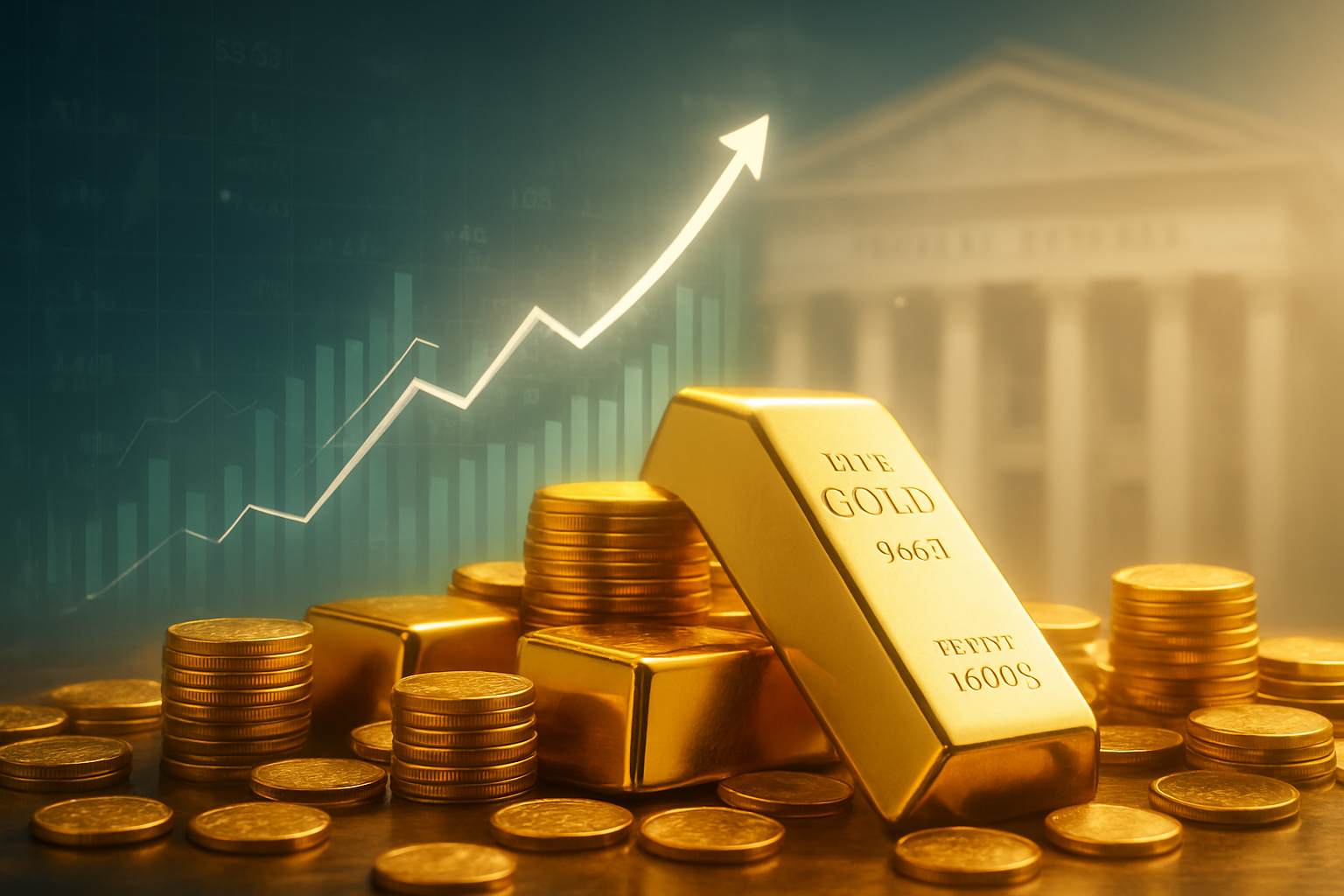
For much of the past year, whispers in financial circles questioned gold's (XAU) ability to attract significant buying interest, even as expectations of a dovish Federal Reserve began to solidify. Analysts pondered why the traditional safe-haven asset seemed to struggle, particularly given the anticipated shift towards lower interest rates. However, as December 2025 unfolds, the narrative has dramatically flipped. Gold prices are not merely attracting buyers; they are experiencing a powerful rally, reaching multi-week highs and cementing one of their strongest annual performances in decades. This surge is directly attributable to, rather than hindered by, the Federal Reserve's increasingly accommodative stance.
The perceived struggle has given way to a clear bullish trend, with market participants now actively positioning for continued monetary easing. The prospect of falling real interest rates, a weakening U.S. dollar, and persistent geopolitical uncertainties have converged to create a potent cocktail for gold, transforming it from a perplexing underperformer into a star asset in investors' portfolios. The market is now keenly focused on upcoming Fed decisions, with a significant probability of further rate cuts, reinforcing gold's appeal as a non-yielding asset in a declining yield environment.
The Golden Resurgence: A Deep Dive into the Rally's Drivers
Gold's impressive ascent in late 2025 marks a significant turnaround, with some reports indicating nearly a 60% year-to-date increase, its best annual performance since 1979. This robust rally is a direct consequence of a confluence of factors, primarily centered around the Federal Reserve's pivot towards a more dovish monetary policy. The timeline of events leading to this moment paints a clear picture of shifting market dynamics.
The Federal Reserve initiated its first rate cut in September 2024, signaling a departure from its aggressive tightening cycle. This was followed by further reductions at the November 7, 2024, and December 18, 2024, FOMC meetings, bringing the federal funds rate target down significantly. These initial cuts laid the groundwork for a supportive environment for gold. By March 2025, gold hit $3,051.99 per ounce after the Fed held rates steady but revised growth projections downward and inflation projections upward, hinting at a stagflationary scenario that traditionally benefits gold. The momentum continued, with gold reaching an all-time high of $3,499.88 per ounce in April 2025, later touching $3,500/oz.
More recently, late November 2025 saw dovish commentary from influential Federal Reserve officials, including Governor Christopher Waller and New York Fed President John Williams. Their remarks significantly heightened market expectations for a December 2025 rate cut, with probabilities now hovering around 87-89% for a 25 basis point reduction at the upcoming December 9-10 FOMC meeting. Concurrently, softer U.S. economic data, such as the November 2025 ISM Manufacturing PMI falling to 48.2, further reinforced the necessity for monetary easing.
Key players driving this rally include not just speculative investors but also central banks globally. Central banks, particularly from emerging economies like China, Turkey, and Poland, have been aggressively accumulating gold reserves, purchasing over 1,000 tonnes annually for three consecutive years through 2024. This consistent institutional demand provides a strong structural underpinning for gold prices. Furthermore, gold-backed Exchange Traded Funds (ETFs), such as SPDR Gold Shares (NYSEArca: GLD), have witnessed multi-year high inflows, reflecting a renewed institutional appetite for the precious metal. The initial market reaction to these developments has been overwhelmingly bullish, with strong price appreciation and a clear shift in sentiment towards gold as a preferred safe-haven asset.
Corporate Fortunes: Winners and Losers in a Golden Era
The surging gold prices are creating a distinct landscape of winners and losers within the financial markets, particularly impacting companies directly involved in gold mining and investment vehicles. For gold mining companies, the current environment is unequivocally positive. Higher gold prices directly translate into increased revenues and improved profit margins, assuming production costs remain stable.
Leading gold producers like Barrick Gold (NYSE: GOLD) and Newmont (NYSE: NEM) are poised to be significant beneficiaries. These companies operate large-scale mines globally, and a sustained increase in gold prices can dramatically boost their financial performance. Investors in these companies could see enhanced shareholder returns through increased dividends, share buybacks, or reinvestment into exploration and expansion projects. Smaller, junior mining companies with promising deposits might also find it easier to secure financing for development, as the economic viability of their projects improves with higher gold prices. The SPDR Gold Shares (NYSEArca: GLD) ETF, a popular vehicle for investors to gain exposure to gold without directly owning the physical metal, is experiencing substantial inflows, signaling strong investor confidence and benefiting the fund providers.
Conversely, companies heavily reliant on a strong U.S. dollar or those that benefit from higher interest rates might face headwinds. While the direct impact on non-gold-related sectors is less immediate, a weaker dollar—a consequence of dovish Fed policy that benefits gold—can make imported goods more expensive for U.S. companies and consumers. Financial institutions heavily invested in fixed-income assets or those whose business models thrive on higher lending rates might see some pressure, though the broader market sentiment of easing monetary policy is generally supportive of equity markets. However, in the context of gold, the primary winners are those directly exposed to the metal's price movements.
Broader Implications: Gold's Role in a Shifting Global Economy
The current gold rally is not an isolated event but rather a significant indicator of broader trends reshaping the global financial landscape. It underscores a growing preference for tangible assets amidst economic uncertainties and a gradual de-dollarization trend among central banks. The consistent demand from central banks, particularly from emerging markets, suggests a strategic diversification away from the U.S. dollar, fitting into a wider geopolitical narrative of reducing reliance on a single reserve currency. This trend has been building for several years, and the current Fed policy provides further impetus.
The ripple effects of this gold surge extend beyond the precious metals market. A weaker U.S. dollar, driven by anticipated rate cuts, can influence other commodity prices, making dollar-denominated raw materials cheaper for international buyers and potentially stimulating demand. It also impacts currency markets, with other major currencies potentially strengthening against the dollar. The regulatory and policy implications are primarily tied to the Federal Reserve's monetary policy path. Should the Fed continue its dovish trajectory, it will reinforce the conditions favorable for gold. Any unexpected hawkish pivot, however, could quickly reverse sentiment.
Historically, gold has performed exceptionally well during periods of declining real interest rates and heightened economic or geopolitical uncertainty. The current environment, characterized by easing monetary policy and persistent global tensions, mirrors these historical precedents. Comparisons can be drawn to periods like 2008-2012 and 2019-2021, when gold experienced strong bull markets amid negative real yields and significant economic upheaval. This historical context lends credibility to the current rally, suggesting it is not merely speculative but driven by fundamental economic forces.
The Path Ahead: Navigating Gold's Future Trajectory
Looking ahead, the trajectory of gold prices will largely hinge on the Federal Reserve's continued monetary policy decisions and the evolving global economic and geopolitical landscape. In the short term, the market is almost certain of a 25 basis point rate cut at the December 9-10, 2025, FOMC meeting. This immediate catalyst is expected to provide further upward momentum for gold. Beyond that, upcoming U.S. macro data, including the ADP report on private-sector employment, ISM Services PMI, and the Personal Consumption Expenditures (PCE) Price Index, will be crucial in shaping expectations for future rate cuts in early 2026. Any data indicating a further slowdown in economic activity or persistent disinflationary pressures could reinforce the dovish outlook, benefiting gold.
In the long term, sustained central bank demand is likely to remain a significant underpinning for gold prices. Geopolitical tensions, whether from ongoing conflicts or trade disputes, will continue to drive safe-haven demand. Potential strategic pivots or adaptations required from investors include closely monitoring the Fed's "dot plot" projections for future interest rates and adjusting portfolio allocations accordingly. Market opportunities may emerge from potential dips, which could be seen as buying opportunities, while challenges could include increased volatility around major economic data releases or any unexpected hawkish shift from central banks globally.
Potential scenarios include a continued, albeit perhaps slower, ascent for gold if the Fed implements several more rate cuts through 2026, coupled with persistent global uncertainties. Alternatively, a scenario where inflation proves stickier than expected, forcing the Fed to pause or even reverse its dovish stance, could lead to a correction in gold prices. However, given the current momentum and fundamental drivers, the bias appears to be towards continued strength, with investors seeking to capitalize on the ongoing shift in monetary policy.
A Golden Horizon: Key Takeaways and Future Watchpoints
The journey of gold from perceived struggle to a robust rally in late 2025 underscores its enduring role as a critical asset in a dynamic financial world. The primary takeaway is the profound impact of monetary policy, specifically the Federal Reserve's dovish pivot, on gold's valuation. Expectations of lower real interest rates and a weaker U.S. dollar have been the twin engines propelling this significant price appreciation. Furthermore, the strong and consistent demand from central banks globally highlights a broader, structural shift in asset allocation, reinforcing gold's foundational support.
Moving forward, the market assessment for gold remains largely bullish, contingent on the Fed's actions. While periods of profit-taking or consolidation are natural in any strong rally, the underlying fundamentals appear supportive. The lasting impact of this period could be a re-evaluation of gold's role in diversified portfolios, cementing its status not just as an inflation hedge but also as a hedge against currency debasement and geopolitical instability.
Investors should closely watch several key indicators in the coming months. Foremost among these are the Federal Reserve's FOMC meetings and any accompanying statements or projections, particularly regarding the pace and extent of future rate cuts. U.S. economic data, especially inflation metrics and employment figures, will also be critical in shaping the Fed's policy path. Geopolitical developments, including any escalation or de-escalation of global tensions, will continue to influence safe-haven demand for gold. Finally, monitoring central bank gold purchases and institutional inflows into gold-backed ETFs will provide further insights into sustained market sentiment.
This content is intended for informational purposes only and is not financial advice