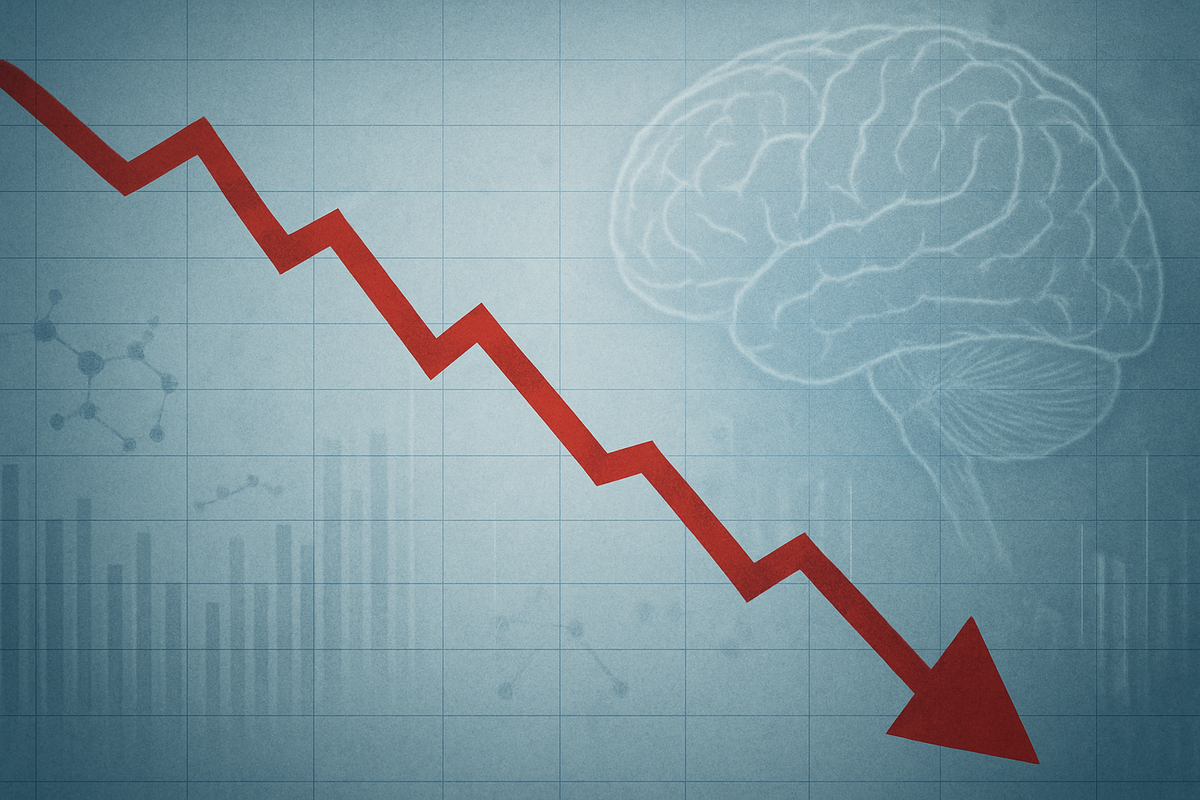
Copenhagen, Denmark – November 24, 2025 – Novo Nordisk's (CPH: NOVO B) stock experienced a significant and immediate downturn today, plummeting by over 10% in early trading, following the announcement of disappointing results from its highly anticipated late-stage clinical trials for an Alzheimer's disease drug. The trials, which tested an oral formulation of the company's blockbuster semaglutide, failed to demonstrate a statistically significant slowing of cognitive decline in patients, effectively dashing hopes for a major new application of the widely successful GLP-1 agonist.
The setback represents a considerable blow to Novo Nordisk's ambitions of expanding its market dominance beyond diabetes and obesity into the vast and challenging neurodegenerative disease space. While analysts had largely viewed the Alzheimer's endeavor as a high-risk "lottery ticket," the definitive failure removes a potential future growth catalyst, leading to a sharp reassessment of the company's immediate prospects and fueling broader market anxieties regarding its pipeline diversification strategies.
Trial Setback Rocks Market Confidence
Today's announcement confirmed that the two large-scale Phase III trials, known as EVOKE and EVOKE+, did not meet their primary objective. These trials involved a combined 3,808 patients suffering from mild cognitive impairment or mild dementia due to Alzheimer's disease, with the aim of assessing whether oral semaglutide could slow the progression of cognitive decline. Despite reporting an "improvement of Alzheimer's disease-related biomarkers," this positive biological signal unfortunately did not translate into a delay in the clinical progression of the disease, as measured by cognitive assessments. Consequently, Novo Nordisk has decided to discontinue a planned one-year extension of these studies.
The timeline leading up to this moment has seen considerable anticipation surrounding Novo Nordisk's foray into Alzheimer's, driven by the immense success of its GLP-1 drugs like Ozempic and Wegovy in other therapeutic areas. The company had strategically invested in exploring new indications, with Alzheimer's representing a particularly lucrative, albeit notoriously difficult, frontier. Key players involved included Novo Nordisk's research and development teams, the thousands of patients and their families participating in the trials, and the broader scientific and medical communities closely watching for breakthroughs in Alzheimer's treatment. The initial market reaction was swift and decisive: shares in Copenhagen plummeted by more than 12% at the open, settling to be down around 10.3% by midday. This ripple effect was felt across the pharmaceutical sector, with competitor Eli Lilly (NYSE: LLY) seeing a modest decline, while Biogen (NASDAQ: BIIB), another player in the Alzheimer's drug development landscape, experienced a rally of over 4%, suggesting a reallocation of investor confidence.
Shifting Fortunes: Winners and Losers in the Wake of the News
The immediate aftermath of Novo Nordisk's trial failure has created a distinct cleavage between potential winners and losers in the pharmaceutical market. Clearly, Novo Nordisk (CPH: NOVO B) itself is the primary loser in the short term, as evidenced by its significant stock depreciation. The failure removes a potential multi-billion dollar revenue stream and adds to a series of challenging news for the Danish drugmaker in 2025, including a missed acquisition and recent guidance cuts. While the company's core diabetes and obesity franchises remain robust, the inability to diversify into a new major therapeutic area like Alzheimer's raises questions about its long-term growth trajectory amidst increasing competition.
Conversely, companies with existing or promising Alzheimer's pipelines, or those not heavily invested in GLP-1-based Alzheimer's treatments, stand to gain. Biogen (NASDAQ: BIIB), which has faced its own challenges with Alzheimer's drugs like Aduhelm but has Leqembi (developed with Eisai) on the market, saw its shares rally. This suggests investors might be re-evaluating the competitive landscape, potentially seeing Biogen's existing approved treatments as more valuable in the absence of a new, major GLP-1 contender. Eli Lilly (NYSE: LLY), a direct competitor to Novo Nordisk in the GLP-1 space with its drug Mounjaro (and future Zepbound), experienced a slight dip, possibly due to general market apprehension about the difficulty of Alzheimer's research, but its diverse pipeline and strong position in other markets likely cushioned the blow. The trial results may also indirectly benefit smaller biotech firms focused on alternative Alzheimer's mechanisms, as the perceived viability of their approaches might increase in the wake of a prominent GLP-1 failure.
Broader Industry Implications and Future Trends
Novo Nordisk's Alzheimer's trial failure resonates far beyond its immediate financial impact, fitting into broader industry trends and highlighting the immense challenges of neurodegenerative disease research. The event underscores the persistent difficulty in translating promising biomarker changes into tangible clinical benefits for Alzheimer's patients. While GLP-1 agonists have revolutionized metabolic disease treatment, their application in neurological disorders remains a complex and largely unproven frontier. This outcome might lead to a more cautious approach from other pharmaceutical companies considering similar GLP-1-based strategies for neurological conditions, potentially diverting research funds towards other therapeutic mechanisms or more established areas.
The ripple effects could also be felt in the competitive landscape for GLP-1 drugs. With Novo Nordisk's semaglutide unable to open up a new, massive market in Alzheimer's, the competitive intensity in the core obesity and diabetes markets, where Eli Lilly (NYSE: LLY) is a formidable challenger, is likely to increase further. Regulatory bodies will continue to scrutinize all new Alzheimer's drug applications with extreme rigor, reinforcing the high bar for approval in this sensitive area. Historically, the pharmaceutical industry is replete with examples of high-profile failures in Alzheimer's drug development, from Pfizer's (NYSE: PFE) bapineuzumab to Roche's (OTCMKTS: RHHBY) gantenerumab. Novo Nordisk's experience serves as another stark reminder that even companies with robust pipelines and significant resources are not immune to the scientific complexities of this devastating disease, reinforcing the need for diverse research approaches and patience from investors.
What Comes Next: Navigating a Post-Trial Landscape
In the short term, Novo Nordisk (CPH: NOVO B) will likely face continued investor scrutiny and pressure to articulate a clear strategy for future growth beyond its highly successful but increasingly competitive GLP-1 core. The company may need to redouble its efforts in existing therapeutic areas, explore new acquisition targets that align with its strengths, or further invest in novel research outside of the GLP-1 mechanism for neurological conditions. Market opportunities may still emerge from its other pipeline assets, but the immediate focus will be on damage control and rebuilding investor confidence.
Long-term possibilities include a strategic pivot away from high-risk neurological indications for its GLP-1 drugs, or a more targeted approach within neurodegeneration, perhaps focusing on earlier stages of disease or different patient populations if future research uncovers specific biomarkers that respond to GLP-1. Potential strategic adaptations could involve increased collaboration with biotech firms specializing in different Alzheimer's pathways or a greater emphasis on digital health solutions for chronic disease management. Investors should watch for any revised financial guidance, updates on other pipeline developments, and any significant M&A activity that could signal a new strategic direction for the company. The market will be keen to see how Novo Nordisk plans to sustain its impressive growth trajectory without the "lottery ticket" of Alzheimer's.
A Sobering Reality Check for Pharmaceutical Innovation
Today's news from Novo Nordisk (CPH: NOVO B) serves as a sobering reality check for the pharmaceutical industry and investors alike, underscoring the formidable challenges inherent in developing treatments for complex diseases like Alzheimer's. The failure of oral semaglutide to slow cognitive decline, despite showing some biomarker improvements, highlights the critical gap between biological understanding and clinical efficacy. Key takeaways include the high-risk nature of neurodegenerative drug development, the limitations of even highly successful drug classes when applied to new, challenging indications, and the immediate and significant impact such failures can have on a company's market valuation.
Moving forward, the market will assess Novo Nordisk's resilience and its ability to pivot strategically. While the company's robust foundation in diabetes and obesity treatment remains intact, the removal of a significant potential growth driver necessitates a re-evaluation of its long-term outlook. Investors should closely monitor Novo Nordisk's next moves, particularly regarding its R&D investments, potential acquisitions, and any further updates on its existing pipeline. The lasting impact of this event will likely be a reinforced caution in the investment community regarding speculative high-risk ventures in drug development, especially in areas as historically challenging as Alzheimer's disease, and a renewed focus on the core strengths and established market positions of pharmaceutical giants.
This content is intended for informational purposes only and is not financial advice