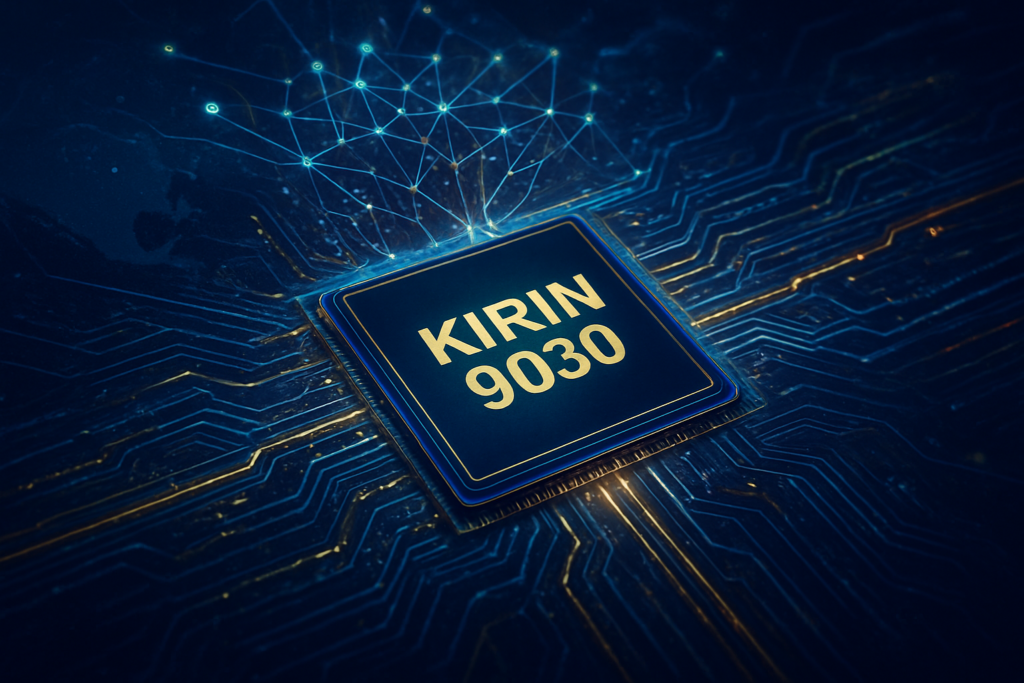
The global technology landscape is witnessing a seismic shift as China intensifies its pursuit of semiconductor self-reliance, a strategic imperative underscored by the recent unveiling of Huawei's (SHE: 002502) Kirin 9030 chip. This advanced system-on-a-chip (SoC), powering Huawei's Mate 80 series smartphones, represents a significant stride in China's efforts to overcome stringent US export restrictions and establish an independent, robust domestic semiconductor ecosystem. Launched in late November 2025, the Kirin 9030 not only reasserts Huawei's presence in the premium smartphone segment but also sends a clear message about China's technological resilience and its unwavering commitment to leading the future of artificial intelligence.
The immediate significance of the Kirin 9030 is multifaceted. It has already boosted Huawei's market share in China's premium smartphone segment, leveraging strong patriotic sentiment to reclaim ground from international competitors. More importantly, it demonstrates China's continued ability to advance its chipmaking capabilities despite being denied access to cutting-edge Extreme Ultraviolet (EUV) lithography machines. While a performance gap with global leaders like Taiwan Semiconductor Manufacturing Co (TSMC: TPE) and Samsung Electronics (KRX: 005930) persists, the chip's existence and adoption are a testament to China's growing prowess in advanced semiconductor manufacturing and its dedication to building an independent technological future.
Unpacking the Kirin 9030: A Technical Deep Dive into China's Chipmaking Prowess
The Huawei Kirin 9030, available in standard and Pro variants for the Mate 80 series, marks a pivotal achievement in China's domestic semiconductor journey. The chip is manufactured by Semiconductor Manufacturing International Corp (SMIC: SHA: 688981) using its N+3 fabrication process. TechInsights, a respected microelectronics research firm, confirms that SMIC's N+3 is a scaled evolution of its previous 7nm-class (N+2) node, placing it between 7nm and 5nm in terms of scaling and transistor density (approximately 125 Mtr/mm²). This innovative approach relies on Deep Ultraviolet (DUV) lithography combined with advanced multi-patterning and Design Technology Co-Optimization (DTCO), a workaround necessitated by US restrictions on EUV technology. However, this reliance on DUV multi-patterning for aggressively scaled metal pitches is expected to present significant yield challenges, potentially leading to higher manufacturing costs and constrained production volumes.
The Kirin 9030 features a 9-core CPU configuration. The standard version boasts 12 threads, while the Pro variant offers 14 threads, indicating enhanced multi-tasking capabilities, likely through Simultaneous Multithreading (SMT). Both versions integrate a prime CPU core clocked at 2.75 GHz (likely a Taishan core), four performance cores at 2.27 GHz, and four efficiency cores at 1.72 GHz. The chip also incorporates the Maleoon 935 GPU, an upgrade from the Maleoon 920 in previous Kirin generations. Huawei claims a 35-42% performance improvement over its predecessor, the Kirin 9020, enabling advanced features like generative AI photography.
Initial Geekbench 6 benchmark scores for the Kirin 9030 show a single-core score of 1,131 and a multi-core score of 4,277. These figures, while representing a significant leap for domestic manufacturing, indicate a performance gap compared to current flagship chipsets from global competitors. For instance, Apple's (NASDAQ: AAPL) A19 Pro achieves significantly higher scores, demonstrating a substantial advantage in single-threaded operations. Similarly, chips from Qualcomm (NASDAQ: QCOM) and MediaTek (TPE: 2454) show considerably faster results. Industry experts acknowledge Huawei's engineering ingenuity in advancing chip capabilities with DUV-based methods but also highlight that SMIC's N+3 process remains "substantially less scaled" than industry-leading 5nm processes. Huawei is strategically addressing hardware limitations through software optimization, such as its new AI infrastructure technology aiming for 70% GPU utilization, to bridge this performance gap.
Compared to previous Kirin chips, the 9030's most significant difference is the leap to SMIC's N+3 process. It also introduces a 9-core CPU design, an advancement from the 8-core layout of the Kirin 9020, and an upgraded Maleoon 935 GPU. This translates to an anticipated 20% performance boost over the Kirin 9020 and promises improvements in battery efficiency, AI features, 5G connectivity stability, and heat management. The initial reaction from the AI research community and industry experts is a mix of admiration for Huawei's resilience and a realistic acknowledgment of the persistent technology gap. Within China, the Kirin 9030 is celebrated as a national achievement, a symbol of technological independence, while international analysts underscore the ingenuity required to achieve this progress under sanctions.
Reshaping the AI Landscape: Implications for Tech Giants and Startups
The advent of Huawei's Kirin 9030 and China's broader semiconductor advancements are profoundly reshaping the global AI industry, creating distinct advantages for Chinese companies while presenting complex competitive implications for international tech giants and startups.
Chinese Companies: A Protected and Growing Ecosystem
Chinese companies stand to be the primary beneficiaries. Huawei (SHE: 002502) itself gains a critical component for its advanced smartphones, reducing dependence on foreign supply chains and bolstering its competitive position. Beyond smartphones, Huawei's Ascend series chips are central to its data center AI strategy, complemented by its MindSpore deep learning framework. SMIC (SHA: 688981), as China's largest chipmaker, directly benefits from the national drive for self-sufficiency and increased domestic demand, exemplified by its role in manufacturing the Kirin 9030. Major tech giants like Baidu (NASDAQ: BIDU), Alibaba (NYSE: BABA), and Tencent (HKG: 0700) are heavily investing in AI R&D, developing their own AI models (e.g., Baidu's ERNIE 5.0) and chips (e.g., Baidu's Kunlun M100/M300, Alibaba's rival to Nvidia's H20). These companies benefit from a protected domestic market, vast internal data, strong state support, and a large talent pool, allowing for rapid innovation and scaling. AI chip startups such as Cambricon (SHA: 688256) and Moore Threads are also thriving under Beijing's push for domestic manufacturing, aiming to challenge global competitors.
International Companies: Navigating a Fragmented Market
For international players, the implications are more challenging. Nvidia (NASDAQ: NVDA), the global leader in AI hardware, faces significant challenges to its dominance in the Chinese market. While the US conditionally allows exports of Nvidia's H200 AI chips to China, Chinese tech giants and the government are reportedly rejecting these in favor of domestic alternatives, viewing them as a "sugar-coated bullet" designed to impede local growth. This highlights Beijing's strong resolve for semiconductor independence, even at the cost of immediate access to more advanced foreign technology. TSMC (TPE: 2330) and Samsung (KRX: 005930) remain leaders in cutting-edge manufacturing, but China's progress, particularly in mature nodes, could impact their long-term market share in certain segments. The strengthening of Huawei's Kirin line could also impact the market share of international mobile SoC providers like Qualcomm (NASDAQ: QCOM) and MediaTek (TPE: 2454) within China. The emergence of Chinese cloud providers expanding their AI services, such as Alibaba Cloud and Tencent Cloud, increases competition for global giants like Amazon Web Services and Microsoft (NASDAQ: MSFT) Azure.
The broader impact includes a diversification of supply chains, with reduced reliance on foreign semiconductors affecting sales for international chipmakers. The rise of Huawei's MindSpore and other Chinese AI frameworks as alternatives to established platforms like PyTorch and Nvidia's CUDA could lead to a fragmented global AI software landscape. This competition is fueling a "tech cold war," where countries may align with different technological ecosystems, affecting global supply chains and potentially standardizing different technologies. China's focus on optimizing AI models for less powerful hardware also challenges the traditional "brute-force computing" approach, which could influence global AI development trends.
A New Chapter in the AI Cold War: Wider Significance and Global Ramifications
The successful development and deployment of Huawei's Kirin 9030 chip, alongside China's broader advancements in semiconductor manufacturing, marks a pivotal moment in the global technological landscape. This progress transcends mere economic competition, positioning itself squarely at the heart of an escalating "tech cold war" between the U.S. and China, with profound implications for artificial intelligence, geopolitics, and international supply chains.
The Kirin 9030 is a potent symbol of China's resilience under pressure. Produced by SMIC using DUV multi-patterning techniques without access to restricted EUV lithography, it demonstrates an impressive capacity for innovation and workaround solutions. This achievement validates China's strategic investment in domestic capabilities, aiming for 70% semiconductor import substitution by 2025 and 100% by 2030, backed by substantial government funding packages. In the broader AI landscape, this means China is actively building an independent AI hardware ecosystem, exemplified by Huawei's Ascend series chips and the company's focus on software innovations like new AI infrastructure technology to boost GPU utilization. This adaptive strategy, leveraging open-source AI models and specialized applications, helps optimize performance despite hardware constraints, driving innovation in AI applications.
However, a considerable gap persists in cutting-edge AI chips compared to global leaders. While China's N+3 process is a testament to its resilience, it still lags behind the raw computing power of Nvidia's (NASDAQ: NVDA) H100 and upcoming B100/B200 chips, which are manufactured on more advanced 4nm and 3nm nodes by TSMC (TPE: 2330). This raw power is crucial for training the largest and most sophisticated AI models. The geopolitical impacts are stark: the Kirin 9030 reinforces the narrative of technological decoupling, leading to a fragmentation of global supply chains. US export controls and initiatives like the CHIPS and Science Act aim to reduce reliance on vulnerable chokepoints, while China's retaliatory measures, such as export controls on gallium and germanium, further disrupt these chains. This creates increased costs, potential inefficiencies, and a risk of missed market opportunities as companies are forced to navigate competing technological blocs.
The emergence of parallel technology ecosystems, with both nations investing trillions in domestic production, affects national security, as advanced precision weapons and autonomous systems rely heavily on cutting-edge chips. China's potential to establish alternative norms and standards in AI and quantum computing could further fragment the global technology landscape. Compared to previous AI milestones, where breakthroughs were often driven by software algorithms and data availability, the current phase is heavily reliant on raw computing power from advanced semiconductors. While China's N+3 technology is a significant step, it underscores that achieving true leadership in AI requires both hardware and software prowess. China's focus on software optimization and practical AI applications, sometimes surpassing the U.S. in deployment scale, represents an alternative pathway that could redefine how AI progress is measured, shifting focus from raw chip power to optimized system efficiency and application-specific innovation.
The Horizon of Innovation: Future Developments in China's AI and Semiconductor Journey
As of December 15, 2025, China's semiconductor and AI sectors are poised for dynamic near-term and long-term developments, propelled by national strategic imperatives and a relentless pursuit of technological independence. The Kirin 9030 is but one chapter in this unfolding narrative, with ambitious goals on the horizon.
In the near term (2025-2027), incremental yet meaningful progress in semiconductor manufacturing is expected. While SMIC's N+3 process, used for the Kirin 9030, is a DUV-based achievement, the company faces "significant yield challenges." However, domestic AI chip production is seeing rapid growth, with Chinese homegrown AI chips capturing over 50% market share in Chinese data centers by late 2024. Huawei (SHE: 002502) is projected to secure 50% of the Chinese AI chip market by 2026, aiming to address production bottlenecks through its own fab buildout. Notably, Shanghai Micro Electronics Equipment (SMEE) plans to commence manufacturing 28nm chip-making machines in early 2025, crucial for various applications. China also anticipates trial production of its domestic EUV system, utilizing Laser-induced Discharge Plasma (LDP) technology, by Q3 2025, with mass production slated for 2026. On the AI front, China's "AI Plus" initiative aims for deep AI integration across six key domains by 2027, targeting adoption rates for intelligent terminals and agents exceeding 70%, with the core AI industry projected to surpass $140 billion in 2025.
Looking further ahead (2028-2035), China's long-term semiconductor strategy focuses on achieving self-reliance and global competitiveness. Experts predict that successful commercialization of domestic EUV technology could enable China to advance to 3nm or 2nm chip production by 2030, potentially challenging ASML (AMS: ASML), TSMC (TPE: 2330), and Samsung (KRX: 005930). This is supported by substantial government investment, including a $47 billion fund established in May 2024. Huawei is also establishing a major R&D center for exposure and wafer fabrication equipment, underscoring long-term commitment to domestic toolmaking. By 2030, China envisions adoption rates of intelligent agents and terminals exceeding 90%, with the "intelligent economy" becoming a primary driver of growth. By 2035, AI is expected to form the backbone of intelligent economic and social development, transforming China into a leading global AI innovation hub.
Potential applications and use cases on the horizon are vast, spanning intelligent manufacturing, enhanced consumer electronics (e.g., generative AI photography, AI glasses), the continued surge in AI-optimized data centers, and advanced autonomous systems. AI integration into public services, healthcare, and scientific research is also a key focus. However, significant challenges remain. The most critical bottleneck is EUV access, forcing reliance on less efficient DUV multi-patterning, leading to "significant yield challenges." While China is developing its own LDP-based EUV technology, achieving sufficient power output and integrating it into mass production are hurdles. Access to advanced Electronic Design Automation (EDA) tools also remains a challenge. Expert predictions suggest China is catching up "faster than expected," with some attributing this acceleration to US sanctions "backfiring." China's AI chip supply is predicted to surpass domestic demand by 2028, hinting at potential exports and the formation of an "AI 'Belt & Road' Initiative." The "chip war" is expected to persist for decades, shaping an ongoing geopolitical and technological struggle.
A Defining Moment: Assessing China's AI and Semiconductor Trajectory
The unveiling of Huawei's (SHE: 002502) Kirin 9030 chip and China's broader progress in semiconductor manufacturing mark a defining moment in the history of artificial intelligence and global technology. This development is not merely about a new smartphone chip; it symbolizes China's remarkable resilience, strategic foresight, and unwavering commitment to technological self-reliance in the face of unprecedented international pressure. As of December 15, 2025, the narrative is clear: China is actively forging an independent AI ecosystem, reducing its vulnerability to external geopolitical forces, and establishing alternative pathways for innovation.
The key takeaways from this period are profound. The Kirin 9030, produced by SMIC (SHA: 688981) using its N+3 process, demonstrates China's ability to achieve "5nm-grade" performance without access to advanced EUV lithography, a testament to its engineering ingenuity. This has enabled Huawei to regain significant market share in China's premium smartphone segment and integrate advanced AI capabilities, such as generative AI photography, into consumer devices using domestically sourced hardware. More broadly, China's semiconductor progress is characterized by massive state-backed investment, significant advancements in manufacturing nodes (even if behind the absolute cutting edge), and a strategic focus on localizing the entire semiconductor supply chain, from design to equipment. The reported rejection of Nvidia's (NASDAQ: NVDA) H200 AI chips in favor of domestic alternatives further underscores China's resolve to prioritize independence over immediate access to foreign technology.
In the grand tapestry of AI history, this development signifies the laying of a foundational layer for independent AI ecosystems. By developing increasingly capable domestic chips, China ensures its AI development is not bottlenecked or dictated by foreign technology, allowing it to control its own AI hardware roadmap and foster unique AI innovations. This strategic autonomy in AI, particularly for powering large language models and complex machine learning, is crucial for national security and economic competitiveness. The long-term impact will likely lead to an accelerated technological decoupling, with the emergence of two parallel technological ecosystems, each with its own supply chains, standards, and innovations. This will have significant geopolitical implications, potentially altering the balance of technological and economic power globally, and redirecting innovation towards novel approaches in chip design, manufacturing, and AI system architecture under constraint.
In the coming weeks and months, several critical developments warrant close observation. Detailed independent reviews and teardowns of the newly launched Huawei Mate 80 series will provide concrete data on the Kirin 9030's real-world performance and manufacturing process. Reports on SMIC's ability to produce the Kirin 9030 and subsequent chips at scale with economically viable yields will be crucial. We should also watch for further announcements and evidence of progress regarding Huawei's plans to open dedicated AI chip production facilities by the end of 2025 and into 2026. The formal approval of China's 15th Five-Year Plan (2026-2030) in March 2026 will unveil more specific goals and funding for advanced semiconductor and AI development. The actual market dynamics and uptake of domestic AI chips in China, especially in data centers, following the reported rejection of Nvidia's H200, will indicate the effectiveness of China's "semiconductor independence" strategy. Finally, any further reported breakthroughs in Chinese-developed lithography techniques or the widespread deployment of advanced Chinese-made etching, deposition, and testing equipment will signal accelerating self-sufficiency across the entire supply chain, marking a new chapter in the global technology race.
This content is intended for informational purposes only and represents analysis of current AI developments.
TokenRing AI delivers enterprise-grade solutions for multi-agent AI workflow orchestration, AI-powered development tools, and seamless remote collaboration platforms.
For more information, visit https://www.tokenring.ai/.