
V4L2 driver development for MIPI CSI-2 sensors demands accurate device tree configuration, sensor subdevice registration, and media controller pipeline setup before a single frame reaches the application. Vadzo Imaging's Bolt MIPI CSI-2 camera series - the BOLT 234CGS AR0234 Color Global Shutter MIPI Camera, BOLT 544CRS AR0544 HyperLux Color MIPI Camera, BOLT 900MGS IMX900 Monochrome Global Shutter MIPI Camera, and BOLT 1335CRS AR1335 Fixed Focus 4K MIPI Camera gives embedded engineers pre-validated hardware with Linux kernel driver support confirmed on Raspberry Pi, NVIDIA Jetson, and NXP i.MX platforms.
FORT WORTH, TX / ACCESS Newswire / May 25, 2026 / Vadzo Imaging, a provider of embedded vision cameras for OEMs and system integrators, today publishes a technical guide addressing V4L2 driver development for embedded Linux MIPI CSI-2 camera integration. The guide covers the full MIPI CSI-2 camera driver stack from kernel driver structure and device tree configuration through sensor subdevice registration in the Linux camera subsystem and the V4L2 MIPI camera integration sequence required across Raspberry Pi V4L2 driver, NVIDIA Jetson camera integration, and NXP i.MX camera integration platforms. Vadzo's Bolt MIPI CSI-2 camera series supports this workflow directly: every camera in the Bolt series ships with module-level Linux kernel driver packages verified on the platforms covered, giving embedded engineers a confirmed starting point for V4L2 driver development.
V4L2 Driver Development for MIPI CSI-2 Cameras Requires More Than a Generic Kernel Driver
MIPI CSI-2 camera integration in embedded Linux operates across three layers that must all be correct before the V4L2 camera driver delivers frames to the application: the sensor subdevice driver handling register initialization and mode switching through the V4L2 subdev API, the device tree configuration describing MIPI lane count, polarity, and link frequency for both the sensor node and the CSI-2 host controller, and the media controller framework managing pipeline link establishment between sensor pads and CSI-2 host pads. Errors at any layer produce failures, partial frames, sync errors, pipeline stalls that are difficult to trace without confirmed hardware.
The device tree configuration step is where most embedded Linux camera driver work encounters SoC-specific variation. Raspberry Pi V4L2 driver integration uses a different CSI-2 host DT structure than NVIDIA Jetson camera integration or NXP i.MX camera integration and lane mapping properties that are optional on one platform produce integration failures on another. V4L2 driver development validated on a single SoC platform does not automatically transfer; each host controller requires its own verified device tree endpoint configuration.
Vadzo Imaging built the Bolt MIPI CSI-2 camera series with this integration reality in mind. V4L2 driver development for every Bolt camera is verified on Raspberry Pi 4, Raspberry Pi 5, NVIDIA Jetson Orin NX, Orin Nano, Orin AGX, and NXP i.MX8M Plus, with device tree overlays and Linux kernel driver packages provided for each platform so OEM camera integration begins at a known-good baseline rather than from sensor characterization.
"Most embedded Linux camera integration programs lose weeks not because of bad engineering, but because the hardware was never confirmed against the target SoC before the driver work began. Every camera in Vadzo's Bolt MIPI CSI-2 series ships with V4L2 driver development already completed and verified the Linux kernel driver exists, the device tree overlay is tested, and the pipeline brings up on the first attempt. That is the difference between a confirmed hardware platform and a sensor module with a datasheet." - Alwin Vincent, Product Manager, Vadzo Imaging.
BOLT 234CGS - AR0234 2MP Color Global Shutter MIPI Camera
Rolling shutter sensors produce geometric distortion when the subject or the platform is in motion a problem that corrupts spatial accuracy in downstream inference pipelines regardless of how well the V4L2 driver development pipeline is otherwise structured. For robotics camera, drone camera, and high-speed machine vision deployments on Raspberry Pi camera and NVIDIA Jetson platforms, global shutter capture at the sensor level is the correct solution.
The BOLT 234CGS 2MP AR0234 MIPI CSI-2 camera is built on the Onsemi AR0234CS, a 1/2.6″ global shutter CMOS with 3.0µm pixel pitch delivering 1920×1200 at up to 120fps. The AR0234 Color Global Shutter MIPI Camera exposes all pixels simultaneously, eliminating rolling shutter skew from the V4L2 pipeline regardless of platform speed or vibration. The embedded statistics engine, windowing, and pixel binning reduce V4L2 buffer pressure on resource-constrained SoCs without sacrificing frame rate making the BOLT 234CGS a low latency MIPI camera for real-time edge inference.
Key specs: 2MP (1920×1200) | Onsemi AR0234 | 1/2.6″ 3.0µm BSI | Global Shutter | 2-lane/4-lane MIPI CSI-2 | S Mount (M12 Standard) | −30°C to 70°C
BOLT 544CRS - AR0544 5MP HyperLux Color Rolling Shutter MIPI Camera
Outdoor video surveillance camera, traffic monitoring camera, and retail analytics camera deployments share a consistent sensor limitation: standard dynamic range sensors produce blown highlights or crushed shadows in scenes with simultaneous bright and shaded regions. For V4L2 MIPI camera integration pipelines that must deliver usable image data across the full scene without per-frame HDR merging in the application layer, sensor-level HDR processing is the correct hardware approach.
The BOLT 544CRS 1080p Full HD MIPI Camera is built on the Onsemi AR0544 HyperLux, delivering 5MP resolution with embedded HDR processing and low-power operation suited to thermally constrained embedded platforms. The AR0544 Color Low Power MIPI CSI-2 Camera delivers improved signal-to-noise ratio in low-light regions while maintaining highlight handling in high-brightness areas providing the V4L2 driver development pipeline with consistent, usable frames across dynamic lighting without HDR merging in the application. The 5MP AR0544 MIPI CSI-2 Camera suits facial recognition camera, kiosk camera, and security camera configurations where thermal and power constraints limit per-module draw. The 1080p AR0544 Rolling Shutter MIPI Camera connects via 2-lane or 4-lane MIPI CSI-2 with driver support on Raspberry Pi 4, Raspberry Pi 5, NVIDIA Jetson Orin, and NXP i.MX8M Plus.
Key specs: 5MP (2592×1944) | Onsemi AR0544 HyperLux | 1/4.2″ 1.4 µm BSI | Rolling Shutter | 2-lane/4-lane MIPI CSI-2 | Embedded HDR | S Mount (M12 Standard) | −30°C to 85°C
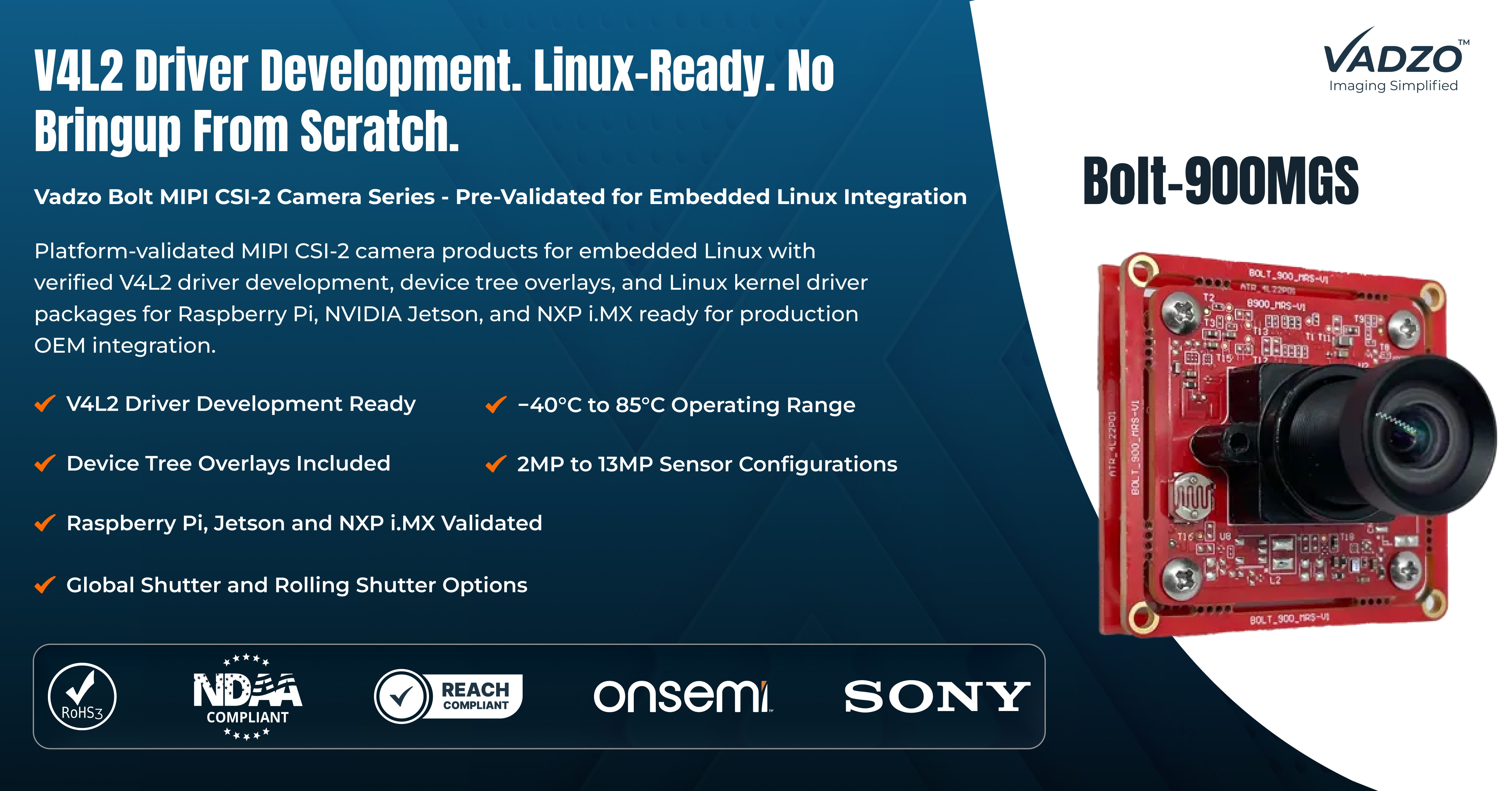
BOLT 900MGS - IMX900 3MP Monochrome Global Shutter MIPI Camera
Machine vision systems operating under structured light or NIR illumination face two simultaneous sensor-level problems: rolling shutter distortion corrupts fringe accuracy under structured light patterns, and Bayer color filter arrays reduce NIR sensitivity at 850nm and 940nm to levels that degrade biometric recognition reliability. Resolving both in the V4L2 driver development pipeline requires a sensor that provides global shutter accuracy and monochrome NIR sensitivity simultaneously not one or the other.
The BOLT 900MGS IMX900 Monochrome Global Shutter MIPI Camera is built on the Sony Pregius S IMX900, a fourth-generation stacked CMOS global shutter sensor with 1/3.1″ format, 2.25µm pixel pitch, and 3MP (2064×1552) resolution. Removing the Bayer array maximizes photon capture at every wavelength, delivering NIR sensitivity camera performance at 850nm and 940nm that color variants cannot match the specification that determines usability for security camera, night-mode video surveillance, and biometric capture under IR illumination. The IMX900 Quad HDR MIPI Camera delivers Quad HDR up to 120dB from the sensor's stacked architecture, preserving scene detail across extreme contrast ranges in a single frame without multi-frame merging. The 3MP IMX900 Mono MIPI CSI-2 camera operates across −40°C to 85°C with V4L2 driver development support verified on Raspberry Pi 4, Raspberry Pi 5, NVIDIA Jetson Orin NX, Orin Nano, Orin AGX, NVIDIA XavierNX camera platforms, and NXP i.MX8M Plus.
Key specs: 3MP (2064×1552) | Sony Pregius S IMX900 | 1/3.1″ 2.25µm BSI | Global Shutter | 2-lane/4-lane MIPI CSI-2 | Quad HDR (120dB) | S Mount (M12 Standard) | −40°C to 85°C
BOLT 1335CRS - AR1335 13MP Fixed Focus 4K Rolling Shutter MIPI Camera
Embedded inspection systems, medical device camera platforms, and facial recognition camera deployments require pixel density sufficient to resolve fine features at the sensor level surface defects below 0.1mm, facial landmark geometry at enrollment accuracy, or diagnostic tissue detail. At lower resolutions, inference models compensate through interpolation, degrading classification accuracy at feature boundaries. The V4L2 driver development pipeline delivering 4K AR1335 Color MIPI Camera data directly to the inference engine eliminates this interpolation penalty at the frame source.
The BOLT 1335CRS 13MP AR1335 MIPI Camera is built on the Onsemi AR1335, a 1/3.2″ BSI CMOS sensor with 1.1µm pixel pitch delivering 13MP (4208×3120) at full resolution. The 1080p AR1335 Rolling Shutter MIPI Camera output mode provides bandwidth-constrained platforms a resolution step-down through pixel binning, using the same embedded Linux camera driver control path without hardware changes. The AR1335's BSI architecture improves photon collection at the pixel level, maintaining image quality in lower illumination environments relevant to indoor inspection and medical imaging. ROI windowing through the V4L2 subdev API limits full-frame buffer transfers on NVIDIA Nano camera and NXP i.MX camera integration platforms where DDR bandwidth is a shared system resource, making this 4K embedded vision camera practical on SoCs with constrained memory controllers.
Key specs: 13MP (4208×3120) | Onsemi AR1335 | 1/3.2″ 1.1µm BSI | Rolling Shutter | 2-lane/4-lane MIPI CSI-2 | Standard DR | S Mount (M12 Standard) | −30°C to 70°C
Applications
Robotics and Autonomous Platforms: The BOLT 234CGS AR0234 Color Global Shutter MIPI Camera delivers 120fps distortion-free capture for robotic arm tracking, pick-and-place, and AGV navigation. The BOLT 900MGS IMX900 Mono MIPI camera adds NIR sensitivity and Quad HDR for structured-light 3D scanning and inspection robotics.
Surveillance, Traffic, and Analytics: The BOLT 544CRS 5MP AR0544 MIPI CSI-2 Camera handles mixed-illumination outdoor conditions across video surveillance camera, traffic monitoring camera, and retail analytics camera deployments. The BOLT 1335CRS 4K AR1335 Color MIPI Camera adds resolution density for license plate recognition and long-range subject identification.
Biometrics and Medical Imaging: The BOLT 900MGS IMX900 Monochrome Global Shutter MIPI Camera covers facial recognition camera systems, iris scanning, and vein recognition under NIR illumination. The BOLT 1335CRS 13MP AR1335 MIPI Camera delivers the pixel density that medical device camera and diagnostic imaging platforms require.
Edge AI and Embedded Inference: All four Bolt MIPI cameras support ROI windowing and pixel binning for bandwidth-efficient V4L2 driver development pipeline operation on resource-constrained SoCs. The BOLT 234CGS 2MP AR0234 MIPI camera at 120fps global shutter and the BOLT 544CRS 5MP AR0544 MIPI Camera with embedded HDR cover the two primary embedded AI inference deployment scenarios high-speed capture for motion-critical recognition and HDR-corrected capture for variable-light outdoor deployment.
Frequently Asked Questions (FAQs)
1) How does V4L2 driver development differ for global shutter versus rolling shutter MIPI CSI-2 sensors on Raspberry Pi?
From a V4L2 driver development perspective, global shutter and rolling shutter sensors share the same V4L2 subdev framework both require sensor device tree node definitions, MIPI lane configuration at the endpoint level, and pad format negotiation through the V4L2 subdev API. The practical difference appears at the output data level, not at the driver structure itself. Global shutter sensors expose all pixels simultaneously, so the V4L2 buffer carries geometrically accurate frame data regardless of platform vibration or subject speed. Rolling shutter sensors introduce distortion proportional to motion during row readout. For Raspberry Pi V4L2 driver integration, Vadzo's BOLT 234CGS delivering 1920×1200 at 120fps as a 2MP AR0234 MIPI CSI-2 camera and BOLT 900MGS delivering 3.2MP as a 3MP IMX900 Mono MIPI CSI-2 camera with Quad HDR both ship with Pi-specific device tree overlays and Linux kernel driver packages verified on Raspberry Pi 4 and Raspberry Pi 5.
2) What device tree configuration steps are critical for MIPI CSI-2 camera integration on NXP i.MX platforms
NXP i.MX camera integration requires the sensor device tree node to define the MIPI CSI-2 endpoint with the correct lane count, data-lane ordering, and link frequency matching the sensor register map. The i.MX8M Plus CSI-2 host controller requires explicit clock-lanes and data-lanes properties in the endpoint node, and media controller pipeline links between the sensor subdevice and the ISI must be established before streaming begins. Incorrect or absent lane polarity properties produce partial frame output that appears identical to ISP misconfiguration, which is why matching the device tree exactly to the sensor's D-PHY configuration is the first debug step in any NXP i.MX Linux camera integration. Vadzo provides NXP i.MX8M Plus-specific device tree overlays with every Bolt MIPI camera the BOLT 234CGS 2MP AR0234 MIPI CSI-2 camera, BOLT 544CRS 5MP AR0544 MIPI CSI-2 Camera, BOLT 900MGS 3MP IMX900 Mono MIPI CSI-2 camera, and BOLT 1335CRS 13MP AR1335 MIPI Camera eliminating lane configuration errors at the start of integration.
3) Which MIPI CSI-2 camera is best suited for NIR-illuminated biometric systems running on NVIDIA Jetson
For NVIDIA Jetson camera integration platforms running NIR-illuminated biometric applications iris recognition, vein pattern scanning, or face liveness detection under IR illumination the BOLT 900MGS IMX900 Monochrome Global Shutter MIPI Camera is the correct hardware choice. The 3MP IMX900 Mono MIPI CSI-2 camera removes the Bayer color filter, maximizing NIR sensitivity at 850nm and 940nm where biometric illuminators typically operate. The Sony Pregius S IMX900's global shutter eliminates rolling shutter distortion during capture critical for iris and vein imaging where geometric accuracy directly affects enrollment and matching reliability. Quad HDR up to 120dB handles contrast between NIR-illuminated subject regions and unlit background without per-frame exposure adjustments. Vadzo provides Jetson Orin NX, Orin Nano, and Orin AGX Linux kernel driver packages for the BOLT 900MGS, with V4L2 driver development integration verified and device tree overlays confirmed on all three Jetson Orin platforms.
4) How should an embedded engineer structure the V4L2 media controller pipeline for a MIPI CSI-2 camera in a Linux kernel driver?
The V4L2 media controller pipeline for a MIPI CSI-2 camera in embedded Linux follows a defined entity chain: the sensor V4L2 subdevice exposes source pads, which link to the CSI-2 host receiver sink pads, which link through the SoC ISP entities to the V4L2 video device that delivers frames to the application. Establishing this pipeline requires running media-ctl to create links between entity pads and setting pad format at each link boundary using v4l2-subctl set-fmt. A common integration error is setting format at the video device level without propagating format through the entire pad chain which produces stream-on success with zero-filled or corrupted buffers. Vadzo's Bolt MIPI CSI-2 camera series BOLT 234CGS, BOLT 544CRS, BOLT 900MGS, and BOLT 1335CRS ships with platform-specific media controller pipeline configuration scripts alongside device tree overlays, so this pad format setup starts from a confirmed reference rather than trial and error.
5) What should embedded engineers evaluate in a MIPI CSI-2 camera module before committing to V4L2 driver development?
The most important evaluation criteria for an OEM-grade MIPI CSI-2 camera module entering V4L2 driver development are: verified MIPI D-PHY electrical compliance at the target lane speed, a complete register map with application-mode initialization sequences, confirmed SoC-platform Linux kernel driver availability, and consistent board-level signal integrity that matches the datasheet. Camera modules that meet only the optical specification but lack confirmed driver support create open-ended bringup timelines that add weeks to OEM programs. Vadzo's Bolt MIPI CSI-2 camera series meets all four criteria the BOLT 234CGS 2MP AR0234 MIPI CSI-2 camera, BOLT 544CRS 5MP AR0544 MIPI CSI-2 Camera, BOLT 900MGS 3MP IMX900 Mono MIPI CSI-2 camera, and BOLT 1335CRS 13MP AR1335 MIPI Camera are each delivered with platform-level Linux kernel driver packages, device tree overlays, and integration documentation for Raspberry Pi camera configurations, NVIDIA Jetson platforms, and NXP i.MX.
Availability
The BOLT 234CGS AR0234 Color Global Shutter MIPI Camera, BOLT 544CRS 5MP AR0544 MIPI Camera, BOLT 900MGS IMX900 Monochrome Global Shutter MIPI Camera, and BOLT 1335CRS AR1335 Fixed Focus 4K MIPI Camera are available now for evaluation and production orders through Vadzo's Bolt MIPI CSI-2 camera series with no minimum order requirement. Each evaluation unit includes the camera module, default M12 lens, and driver documentation covering device tree overlays and Linux kernel driver packages for all supported platforms. Contact support@vadzoimaging.com to request evaluation units or discuss OEM integration requirements.
About Vadzo Imaging
Vadzo Imaging develops embedded and machine vision cameras for OEMs and system integrators building production-ready vision systems across industrial automation, robotics, UAV and drone platforms, smart surveillance, and edge AI. The company's MIPI CSI-2 camera series, alongside USB, GigE, Wi-Fi, and SerDes interface camera products, supports the full range of embedded deployment architectures from compact onboard payloads to distributed networked systems. Vadzo provides end-to-end imaging support including sensor integration, ISP tuning, firmware development, and OEM camera customization services using the Vadzo NXT SDK for Innova camera platforms that simplify development and deployment at scale. Visit www.vadzoimaging.com to explore the full embedded vision camera portfolio.
Media Contact
Alwin Vincent
Vadzo Imaging
Email: alwin@vadzoimaging.com
LinkedIn: Vadzo Imaging
YouTube: Vadzo Imaging
X: Vadzo Imaging
SOURCE: Vadzo Imaging
View the original press release on ACCESS Newswire