Every trader experiences drawdowns. At some point, losses will accumulate, confidence will take a hit, and account equity will move in the wrong direction. Drawdowns are a normal part of trading, yet many traders treat them as a sign that something is fundamentally broken.
That reaction can make the situation worse.
A drawdown is not necessarily evidence of a bad strategy. Sometimes it is simply the cost of operating in a market where outcomes are never guaranteed. The real challenge is not avoiding drawdowns entirely. The challenge is recovering from them without damaging your account or your decision-making process.
Many traders who eventually become successful go through periods where they struggle. What separates them from traders who disappear is usually their response to adversity. Some become emotional, increase risk, and attempt to recover losses quickly. Others slow down, assess the situation, and rebuild steadily.
The second group tends to survive.
What Is a Drawdown?
A drawdown refers to the decline in account value from a previous peak.
For example, if a trading account grows from $10,000 to $12,000 and then falls to $10,800, the drawdown is measured from the $12,000 peak.
Drawdowns occur in every trading system. Even profitable trading strategies experience periods where losses outweigh gains.
Understanding this helps traders avoid a common mistake: assuming every losing streak means the strategy has stopped working.
Why Drawdowns Feel Worse Than They Are
Losses affect people differently from gains.
Most traders have experienced the feeling of watching several trades fail in a row. The account balance may still be healthy, yet confidence begins to fade. Doubt starts appearing. Simple decisions become more difficult.
This is one reason why drawdowns are dangerous. The financial damage is mostly manageable. The psychological damage can be much larger.
A trader who loses 10% of an account may be able to recover financially. A trader who loses confidence may start making poor decisions that create even bigger problems.
Understanding the Mathematics of Recovery
One reason traders should respect drawdowns is that recovery becomes increasingly difficult as losses grow.
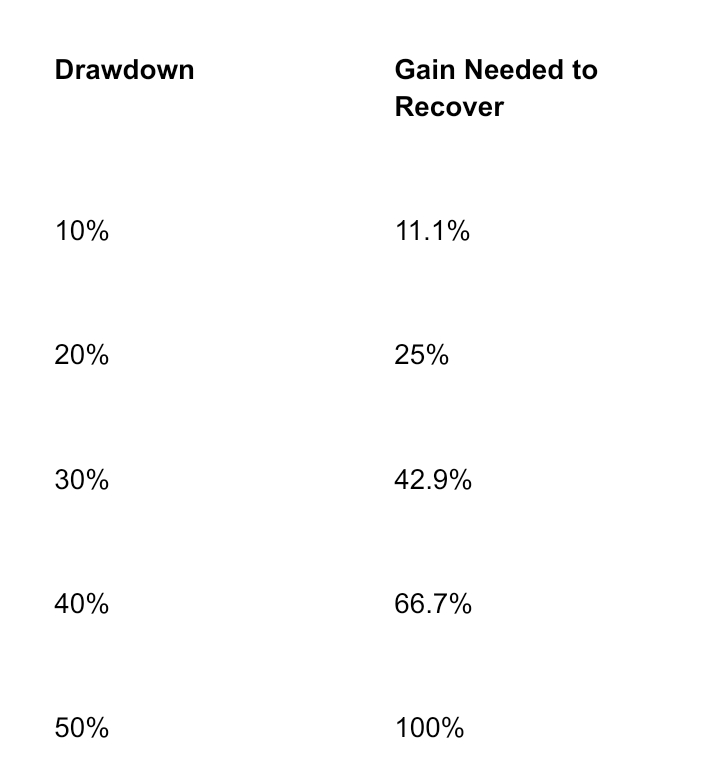
A 10% drawdown is relatively manageable. A 50% drawdown requires the account to double just to return to its previous high.
This is why professional traders focus heavily on limiting losses. Preventing large drawdowns is easier than recovering from them later.
Step One: Stop Trying to Recover Quickly
The strange thing about drawdowns is that they become larger during the recovery attempt.
A trader loses 10% and decides that earning it back slowly will take too long. The next trade gets a little more size. Then another. Before long, the focus has shifted from trading well to getting back to a certain account balance.
That pressure changes behavior.
Trades that would normally be ignored suddenly look attractive. A setup that is only "good enough" starts feeling like an opportunity that cannot be missed. The account becomes the center of attention instead of the chart.
Most traders have gone through this at some point. The frustrating part is that the market has no idea someone is trying to recover losses. It does not offer easier trades because last week was difficult.
In practice, recoveries usually happen in a much less dramatic way than people imagine. A few good trades, followed by a few more. Risk stays controlled. Confidence slowly returns. Looking back, the account recovers almost quietly.
Trying to force the process creates a second drawdown before the first one has even finished.
Take a Step Back and Analyze What Happened
Before placing the next trade, it helps to understand the source of the drawdown.
Not every drawdown has the same cause.
Questions worth asking include:
- Was the strategy followed correctly?
- Did market conditions change?
- Was the risk too high?
- Were trades entered emotionally?
- Did correlation increase exposure unexpectedly?
Sometimes the strategy is working exactly as designed, and the losses simply fall within normal expectations.
Other times, the drawdown exposes weaknesses that need attention.
The goal is to diagnose the problem rather than react emotionally to the outcome.
Reduce Position Size Temporarily
This idea sounds simple, yet many traders resist it.
After all, if the account is down, shouldn't the goal be to make more money rather than less?
That way of thinking is understandable, but it creates additional pressure at exactly the wrong time.
Imagine a football player who is struggling with form. Most coaches would not ask that player to take more risks immediately. They would focus on rebuilding confidence through simpler decisions first.
Trading is not very different.
Reducing position size for a while creates breathing room. Small losses feel less painful. Good decisions become easier to repeat. The trader stops worrying about every fluctuation and starts paying attention to execution again.
Interestingly, many traders notice that their performance improves after they reduce risk. Not because smaller positions generate larger profits, but because the emotional weight attached to every trade becomes lighter.
Sometimes the fastest way forward begins with taking a small step back.
Focus on Process Instead of Profit
One of the hardest parts of recovering from a drawdown is resisting the urge to constantly check the account balance.
The temptation is understandable.
Every trader wants to know how close they are to getting back to where they were. The problem is that focusing too heavily on the balance creates frustration. Progress feels slow. A winning trade never seems large enough. A losing trade feels larger than it really is.
This is why many experienced traders spend less time thinking about money and more time thinking about execution.
They ask different questions.
Questions such as these become more useful:
- Did I follow my rules?
- Was position sizing appropriate?
- Did I respect my stop-loss?
- Was the setup valid?
If those questions are answered positively, progress is being made even if profits have not yet returned.
Avoid Revenge Trading
Revenge trading is one of the fastest ways to deepen a drawdown.
It usually begins with frustration.
A trader takes a loss and immediately looks for another opportunity. Then another. Position sizes start increasing. Patience disappears.
At that point, the goal is no longer to trade well.
The goal becomes recovering money.
Markets tend to punish that mindset.
One useful habit is creating a personal circuit breaker.
For example:
- Stop trading after three losses in a day.
- Stop trading after reaching a daily loss limit.
- Take a mandatory break after a large losing trade.
These rules create distance between emotions and decision-making.
Review Trading Records
Many traders keep journals when things are going well and abandon them when things are not.
That is usually backwards.
The most valuable information appears during difficult periods.
Reviewing trading records can reveal patterns such as:
- Entering too early
- Taking trades outside the plan
- Holding losing positions too long
- Overtrading
- Increasing risk after losses
Small mistakes repeated dozens of times create large drawdowns. Without records, these patterns can remain invisible.
Accept That Market Conditions Change
Markets move through different environments.
A strategy that performs well during strong trends may struggle during consolidation.
A breakout strategy may perform differently when volatility contracts.
This does not automatically mean the strategy is broken.
Many traders abandon perfectly good systems because they encounter a temporary period of underperformance.
Before making major changes, compare recent results with historical expectations.
If the current drawdown remains within normal parameters, patience may be the correct response.
The Importance of Confidence During Recovery
Confidence matters in trading, but it must be based on evidence rather than emotion.
After a drawdown, confidence disappears.
Some traders attempt to force it back through larger positions or aggressive trading.
A better approach is to earn confidence gradually.
Small wins help.
Following rules consistently helps.
Seeing disciplined execution repeated over time helps.
Confidence built on process tends to last longer than confidence built on a lucky winning streak.
Recovering From Large Drawdowns
Large drawdowns require a different mindset.
A trader who is down 40% or 50% faces two separate challenges:
- Financial recovery
- Psychological recovery
Both take time.
Trying to recover a large drawdown aggressively may create additional losses.
Instead, traders may need to accept that recovery could take weeks or months.
This is difficult because most people naturally want quick solutions.
Markets rarely provide them.
In many cases, slowing down becomes the fastest route back to consistency.
Why Professional Traders Think Differently
One thing that surprises newer traders is how casually experienced traders talk about losses.
Not because they enjoy losing money. Nobody does.
The difference is that they have seen enough market cycles to understand that drawdowns are part of the job.
A trader who has been active for years has probably experienced periods where nothing seemed to work. They have likely gone through weeks where every setup failed and months where progress felt painfully slow.
Over time, that experience changes perspective.
Instead of treating every drawdown as a crisis, they start viewing it as information. Is the strategy behaving normally? Has market behavior changed? Is the risk management plan still working?
The questions become more analytical and less emotional.
Many professionals think in terms of large sample sizes rather than individual outcomes. A single trade matters very little. Even a single week may not matter very much. What matters is how performance looks across dozens or hundreds of trades.
That perspective makes temporary setbacks easier to manage.
Building a Recovery Plan
A structured recovery plan can help restore consistency.
A typical plan may include:
- Reduced position sizing
- Strict daily loss limits
- Trading only high-quality setups
- Reviewing recent trades
- Tracking emotional decisions
- Maintaining a trading journal
The purpose is not to recover quickly.
The purpose is to recover correctly.
Those are not always the same thing.
Common Recovery Mistakes
Several mistakes repeatedly appear during drawdowns.
Increasing Risk Too Early
Trying to force faster recovery can increase losses.
Abandoning the Trading Plan
Many traders stop following rules after a losing streak.
Strategy Hopping
Switching systems repeatedly creates confusion and inconsistency.
Focusing on the Account Balance
Constantly monitoring losses increases emotional pressure.
Trading Out of Frustration
Emotional decisions rarely improve performance.
Conclusion
Ask ten experienced traders about the worst period of their trading career, and most will have a story.
Some will talk about a month where nothing worked. Others will remember a drawdown that felt endless while it was happening. A few will probably admit that they made things worse before they made them better.
Those experiences are more common than many people realize.
Drawdowns are uncomfortable because they challenge confidence. They make traders question their strategy, their discipline, and sometimes even their ability. Yet they are also one of the few experiences every long-term trader shares.
The important thing is not avoiding them completely. That is unrealistic.
What matters is the response.
The traders who recover tend to slow down rather than speed up. They become more selective instead of more aggressive. They focus on execution, review their mistakes honestly, and allow confidence to return naturally rather than trying to force it.
Recovery rarely feels dramatic in real time. Most of the time, it happens gradually. One disciplined trade. Then another. Then a week where things start looking normal again.
By the time the drawdown is gone, the trader realizes that patience accomplished what aggression never could.
A drawdown is not the end of a trading journey. In many cases, it is simply the period that teaches the lessons a winning streak never would.