Choosing a software development partner is one of the most consequential decisions a startup founder, CTO, or product manager will make. The wrong choice results in delayed delivery, technical debt, wasted budget, and products that need to be rebuilt. The right choice produces software that works, scales, and can be maintained and extended as the business grows.
This article provides a practical framework for evaluating software development companies before committing to an engagement.
What Custom Software Development Actually Involves
Custom software development is the process of designing and building software specifically for one organization's requirements - as opposed to purchasing and configuring a commercial off-the-shelf product. The output is a codebase owned entirely by the client, built to fit specific workflows, integration requirements, and business logic that generic tools cannot accommodate.
The scope varies significantly. A startup might need an MVP built in eight weeks to validate a product hypothesis. An enterprise might need a multi-year digital transformation program that replaces legacy infrastructure across multiple departments. Both are custom software development engagements - they differ in scale and complexity, not in kind.
When to Work With a Software Development Company
Three situations consistently indicate that working with an external software development company is the right call.
No internal engineering capacity. Startups and small businesses without technical co-founders or engineering teams need an external partner to build their product. Hiring a full internal team from scratch takes months and carries significant fixed cost before any software is delivered.
Specific skill gaps. An existing engineering team may lack expertise in a particular domain - mobile development, AI implementation, cloud architecture, QA - that a project requires. An external partner fills that gap without a permanent hire.
Speed requirements. When time to market is a competitive constraint, augmenting an internal team with an external partner accelerates delivery in ways that sequential hiring cannot.
The Evaluation Criteria That Predict Project Outcomes
Most vendor evaluation processes focus on portfolio quality and hourly rates. Both matter, but neither predicts project outcomes as reliably as process quality and communication structure.
Product design capability. Software built without prior design and discovery work solves the wrong problem efficiently. A credible partner conducts requirements analysis and design before engineering begins - not as a formality, but as the foundation that determines whether the final product serves its intended purpose.
QA and security testing integration. Testing performed as a separate phase at the end of development consistently surfaces issues too late and too expensively. QA integrated throughout development catches problems when they are cheapest to fix. Security testing in particular - especially for products handling sensitive data - should be a standard practice, not an optional add-on.
Code ownership terms. The client should own all source code, architecture documentation, and deployment configuration from the first sprint. Vendors who retain code ownership or build on proprietary frameworks that create dependency are establishing leverage that transfers value from the client to themselves over time.
Post-launch support model. Software requires ongoing maintenance after go-live: dependency updates, bug fixes, performance monitoring, and adaptation to changes in connected systems. A vendor without a defined post-launch support model is not a long-term partner.
Development Model Comparison
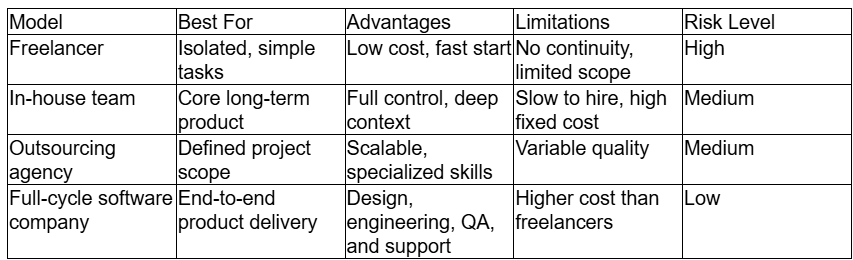
For complex or long-running projects - digital transformation programs, AI implementation, multi-platform products - the full-cycle model carries the lowest risk because continuity across discovery, development, QA, and post-launch support is built into the engagement structure.
Partner Evaluation Checklist
Before committing to a vendor, assess these criteria explicitly:
- Technical expertise - Demonstrated capability in the specific technologies the project requires
- Product design capabilities - Design and discovery work conducted before engineering begins
- Relevant portfolio - Completed projects with comparable complexity, domain, or integration requirements
- Communication process - Defined update cadence; documented process for scope change management
- Project management approach - Methodology appropriate to the project type; transparent milestone tracking
- QA and security testing - Integrated throughout development, covering functional and security requirements
- Code ownership - Full intellectual property transfer to the client from the first deliverable
- Post-launch support - Defined maintenance and monitoring model after go-live
- Ability to scale - Capacity to expand or reduce team size as project requirements evolve
- Breadth of experience - Web, mobile, AI, and digital transformation across startup, SME, and enterprise contexts
Where CodeGeeks Solutions Fits
CodeGeeks Solutions is a software development company serving startups, SMEs, and enterprise clients. Services cover the full product lifecycle: product design, software engineering, web and mobile development, product management, QA and security testing, AI automation, AI transformation, legacy modernization, and digital transformation.
The company's engagement model is structured around milestone-based delivery, with code ownership transferring to the client from the first sprint. For businesses carrying technical debt from older systems, CodeGeeks Solutions provides AI-driven legacy modernization as a defined service - not bundled into a broader retainer, but scoped and delivered as a standalone program.
For AI-specific work, the offering spans automation implementation, AI transformation strategy, and integration of AI capabilities into existing products - applied to processes where the efficiency gains are measurable rather than speculative.
Businesses that need product design, software engineering, AI transformation, QA, or scalable web and mobile development can evaluate CodeGeeks Solutions as a technology partner for custom software projects.