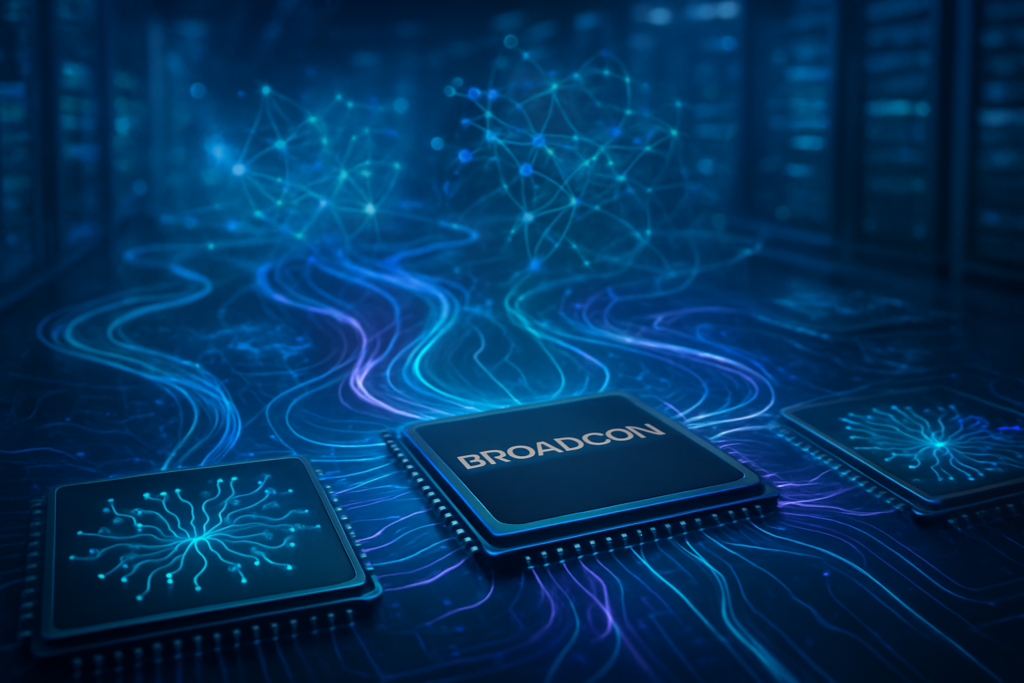
Broadcom (NASDAQ: AVGO) is set to significantly accelerate its already impressive trajectory in the artificial intelligence (AI) sector, projecting its Fiscal Quarter 1 (FQ1) 2026 AI semiconductor revenue to reach an astounding $8.2 billion. This forecast, announced on December 11, 2025, represents a doubling of its AI semiconductor revenue year-over-year and firmly establishes the company as a foundational pillar in the ongoing AI revolution. The monumental growth is primarily driven by surging demand for Broadcom's specialized custom AI accelerators and its cutting-edge Ethernet AI switches, essential components for building the hyperscale data centers that power today's most advanced AI models.
This robust projection underscores Broadcom's strategic shift and deep entrenchment in the AI value chain. As tech giants and AI innovators race to scale their computational capabilities, Broadcom's tailored hardware solutions are proving indispensable, providing the critical "plumbing" necessary for efficient and high-performance AI training and inference. The company's ability to deliver purpose-built silicon and high-speed networking is not only boosting its own financial performance but also shaping the architectural landscape of the entire AI industry.
The Technical Backbone of AI: Custom Silicon and Hyper-Efficient Networking
Broadcom's projected $8.2 billion FQ1 2026 AI semiconductor revenue is a testament to its deep technical expertise and strategic product development, particularly in custom AI accelerators and advanced Ethernet AI switches. The company has become a preferred partner for major hyperscalers, dominating approximately 70% of the custom AI ASIC (Application-Specific Integrated Circuit) market. These custom accelerators, often referred to as XPUs, are co-designed with tech giants like Google (for its Tensor Processing Units or TPUs), Meta (for its Meta Training and Inference Accelerators or MTIA), Amazon, Microsoft, ByteDance, and notably, OpenAI, to optimize performance, power efficiency, and cost for specific AI workloads.
Technically, Broadcom's custom ASICs offer significant advantages, demonstrating up to 30% better power efficiency and 40% higher inference throughput compared to general-purpose GPUs for targeted tasks. Key innovations include the 3.5D eXtreme Dimension system-in-package (XDSiP) platform, which enables "face-to-face" 3.5D integration for breakthrough performance and power efficiency. This platform can integrate over 6,000 mm² of silicon and up to 12 high-bandwidth memory (HBM) stacks, facilitating high-efficiency, low-power computing at AI scale. Furthermore, Broadcom is integrating silicon photonics through co-packaged optics (CPO) directly into its custom AI ASICs, placing high-speed optical connections alongside the chip to enable faster data movement with lower power consumption and latency.
Complementing its custom silicon, Broadcom's advanced Ethernet AI switches form the critical networking fabric for AI data centers. Products like the Tomahawk 6 (BCM78910 Series) stand out as the world's first 102.4 Terabits per second (Tbps) Ethernet switch chip, built on TSMC’s 3nm process. It doubles the bandwidth of previous generations, featuring 512 ports of 200GbE or 1,024 ports of 100GbE, enabling massive AI training and inference clusters. The Tomahawk Ultra (BCM78920 Series) further optimizes for High-Performance Computing (HPC) and AI scale-up with ultra-low latency of 250 nanoseconds at 51.2 Tbps throughput, incorporating "lossless fabric technology" and "In-Network Collectives (INC)" to accelerate communication. The Jericho 4 router, also on TSMC's 3nm, offers 51.2 Tbps throughput and features 3.2 Terabits per second (Tbps) HyperPort technology, consolidating four 800 Gigabit Ethernet (GbE) links into a single logical port to improve link utilization and reduce job completion times.
Broadcom's approach notably differs from competitors like Nvidia (NASDAQ: NVDA) by emphasizing open, standards-based Ethernet as the interconnect for AI infrastructure, challenging Nvidia's InfiniBand dominance. This strategy offers hyperscalers an open ecosystem, preventing vendor lock-in and providing flexibility. While Nvidia excels in general-purpose GPUs, Broadcom's strength lies in highly efficient custom ASICs and a comprehensive "End-to-End Ethernet AI Platform," including switches, NICs, retimers, and optical DSPs, creating an integrated architecture few rivals can replicate.
Reshaping the AI Ecosystem: Impact on Tech Giants and Competitors
Broadcom's burgeoning success in AI semiconductors is sending ripples across the entire tech industry, fundamentally altering the competitive landscape for AI companies, tech giants, and even startups. Its projected FQ1 2026 AI semiconductor revenue, part of an estimated 103% year-over-year growth to $40.4 billion in AI revenue for fiscal year 2026, positions Broadcom as an indispensable partner for the largest AI players. The recent $10 billion XPU order from OpenAI, widely reported, further solidifies Broadcom's long-term revenue visibility and strategic importance.
Major tech giants stand to benefit immensely from Broadcom's offerings. Companies like Google (NASDAQ: GOOGL), Meta Platforms (NASDAQ: META), Microsoft (NASDAQ: MSFT), Amazon (NASDAQ: AMZN), ByteDance, and OpenAI are leveraging Broadcom's custom AI accelerators to build highly optimized and cost-efficient AI infrastructures tailored to their specific needs. This capability allows them to achieve superior performance for large language models, significantly reduce operational costs, and decrease their reliance on a single vendor for AI compute. By co-designing chips, these hyperscalers gain strategic control over their AI hardware roadmaps, fostering innovation and differentiation in their cloud AI services.
However, this also brings significant competitive implications for other chipmakers. While Nvidia maintains its lead in general-purpose AI GPUs, Broadcom's dominance in custom ASICs presents an "economic disruption" at the high end of the market. Hyperscalers' preference for custom silicon, which offers better performance per watt and lower Total Cost of Ownership (TCO) for specific workloads, particularly inference, could erode Nvidia's pricing power and margins in this lucrative segment. This trend suggests a potential "bipolar" market, with Nvidia serving the broad horizontal market and Broadcom catering to a handful of hyperscale giants with highly optimized custom silicon. Companies like Advanced Micro Devices (NASDAQ: AMD) and Intel (NASDAQ: INTC), primarily focused on discrete GPU sales, face pressure to replicate Broadcom's integrated approach.
For startups, the impact is mixed. While the shift towards custom silicon by hyperscalers might challenge smaller players offering generic AI hardware, the overall expansion of the AI infrastructure market, particularly with the embrace of open Ethernet standards, creates new opportunities. Startups specializing in niche hardware components, software layers, AI services, or solutions that integrate with these specialized infrastructures could find fertile ground within this evolving, multi-vendor ecosystem. The move towards open standards can drive down costs and accelerate innovation, benefiting agile smaller players. Broadcom's strategic advantages lie in its unparalleled custom silicon expertise, leadership in high-speed Ethernet networking, deep strategic partnerships, and a diversified business model that includes infrastructure software through VMware.
Broadcom's Role in the Evolving AI Landscape: A Foundational Shift
Broadcom's projected doubling of FQ1 2026 AI semiconductor revenue to $8.2 billion is more than just a financial milestone; it signifies a foundational shift in the broader AI landscape and trends. This growth cements Broadcom's role as a "silent architect" of the AI revolution, moving the industry beyond its initial GPU-centric phase towards a more diversified and specialized infrastructure. The company's ascendancy aligns with two critical trends: the widespread adoption of custom AI accelerators (ASICs) by hyperscalers and the pervasive deployment of high-performance Ethernet AI networking.
The rise of custom ASICs, where Broadcom holds a commanding 70% market share, represents a significant evolution. Hyperscale cloud providers are increasingly designing their own chips to optimize performance per watt and reduce total cost, especially for inference workloads. This shift from general-purpose GPUs to purpose-built silicon for specific AI tasks is a pivotal moment, empowering tech giants to exert greater control over their AI hardware destiny and tailor chips precisely to their software stacks. This strategic independence fosters innovation and efficiency at an unprecedented scale.
Simultaneously, Broadcom's leadership in advanced Ethernet networking is transforming how AI clusters communicate. As AI workloads become more complex, the network has emerged as a primary bottleneck. Broadcom's Tomahawk and Jericho switches provide the ultra-fast and scalable "plumbing" necessary to interconnect thousands of processors, positioning open Ethernet as a credible and cost-effective alternative to proprietary solutions like InfiniBand. This widespread adoption of Ethernet for AI networking is driving a rapid build-out and modernization of data center infrastructure, necessitating higher bandwidth, lower latency, and greater power efficiency.
This development is comparable in impact to earlier breakthroughs in AI hardware, such as the initial leveraging of GPUs for parallel processing. It marks a maturation of the AI industry, where efficiency, scalability, and specialized performance are paramount, moving beyond a sole reliance on general-purpose compute. Potential concerns, however, include customer concentration risk, as a substantial portion of Broadcom's AI revenue relies on a limited number of hyperscale clients. There are also worries about potential "AI capex digestion" in 2026-2027, where hyperscalers might slow down infrastructure spending after aggressive build-outs. Intense competition from Nvidia, AMD, and other networking players, along with geopolitical tensions, also remain factors to watch.
The Road Ahead: Continued Innovation and Market Expansion
Looking ahead, Broadcom is poised for sustained growth and innovation in the AI sector, with expected near-term and long-term developments that will further solidify its market position. The company anticipates its AI revenue to reach $40.4 billion in fiscal year 2026, with ambitious long-term targets of over $120 billion in AI revenue by 2030, a sixfold increase from fiscal 2025 estimates. This trajectory will be driven by continued advancements in custom AI accelerators, expanding its strategic partnerships beyond current hyperscalers, and pushing the boundaries of high-speed networking.
In the near term, Broadcom will continue its critical work on next-generation custom AI chips for Google, Meta, Amazon, Microsoft, and ByteDance. The monumental 10-gigawatt AI accelerator and networking deal with OpenAI, with deployment commencing in late 2026 and extending through 2029, represents a significant revenue stream and a testament to Broadcom's indispensable role. Its high-speed Ethernet solutions, such as the 102.4 Tbps Tomahawk 6 and 51.2 Tbps Jericho 4, will remain crucial for addressing the increasing networking bottlenecks in massive AI clusters. Furthermore, the integration of VMware is expected to create new integrated hardware-software solutions for hybrid cloud and edge AI deployments, expanding Broadcom's reach into enterprise AI.
Longer term, Broadcom's vision includes sustained innovation in custom silicon and networking, with a significant technological shift from copper to optical connections anticipated around 2027. This transition will create a new wave of demand for Broadcom's advanced optical networking products, capable of 100 terabits per second. The company also aims to expand its custom silicon offerings to a broader range of enterprise AI applications beyond just hyperscalers. Potential applications and use cases on the horizon span advanced generative AI, more robust hybrid cloud and edge AI deployments, and power-efficient data centers capable of scaling to millions of nodes.
However, challenges persist. Intense competition from Nvidia, AMD, Marvell, and others will necessitate continuous innovation. The risk of hyperscalers developing more in-house chips could impact Broadcom's long-term margins. Supply chain vulnerabilities, high valuation, and potential "AI capex digestion" in the coming years also need careful management. Experts largely predict Broadcom will remain a central, "hidden powerhouse" of the generative AI era, with networking becoming the new primary bottleneck in AI infrastructure, a challenge Broadcom is uniquely positioned to address. The industry will continue to see a trend towards greater vertical integration and custom silicon, favoring Broadcom's expertise.
A New Era for AI Infrastructure: Broadcom at the Forefront
Broadcom's projected doubling of FQ1 2026 AI semiconductor revenue to $8.2 billion marks a profound moment in the evolution of artificial intelligence. It underscores a fundamental shift in how AI infrastructure is being built, moving towards highly specialized, custom silicon and open, high-speed networking solutions. The company is not merely participating in the AI boom; it is actively shaping its underlying architecture, positioning itself as an indispensable partner for the world's leading tech giants and AI innovators.
The key takeaways are clear: custom AI accelerators and advanced Ethernet AI switches are the twin engines of Broadcom's remarkable growth. This signifies a maturation of the AI industry, where efficiency, scalability, and specialized performance are paramount, moving beyond a sole reliance on general-purpose compute. Broadcom's strategic partnerships with hyperscalers like Google and OpenAI, combined with its robust product portfolio, cement its status as the clear number two AI compute provider, challenging established market dynamics.
The long-term impact of Broadcom's leadership will be a more diversified, resilient, and optimized AI infrastructure globally. Its contributions will enable faster, more powerful, and more cost-effective AI models and applications across cloud, enterprise, and edge environments. As the "AI arms race" continues, Broadcom's role in providing the essential "plumbing" will only grow in significance.
In the coming weeks and months, industry observers should closely watch Broadcom's detailed FY2026 AI revenue outlook, potential new customer announcements, and updates on the broader AI serviceable market. The successful integration of VMware and its contribution to recurring software revenue will also be a key indicator of Broadcom's diversified strength. While challenges like competition and customer concentration exist, Broadcom's strategic foresight and technical prowess position it as a resilient and high-upside play in the long-term AI supercycle, an essential company to watch as AI continues to redefine our technological landscape.
This content is intended for informational purposes only and represents analysis of current AI developments.
TokenRing AI delivers enterprise-grade solutions for multi-agent AI workflow orchestration, AI-powered development tools, and seamless remote collaboration platforms.
For more information, visit https://www.tokenring.ai/.