




Financial News
Walmart (WMT) 2025 Deep-Dive: The Omnichannel Giant Dominates the Holiday Season
Today’s Date: December 22, 2025
Introduction
As the final shopping days of the 2025 holiday season wind down, Walmart Inc. (NYSE: WMT) stands as the undisputed titan of global retail. While many analysts entered the year fearing a "consumer cliff" driven by persistent interest rates and a slowing labor market, Walmart has defied gravity. The company has transformed from a traditional big-box retailer into a sophisticated, multi-channel ecosystem where physical storefronts, a massive third-party marketplace, and high-margin advertising services converge.
In 2025, Walmart has become the ultimate economic bellwether. Its ability to capture both the value-seeking low-income demographic and the "trade-down" high-income shopper (those earning over $100,000 annually) has pushed its market capitalization to historic levels. With the recent announcement of a leadership transition and record-breaking holiday logistics, the Bentonville-based giant is no longer just defending its turf against Amazon—it is setting the new gold standard for omnichannel retail.
Historical Background
The story of Walmart began in 1962 when Sam Walton opened the first "Wal-Mart Discount City" in Rogers, Arkansas. Walton’s founding philosophy—"Everyday Low Price" (EDLP)—was radical at the time, focusing on high volume and low margins to undercut competitors and pass savings to customers. By 1970, the company went public, and by the 1980s, it had pioneered the "Supercenter" model, combining general merchandise with a full-scale grocery store.
The 21st century brought new challenges, most notably the rise of e-commerce and Amazon. Under the leadership of Doug McMillon, who took the helm in 2014, Walmart underwent a massive cultural and technological pivot. Key acquisitions, such as Jet.com in 2016 and Flipkart in 2018, signaled a shift away from just "piling it high and selling it cheap" in stores to becoming a digital powerhouse. Today, Walmart is a global conglomerate with over 10,500 stores under 46 banners in 24 countries, having successfully navigated the transition from the "analog" retail age to the "automated" one.
Business Model
Walmart’s business model has evolved into a sophisticated "flywheel" where its massive retail scale supports higher-margin services. The business is divided into three primary segments:
- Walmart U.S.: The largest segment, accounting for roughly 70% of revenue. It operates Supercenters, Discount Stores, and Neighborhood Markets. In 2025, this segment’s growth has been fueled by its dominance in grocery and a rapidly expanding e-commerce presence.
- Walmart International: Operates in markets like Mexico (Walmex), Canada, China, and India (Flipkart/PhonePe). This segment serves as a growth engine, particularly in high-growth emerging markets.
- Sam’s Club: A membership-only warehouse club that competes directly with Costco. It has seen a resurgence in 2025, driven by technological innovations like "Scan & Go" and a robust private label (Member’s Mark).
Beyond traditional retail, Walmart has diversified into Walmart Connect (its advertising arm), Walmart Luminate (data analytics for suppliers), and Walmart+ (a subscription membership). These services carry significantly higher margins than selling a gallon of milk, effectively subsidizing the company's low prices for consumers.
Stock Performance Overview
Walmart's stock (NYSE: WMT) has been a standout performer in 2025. Following a 3-for-1 stock split in February 2024, the shares became more accessible to retail investors, sparking a wave of liquidity that supported the upward trend throughout the following year.
- 1-Year Performance: In 2025, WMT shares surged approximately 24%, significantly outperforming the S&P 500's retail sector. The stock currently trades near its 52-week high of $117.45.
- 5-Year Performance: Over the last five years, WMT has delivered a total return of roughly 150%, a testament to the success of its e-commerce pivot and margin expansion.
- 10-Year Performance: Long-term shareholders have seen the stock rise by nearly 600% (adjusted for the split and dividends).
The stock's resilience is often attributed to its "defensive growth" profile. During inflationary periods, consumers flock to Walmart for value; during economic booms, they spend more on discretionary items via its marketplace.
Financial Performance
The financial health of Walmart in late 2025 is robust. For the most recent fiscal periods, the company reported:
- Revenue: Fiscal Year 2025 revenue reached a staggering $680.99 billion. More recently, Q3 FY2026 results (ending late 2025) showed revenue of $179.5 billion, a 5.8% year-over-year increase.
- E-commerce: Digital sales now represent 18% of total revenue, with the U.S. e-commerce segment reaching profitability for the first time in late 2025—a milestone long-awaited by Wall Street.
- Margins: Consolidated net margins improved to 2.38%. While retail margins remain thin, the growth in advertising revenue—which hit a $10 billion annual run rate this year—has provided a critical tailwind.
- Capital Allocation: In 2025, Walmart raised its annual dividend by 13% to $0.94 per share and continued its aggressive $15 billion share repurchase program.
Leadership and Management
The defining leadership news of 2025 is the impending retirement of CEO Doug McMillon, effective January 31, 2026. McMillon, a Walmart "lifer" who started in a distribution center, is widely credited with saving Walmart from digital irrelevance.
His successor, John Furner, currently the CEO of Walmart U.S., is a seasoned executive known for his focus on automation and store-led fulfillment. The transition is viewed as a "continuity play" by the board. Furner’s deep understanding of the U.S. consumer and his hand in building the current e-commerce infrastructure suggest that the company’s strategic direction will remain focused on the "omnichannel" flywheel. The management team’s reputation for operational excellence and disciplined capital spending remains a core strength.
Products, Services, and Innovations
Walmart is no longer just a place to buy groceries; it is a technology-enabled logistics platform. Key innovations in 2025 include:
- AI-Driven Supply Chain: 60% of Walmart stores are now serviced by automated distribution centers. These facilities use AI to predict demand and robots to pack trucks, reducing the "cost-to-serve" by nearly 20%.
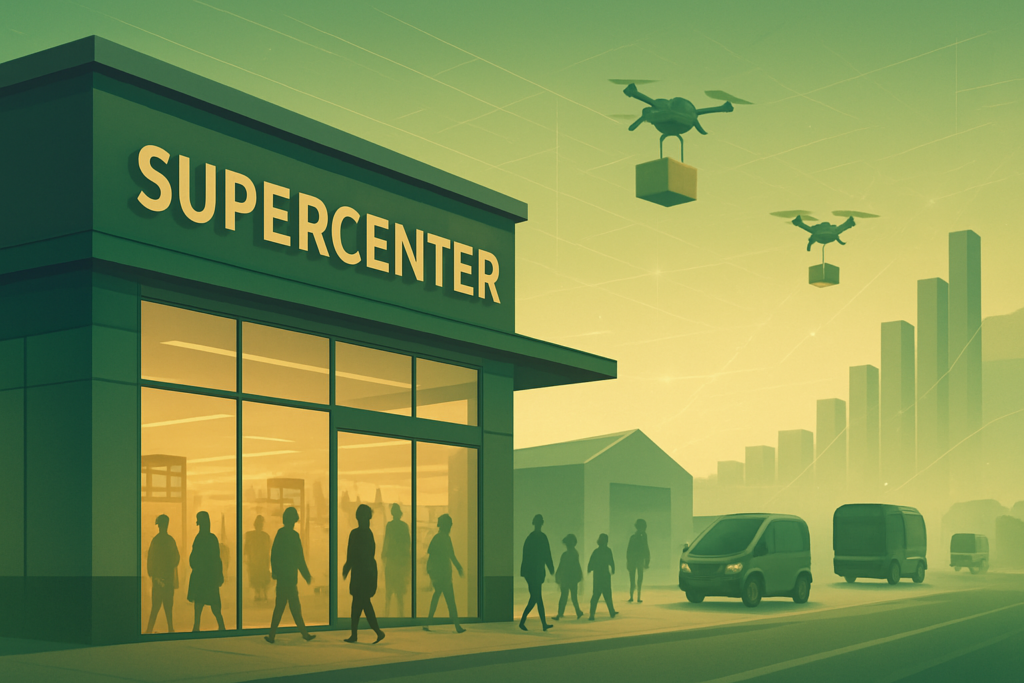
- Drone Delivery: In 2025, Walmart expanded its drone delivery network to cover 75% of the Dallas-Fort Worth metroplex. The company completed over 150,000 drone deliveries this year, often in under 30 minutes.
- Walmart Marketplace: The 3P (third-party) marketplace now hosts over 400,000 sellers. This allows Walmart to offer millions of items without the inventory risk, while collecting fulfillment and advertising fees.
- Fintech & Health: Through its "One" fintech venture and expanded clinical services, Walmart is increasingly embedding itself into the financial and physical well-being of its 250 million weekly customers.
Competitive Landscape
The retail battlefield in 2025 is increasingly concentrated at the top.
- Walmart vs. Amazon (NASDAQ: AMZN): While Amazon dominates non-grocery e-commerce, Walmart holds a massive lead in digital grocery (30% market share vs. Amazon’s 20%). Walmart's "secret weapon" is its 4,700 U.S. stores, which act as local fulfillment centers, allowing for faster and cheaper delivery of fresh food.
- Walmart vs. Target (NYSE: TGT): In 2025, Walmart gained significant share from Target as price-sensitive consumers pivoted toward Walmart’s lower-priced private labels (Great Value) amidst sticky inflation.
- Walmart vs. Costco (NASDAQ: COST): Through Sam’s Club, Walmart is aggressively courting the high-income demographic, narrowing the "membership gap" with Costco through digital convenience features.
- The "China Challenge": The rise of ultra-cheap apps like Temu and Shein has forced Walmart to enhance its own value proposition. Walmart has countered by emphasizing trust, easy in-store returns, and domestic shipping speeds that Chinese cross-border apps cannot match.
Industry and Market Trends
The retail industry in 2025 is defined by "Value-Plus" shopping. Consumers are no longer just looking for the lowest price; they are looking for the lowest price plus the most convenience.
- Omnichannel Ubiquity: The line between online and offline shopping has blurred. In 2025, nearly 50% of Walmart’s digital orders were fulfilled by stores, either through pickup or local delivery.
- Disinflationary Trends: After years of high inflation, 2025 saw disinflation in certain categories like electronics and apparel. Walmart used its scale to force price cuts from suppliers, reinforcing its EDLP image.
- Subscription Fatigue: As consumers cut back on multiple streaming services, the Walmart+ membership has remained resilient due to its tangible utility (free delivery and gas discounts).
Risks and Challenges
Despite its dominance, Walmart faces several significant headwinds:
- Inventory Shrink: Retail theft and administrative "shrink" remain a persistent drain on profits. In 2025, shrink cost Walmart an estimated $3 billion. The company is investing heavily in AI-powered cameras and self-checkout sensors to combat this.
- Labor Costs: As the largest private employer in the U.S., Walmart is highly sensitive to wage inflation. Recent raises for store managers and tech staff have increased the company's "cost of doing business."
- The "Last Mile" Expense: While e-commerce is now profitable, the cost of home delivery remains high. Any spike in fuel prices or driver labor costs could squeeze margins.
- Global Supply Chain Volatility: Continued tensions in the Red Sea and potential new trade tariffs have forced Walmart to diversify its sourcing away from China toward India, Vietnam, and Mexico—a costly and complex transition.
Opportunities and Catalysts
- International Growth: The potential IPO of PhonePe or Flipkart in India remains a massive latent catalyst. These businesses are growing at a faster clip than the U.S. core and could unlock significant shareholder value.
- Advertising Expansion: Walmart Connect is still in its early innings. As more third-party sellers join the marketplace, the demand for ad placements will grow, providing a high-margin revenue stream.
- Sam’s Club Expansion: After a period of stagnation, Sam’s Club is opening new locations for the first time in years, targeting high-growth suburban markets.
- B2B Services: Walmart is beginning to sell its proprietary logistics and AI software to other retailers, creating a new "Retail-as-a-Service" revenue stream.
Investor Sentiment and Analyst Coverage
Wall Street is overwhelmingly bullish on Walmart as we close out 2025.
- Consensus: "Strong Buy" rating across 44 major brokerage firms.
- Price Targets: The average price target stands at $125.00, with some "bull case" estimates reaching $136.00 (TD Cowen, Jefferies).
- Institutional Activity: Major institutions like Vanguard and BlackRock have increased their stakes in 2025, viewing the stock as a "safe harbor" during economic uncertainty.
- Retail Sentiment: On social media and retail platforms, sentiment is high, particularly following the successful 2024 stock split which allowed more "Main Street" investors to participate in the stock’s growth.
Regulatory, Policy, and Geopolitical Factors
The geopolitical landscape of 2025 has been a primary focus for Walmart’s board. New trade tariffs on Chinese imports enacted in early 2025 have accelerated the company’s "China Plus One" strategy. Walmart has pledged to triple its exports from India to $10 billion by 2027.
Domestically, the company faces ongoing scrutiny regarding its labor practices and market power. However, Walmart has mitigated some regulatory risk by proactively raising its internal minimum wages and investing in employee education programs, positioning itself as a leader in "corporate responsibility" compared to its peers.
Conclusion
As we look toward 2026, Walmart Inc. (NYSE: WMT) has successfully completed one of the most difficult transitions in corporate history. It is no longer just a "store" but a data-driven, automated logistics machine.
The 2025 holiday season has proven that Walmart’s scale is its ultimate competitive advantage. By delivering nearly half of its Black Friday orders in under three hours, the company has matched Amazon's speed while maintaining Sam Walton’s price leadership. For investors, Walmart offers a unique combination: the safety of a consumer staple with the growth profile of a technology company. While risks like labor costs and global trade tensions remain, the company’s high-margin "flywheel" of advertising and membership income suggests that Walmart’s best days may still be ahead.
This content is intended for informational purposes only and is not financial advice.
More News
View More




Recent Quotes
View MoreQuotes delayed at least 20 minutes.
By accessing this page, you agree to the Privacy Policy and Terms Of Service.