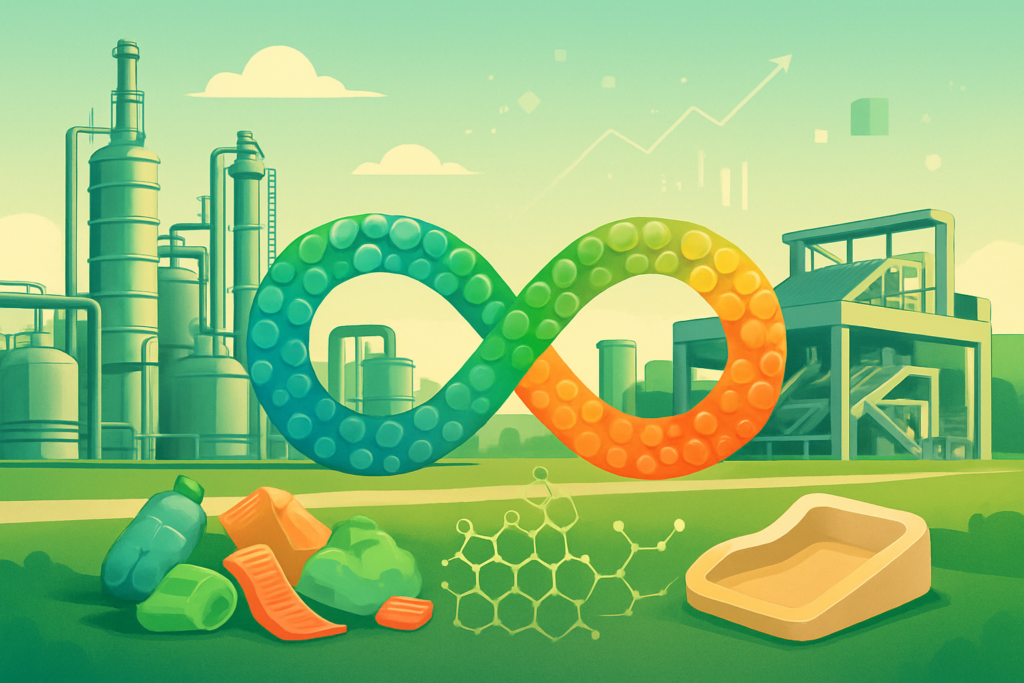
As of March 19, 2026, LyondellBasell Industries N.V. (NYSE: LYB) stands at a critical crossroads, navigating what many analysts are calling the "Great Recalibration." Long regarded as a high-yield "cash cow" of the petrochemical sector, the company has spent the last 24 months aggressively shedding its skin. Under a leadership mandate to transition from a legacy commodity producer to a circular economy leader, LYB is currently the subject of intense debate on Wall Street.
The company is coming off a bruising 2025 fiscal year characterized by a cyclical trough in the global chemical industry and a landmark 50% dividend cut in early 2026. However, a sudden and powerful stock rally in March 2026 suggests that the market may finally be pricing in the success of its strategic pivot. For investors, the question is no longer whether LYB can survive the cycle, but whether its bet on sustainable polymers and asset "pruning" will redefine the economics of the chemicals industry for the next decade.
Historical Background
The story of LyondellBasell is one of the most dramatic in industrial history. The company in its current form was forged through the 2007 merger of Lyondell Chemical Company and Basell Polyolefins—a deal orchestrated by billionaire Leonard Blavatnik’s Access Industries.
Lyondell’s roots trace back to 1985 as a spin-off from Atlantic Richfield Co. (ARCO), while Basell was a 2000 joint venture between BASF and Shell. The timing of their union, however, was catastrophic. Loading the new entity with $24 billion in debt just as the 2008 financial crisis hit, the company was forced into Chapter 11 bankruptcy in early 2009.
What followed is often cited as a textbook "Phoenix" story. LyondellBasell emerged from bankruptcy in 2010 with a restructured balance sheet and a focus on low-cost U.S. shale gas feedstocks. Throughout the 2010s, it became an investor darling, known for its disciplined capital allocation and massive dividend payouts. In 2018, it expanded its specialty footprint by acquiring A. Schulman Inc. for $2.25 billion. By the early 2020s, the focus shifted again—this time away from pure volume toward the "Circular Economy," a transformation accelerated by the appointment of Peter Vanacker as CEO in 2022.
Business Model
LyondellBasell operates a globally integrated manufacturing network, primarily concentrated in the U.S. Gulf Coast and Europe. Its business model has historically revolved around converting hydrocarbons (ethane, propane, and crude oil) into building-block chemicals. As of 2026, the company operates through five primary segments:
- Olefins & Polyolefins (O&P) – Americas: The company’s "crown jewel," leveraging low-cost North American natural gas liquids (NGLs) to produce polyethylene and polypropylene.
- Olefins & Polyolefins – Europe, Asia, and International (EAI): A segment currently undergoing heavy restructuring, including the divestment of high-cost European assets to focus on higher-margin specialty products.
- Intermediates & Derivatives (I&D): Focuses on propylene oxide (PO) and its derivatives, used in everything from insulation to automotive parts.
- Advanced Polymer Solutions (APS): Produces tailored plastic compounds for the healthcare, automotive, and electronics sectors.
- Circular & Low Carbon Solutions (CLCS): The newest segment, dedicated to mechanical and chemical recycling, aiming to produce 2 million metric tons of recycled polymers annually by 2030.
Stock Performance Overview
As of today, March 19, 2026, LYB’s stock performance tells a tale of two eras.
- 1-Year Performance: The stock is down approximately 5% year-over-year, largely due to a dismal 2025. However, it has rallied nearly 80% from its December 2025 lows of $41.50, currently trading near $75.50.
- 5-Year Performance: Reflecting the "lost years" of the chemical downcycle, the stock is down roughly 34.5% over a 5-year horizon. This underperformance relative to the S&P 500 reflects the market’s skepticism regarding European energy costs and the long-term viability of plastic demand.
- 10-Year Performance: On a total return basis (including the dividends paid prior to 2026), the stock has delivered a CAGR of approximately 5%. While modest, it highlights the stock's historical role as an income play rather than a growth vehicle.
Financial Performance
The 2025 fiscal year was a "cleansing" year for LYB’s balance sheet. The company reported a statutory net loss of $738 million ($2.34 per share), driven by massive one-time items including the write-down of European assets and costs associated with closing the Houston refinery.
However, the "under the hood" financials are more resilient. On an adjusted basis, 2025 net income was $563 million ($1.70 per share). Crucially, the company generated $2.3 billion in cash from operations, demonstrating its ability to stay cash-flow positive even in a severe downturn. In Q1 2026, the company took the controversial step of cutting its quarterly dividend from $1.25 to $0.69 per share. While this alienated some income investors, management argues it frees up over $700 million annually to fund its circularity investments and maintain an investment-grade credit rating.
Leadership and Management
CEO Peter Vanacker, who took the helm in May 2022, has become the face of "New LYB." His strategy, titled "Value Through Sustainability," marks a departure from the "volume-at-any-cost" mindset of his predecessors. Vanacker has been decisive in "portfolio pruning," overseeing the exit from the refining business and the sale of non-core European assets.
The board of directors has been largely supportive of this pivot, emphasizing governance and ESG (Environmental, Social, and Governance) targets. While some retail investors have criticized the 2026 dividend cut, institutional analysts have praised Vanacker’s "industrial realism"—acknowledging that the 14-year streak of dividend increases was unsustainable in a world where carbon taxes and plastic regulations are the new normal.
Products, Services, and Innovations
The most significant innovation currently driving LYB’s valuation is its MoReTec technology. Unlike traditional mechanical recycling (which degrades plastic quality), MoReTec is a proprietary catalytic pyrolysis process that breaks down hard-to-recycle plastic waste back into molecular building blocks.
In late 2025, the company achieved significant construction milestones at its first industrial-scale MoReTec-1 plant in Wesseling, Germany. This facility, expected to be fully operational by late 2026, will serve as the blueprint for a global rollout. Additionally, the company’s Circulen suite of products—which includes polymers made from recycled or renewable-based feedstocks—is seeing high demand from consumer brands (like Unilever and P&G) looking to meet sustainability pledges.
Competitive Landscape
LYB competes in a "clash of giants" against Dow Inc. (NYSE: DOW), BASF (OTC: BASFY), and SABIC.
- Vs. Dow: Dow has focused its capital on building "zero-carbon" crackers in Alberta, Canada. LYB, conversely, has leaned harder into the post-consumer waste side of the value chain.
- Vs. BASF: Both companies are struggling with high European energy costs. However, LYB has been faster to divest its European assets, while BASF remains committed to its massive, integrated "Verbund" sites in Germany.
- Strengths: LYB’s primary strength remains its technological lead in chemical recycling and its dominant position in the propylene oxide market.
- Weaknesses: Its historical reliance on commoditized plastics makes it more vulnerable to global oversupply (particularly from new Chinese capacity) than more diversified specialty chemical peers.
Industry and Market Trends
The chemical industry in early 2026 is emerging from a "double-bottom" recession. The first hit came from post-pandemic oversupply in 2023-2024, and the second from the energy shocks of 2025.
Key trends include:
- The Circular Transition: Regulatory mandates in the EU and North America are forcing a shift from virgin plastics to recycled content.
- Feedstock Volatility: The "Shale Advantage" in the U.S. remains intact but has narrowed as domestic natural gas prices have risen.
- De-industrialization of Europe: High energy costs are leading to a structural shift, where bulk chemical production is moving out of Europe, leaving only high-value specialty hubs.
Risks and Challenges
The path forward for LYB is fraught with risk:
- Regulatory Risk: Increasing "plastic taxes" and potential global bans on certain single-use plastics could shrink the addressable market for LYB’s legacy products.
- Execution Risk: The MoReTec technology is groundbreaking but scaling it to a multi-billion dollar business is a massive engineering and financial challenge.
- Dividend Sentiment: By cutting its dividend, LYB has lost its "Dividend Aristocrat" trajectory, which may lead to a permanent shift in its shareholder base from income-seekers to "value-recovery" seekers.
- Refinery Liability: While the Houston refinery has ceased operations, the environmental remediation costs for the 700-acre site remain a potential long-term liability.
Opportunities and Catalysts
Despite the risks, several catalysts could drive LYB higher in late 2026:
- The "Cyclical Bounce": If global manufacturing (PMI) data continues to improve, the demand for polyolefins will likely outstrip current depressed supply levels.
- Asset Monetization: Further sales of European or non-core assets could provide a "cash windfall" that could be used for share buybacks.
- MoReTec-1 Startup: Successful operational results from the German recycling plant in late 2026 would validate the company’s multi-billion dollar "CLCS" segment.
- M&A Potential: With a cleaner balance sheet, LYB may look to acquire specialty chemical players to further dilute its commodity exposure.
Investor Sentiment and Analyst Coverage
Sentiment toward LYB has undergone a remarkable U-turn in the first quarter of 2026. After a year of "Sell" and "Underperform" ratings, major banks have recently upgraded the stock.
- UBS and Citigroup recently moved to "Neutral" and "Buy" respectively, citing the "bottoming of the chemical cycle."
- RBC Capital has set an Outperform target of $82.00, arguing that the market is underestimating the EBITDA contribution of the Value Enhancement Program (VEP), which delivered $1.1 billion in recurring annual savings in 2025.
- Institutional Moves: There has been a notable increase in "Value" fund buying, as the stock’s low P/E ratio (relative to historical averages) makes it an attractive recovery play.
Regulatory, Policy, and Geopolitical Factors
The geopolitical landscape remains a wildcard. LYB’s significant joint ventures in Saudi Arabia and the Middle East expose it to regional instability, which has periodically disrupted shipping and supply chains in early 2026.
Domestically, the U.S. policy environment remains supportive of plastic recycling through various tax credits. However, the company faces increasing pressure from the EU Green Deal, which mandates strict carbon accounting and circularity targets. LYB’s strategic move to transform its Houston refinery site into a "Circular Hub" is a direct response to these policy tailwinds, positioning the company to benefit from future "Green" subsidies.
Conclusion
LyondellBasell (NYSE: LYB) is no longer the predictable, high-dividend income stock of the last decade. It has transformed into a high-stakes bet on the future of sustainable chemistry.
For investors, the current valuation reflects a company that has successfully weathered a "perfect storm" of cyclical downturns and structural pivots. The decision to cut the dividend was painful but arguably necessary to fund the MoReTec-led future. As we move through 2026, the stock is a compelling, albeit volatile, option for those who believe in the recovery of the global manufacturing cycle and the inevitability of the circular economy. The "recalibration" is nearly complete; the next phase is about execution.
This content is intended for informational purposes only and is not financial advice.