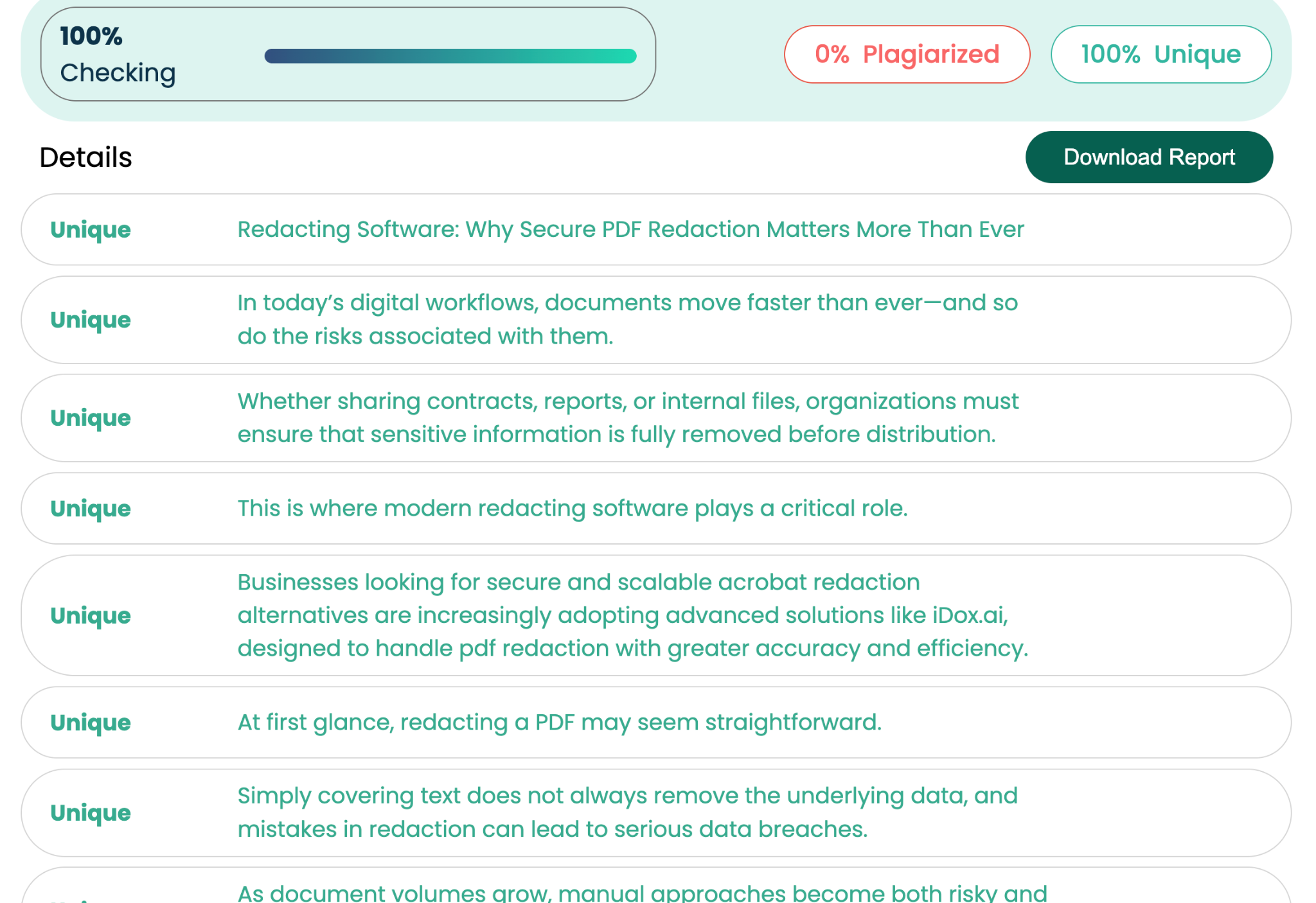
In today’s digital workflows, documents move faster than ever—and so do the risks associated with them. Whether sharing contracts, reports, or internal files, organizations must ensure that sensitive information is fully removed before distribution. This is where modern redacting software plays a critical role. Businesses looking for secure and scalable acrobat redaction alternatives are increasingly adopting advanced solutions like iDox.ai, designed to handle pdf redaction with greater accuracy and efficiency.
At first glance, redacting a PDF may seem straightforward. However, the reality is far more complex. Simply covering text does not always remove the underlying data, and mistakes in redaction can lead to serious data breaches. As document volumes grow, manual approaches become both risky and inefficient.
PDF Redaction: Why It’s More Than Just Hiding Text
The process of pdf redaction is often misunderstood. Many users assume that placing a black box over text is enough to secure a document, but true redaction goes much deeper.
Proper redaction means permanently removing sensitive data from the file, ensuring it cannot be recovered through metadata, copy-paste actions, or file inspection. This includes not only visible text but also hidden layers, annotations, and embedded information.
The stakes are high. In industries such as legal, finance, and healthcare, improperly redacted documents can expose personal data, confidential agreements, or protected records. These risks make accurate pdf redaction essential, not optional.
As organizations handle increasing volumes of documents, the need for reliable and scalable solutions becomes even more critical.
PDF Redaction Tools: From Manual Effort to Intelligent Automation
Traditional pdf redaction tools rely heavily on manual input, requiring users to identify and redact sensitive information line by line. While this approach may work for small tasks, it quickly becomes inefficient when dealing with large datasets.
Modern tools, however, are transforming the process.
Advanced pdf redaction tools use artificial intelligence to automatically detect sensitive data such as personal identifiers, financial information, and confidential business details. This allows organizations to process documents faster while maintaining a higher level of accuracy.
Another important advantage is consistency. Manual processes often vary depending on the user, but automated systems apply the same rules across all documents. This ensures that compliance standards are met uniformly, reducing the risk of oversight.
As businesses scale, these capabilities become essential for maintaining both efficiency and security.
Adobe PDF Redaction Tool: Where Traditional Solutions Fall Short
For many years, the adobe pdf redaction tool has been widely used for document editing and redaction. While it provides basic functionality, it was not designed for the complexity and scale of modern data environments.
One of the main limitations is its reliance on manual workflows. Users must identify sensitive information themselves, which increases the likelihood of errors—especially in large or complex documents.
There are also challenges related to scalability. Processing hundreds or thousands of documents using traditional tools can be time-consuming and resource-intensive, making it difficult for organizations to keep up with demand.
Additionally, traditional tools may not always guarantee complete data removal. In some cases, improperly redacted information can still be accessed, creating hidden vulnerabilities.
These limitations have led many organizations to seek more advanced alternatives that offer automation, intelligence, and stronger security guarantees.
How Modern Redacting Software Improves Security and Efficiency
Modern redacting software is designed to address the shortcomings of traditional tools by combining automation with advanced data detection capabilities.
Instead of relying solely on human input, these systems can analyze documents, identify sensitive content, and apply redaction automatically. This significantly reduces the time required to process documents while improving overall accuracy.
Another key benefit is the ability to handle complex data structures. Whether dealing with scanned files, tables, or multi-layered PDFs, intelligent systems can recognize patterns and ensure that all relevant information is properly removed.
Security is also enhanced through permanent data deletion. Unlike simple visual masking, advanced solutions ensure that sensitive information is completely erased from the document, eliminating the risk of recovery.
By integrating these capabilities into their workflows, organizations can achieve a higher level of protection without sacrificing efficiency.
The Growing Importance of Scalable Redaction Solutions
As businesses continue to generate and share more data, the need for scalable redaction solutions becomes increasingly important. Manual processes cannot keep pace with the volume and complexity of modern document workflows.
Scalable redacting software allows organizations to process large datasets quickly while maintaining consistent standards. This is particularly valuable in scenarios such as legal discovery, regulatory compliance, and public information requests.
At the same time, scalability supports better resource allocation. Teams can focus on higher-value tasks instead of spending hours on repetitive manual work. This shift not only improves productivity but also enhances overall operational efficiency.
Conclusion: Moving Beyond Traditional Redaction Methods
The way organizations approach document security is evolving. What once relied on manual effort is now being transformed by intelligent systems capable of handling complex data environments.
While tools like the adobe pdf redaction tool still provide basic functionality, they are no longer sufficient for businesses operating at scale. Modern pdf redaction tools and advanced approaches to pdf redaction offer the accuracy, speed, and reliability required in today’s landscape.
By adopting next-generation redacting software, organizations can protect sensitive information more effectively, reduce risk, and ensure that every document they share is truly secure.