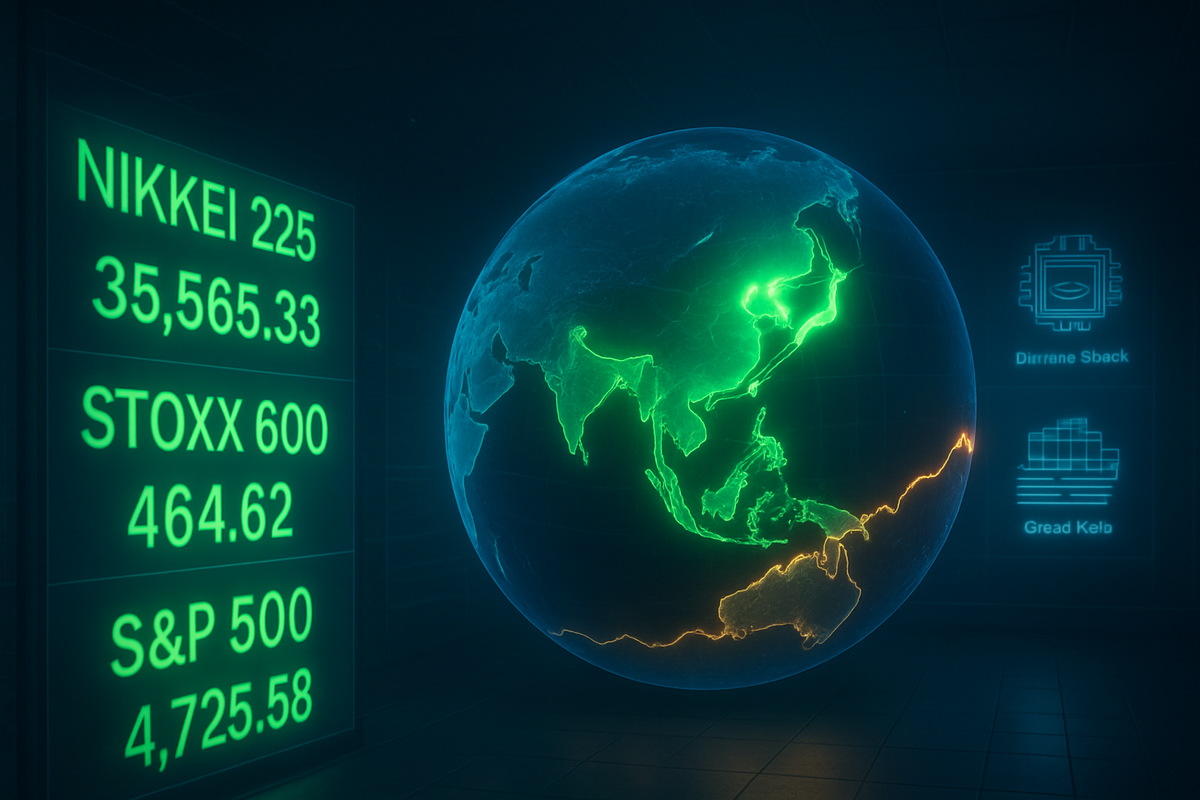
As 2025 draws to a close, the financial world is witnessing a historic shift in the global equity landscape. For the first time in over a decade, the relentless dominance of Wall Street has faltered, with the S&P 500 (NYSEARCA:SPY) lagging behind major international benchmarks. While the U.S. market posted a respectable gain of approximately 15.35% year-to-date as of December 19, 2025, it has been soundly outperformed by the Nikkei 225 (+30.06%), the MSCI Emerging Markets Index (+26.70%), and the STOXX Europe 600 (+16.54%).
This divergence marks the potential end of a 16-year cycle of U.S. exceptionalism. Investors who spent the last decade overweighting domestic tech giants are now grappling with "valuation fatigue" and the emergence of a "Great Rotation" into international value and emerging growth markets. The immediate implications are clear: the global diversification strategy, long dismissed by many retail investors, has returned with a vengeance, reshaping portfolios ahead of 2026.
The Cracks in the AI Monolith: A Timeline of 2025
The year began with a seismic shock that redefined the artificial intelligence narrative. On January 27, 2025, the "DeepSeek Shock" sent ripples through Silicon Valley when the Chinese startup released its R1 model. The revelation that a high-performing reasoning model could be trained for a mere $5.6 million—a fraction of the billions spent by U.S. hyperscalers—triggered a massive sell-off. Nvidia (NASDAQ: NVDA) suffered the largest single-day market cap loss in history, shedding $589 billion as investors questioned the long-term "moat" of expensive U.S. AI infrastructure.
The volatility intensified on April 3, 2025, a day now known as "Tariff Tuesday." The Trump administration’s introduction of sweeping reciprocal tariffs, including a 10% baseline and targeted levies of up to 46% on nations like Vietnam and Taiwan, hit U.S. mega-caps where it hurt most: their supply chains. Apple (NASDAQ: AAPL) saw over $300 billion in value evaporate in 24 hours as markets braced for double-digit price hikes on hardware. Meanwhile, the Federal Reserve remained a source of frustration for much of the year, maintaining a "higher-for-longer" stance to combat sticky inflation before finally delivering its first 25-basis-point cut on September 18, 2025. By the time the Fed pivoted, international markets had already capitalized on more stable policy environments and attractive entry points.
Winners and Losers: The Corporate Divide
The 2025 market was a tale of two halves, favoring "Old Economy" value over high-flying growth. European financial institutions emerged as unexpected stars. HSBC (NYSE: HSBC) and Deutsche Bank (NYSE: DB) leveraged high-interest margins and robust capital return programs to post gains of 30% and 91% respectively. In Japan, the corporate governance reforms of previous years finally bore fruit, with Mitsubishi Heavy Industries (TYO:7011) surging on the back of record defense and energy orders. Toyota Motor (NYSE: TM) also reported record operating income, though its stock faced headwinds late in the year due to tariff concerns.
Conversely, the "Magnificent Seven" experienced a rare year of collective struggle. Beyond the AI-related volatility of Nvidia, Tesla (NASDAQ: TSLA) entered correction territory early in the year, finishing Q1 with a 34.7% loss due to production pauses and regulatory hurdles. Consumer-facing giants were not spared either; Nike (NYSE: NKE) plunged nearly 10% following the tariff announcements, and discount retailers like Five Below (NASDAQ: FIVE) saw their business models upended by the rising cost of imports. Even Palantir (NYSE: PLTR), which bucked the trend with a 121% gain due to its software-first AI approach, could not mask the broader underperformance of the U.S. tech sector relative to international peers.
The Great Rotation: Wider Significance and Historical Context
The underperformance of 2025 is not an isolated event but rather a correction of a historic imbalance. The U.S. market entered the year at its highest valuation premium relative to the rest of the world since 1988, with the S&P 500 trading at roughly 23x forward earnings compared to just 13x for emerging markets. This "valuation gap" eventually became too wide to ignore, triggering a rotation that mirrors the 2000s "Lost Decade." During that period, following the Dot-com crash, the S&P 500 delivered negative annual returns while international and emerging markets thrived.
Furthermore, the softening of the U.S. dollar in the latter half of 2025 provided a significant tailwind for foreign assets. For U.S.-based investors, the currency conversion alone added nearly 10% to the total returns of international holdings. This shift suggests a structural change in the global macro environment, where the fiscal concerns of a downgraded U.S. debt and rising Treasury yields (which spiked above 5% in Q2) have diminished the "safe haven" allure of domestic equities.
Looking Ahead to 2026: A New Market Order
As we move into 2026, analysts from firms like Goldman Sachs and Morgan Stanley anticipate the "Great Rotation" will intensify. The consensus points toward a broadening of market participation, where small-cap stocks and international value plays continue to lead. A key factor to watch will be the U.S. dollar trajectory; many forecasts suggest the DXY index could drift into the low 90s by late 2026, further boosting the attractiveness of emerging market equities in regions like Southeast Asia and India.
Strategic pivots will be required for the coming year. Investors may need to move away from the "index-and-chill" approach that favored U.S. large-caps for so long. The emerging opportunities lie in sectors that benefit from global infrastructure spending and the "efficiency era" of AI software, rather than just the hardware providers. However, challenges remain, particularly the ongoing threat of trade wars and the potential for tariff-driven inflation to force the Fed back into a hawkish stance.
Closing Thoughts: The Diversification Mandate
The primary takeaway from 2025 is the definitive return of the "valuation matters" mantra. The year proved that no market—not even one led by the most powerful tech companies in history—is immune to the laws of gravity when valuations become overstretched and macro headwinds mount. The outperformance of Japan and Europe has validated the importance of geographic diversification, a lesson many investors had forgotten during the long years of U.S. dominance.
Moving forward, the market is likely to remain fragmented. While the U.S. is far from "dead," the era of its undisputed leadership has clearly transitioned into a more balanced, multi-polar equity environment. Investors should keep a close eye on the U.S. dollar index and international earnings growth in the coming months. If the current trends hold, 2026 may not just be another year of international outperformance, but the beginning of a multi-year cycle that favors the patient, value-oriented global investor.
This content is intended for informational purposes only and is not financial advice.