
Don’t you think that a formal letter creates the first impression of the person writing it. The words you choose & the way you put them together can show how seriously you take the conversation. It matters most when you are contacting an employer, a university, official authorities, or a company.
A proper formal letter format gives your thoughts an organised flow and helps the recipient read your message with ease. Get the correct structure, practical examples and common errors that can weaken an otherwise well-written letter.
What is the Correct Structure of a Formal Letter?
A formal letter usually follows a fixed format. Each part has its own place that makes the letter easier to read without unnecessary effort. Good formal letter writing also means keeping the tone professional & the information correct, with concise paragraphs. Here is the standard formal letter format; check it out:
Sender’s address: Add your full postal address at the top of the letter. Your name does not need to appear in this section.
Date: Add the date below the sender’s address. In UK English, a suitable style is 15 September 2026.
Recipient’s address: Provide recipient details [name, designation, organisation and correct postal address].
Salutation: You can use “Dear Mr Smith”, “Dear Ms Jones” or “Dear Sir/Madam”, as per the information.
Subject line: Very important section to give a brief indication of the purpose of your letter.
Opening paragraph: Just write why you are writing the letter. Don’t go with a lengthy introduction.
Main body: Provide facts, requests, timeline or relevant details in logical paragraphs.
Closing paragraph: Whatever the action or response you expect from the recipient, mention it.
Complimentary close: If you know the recipient’s name, use “Yours sincerely”. Use “Yours faithfully” if you have used “Dear Sir/Madam”.
Signature and name: Sign the letter and type your full name underneath.
This letter writing format creates a professional visual hierarchy. It also prevents important information from becoming lost inside long paragraphs.
Formal Letter Sample for Practical Reference
A complete example makes the format easier to follow. The following formal letter sample shows how a professional request may be presented.
24 Green Park Extension
New Delhi – 110016
2 September 2026
The HR Manager
ABC Solutions Pvt. Ltd.
42 Nehru Place
New Delhi – 110019
Dear Sir/Madam,
Subject: Request for Employment Experience Certificate
I am writing to request my experience certificate. From June 2023 to August 2026, I worked at ABC Solutions Pvt. Ltd. as a Marketing Executive in the Digital Marketing Department.
I need the document for my records & future job applications. So, please mention my designation & employment period on the certificate.
Let me know for any kind of assistance from my side. If you could issue the certificate as early as possible, I would appreciate it.
Yours faithfully,
Aarav Sharma
This formal letter format works well when you are writing an official request. The subject makes the purpose clear. Besides, the main text gives the details the recipient needs.
Don’t copy the provided formal letter sample. It is just for structural reference. Details, tone, wording, & closing statements need to match your purpose for the letter.
Formal Letters and Business Letters: What Should You Remember?
Professional correspondence can take several forms. Universities, government departments, employers, service providers, or other official recipients are some places where a formal letter may be sent. A standard business letter format uses the same basic structures as most formal letters.
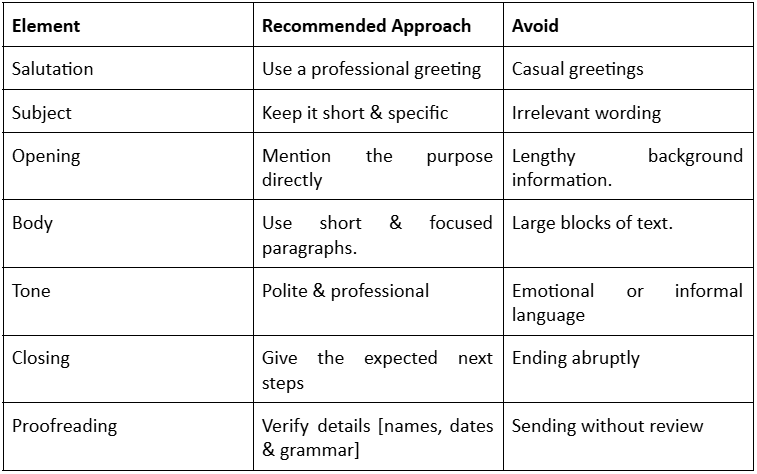
If you think that using complicated vocabulary implies effective business communication. It might not be true. Precise wording, professional courtesy, tone, & logical sequence of details are the factors that govern it.
It goes the same with formal letter writing. Short sentences often work better than elaborate statements. Readers should not need to reread a paragraph to identify your request.
For professionals, familiarity with the business letter format can also support workplace correspondence. Complaint letters, enquiry letters, recommendation requests, official notices and client correspondence may all require a formal approach.
Strong business communication also reflects attention to detail. Things that can reduce the professional quality of your message are incorrect designation, spelling errors, wrong facts, or inappropriate greetings.
Common Formal Letter Mistakes and How to Avoid Them
Even a well-intended letter can lose its professional effect because of small errors. The right letter writing format matters. But the words you use & its presentation also matter.
Here are the common mistakes that you should avoid while writing a formal letter:
Informal greeting: If you are using “Hi there” or “Hey” in official letters, skip them.
Long paragraphs: Break the content into shorter sections. Keep each one centred on a single point.
Complex words: Go with words that are clearer & easier to understand.
Purpose not clear: You need to tell the reader why you are writing the formal letter near the start.
Contractions: In formal letters, use “I am” and “I would” instead of “I’m” and “I’d”.
Unnecessary details: Provide those details that the recipient may need to respond or take action.
Closing is not proper: Match “Yours sincerely” or “Yours faithfully” with the salutation used at the start.
Used different Spelling styles: Keep spellings such as “organisation”, “programme” and “recognise” throughout the letter if you are writing in UK English.
Avoid proofreading: Check names, addresses, dates, punctuation and grammar before sending the letter.
Inconsistent layout: Keep layout uniform throughout the letter [spacing, alignment and paragraph presentation].
Give the letter one more read after finishing it to spot the missed errors. Try this too: Read the letter aloud. It helps you to notice sentences that sound awkward or ideas that have been repeated.
Final Say
A formal letter, when well-written, can do more than deliver information. It will show your organised, concerned, respectful, & attentive professional behaviour. So, use the correct structure & keep the wording of the formal letter suited to the person receiving it.
It is necessary to check the details once more before sending the letter to avoid any misunderstandings. With practice, writing formal letters becomes a more familiar task.