New York, New York--(Newsfile Corp. - September 1, 2026) - Uther Peptide today announced an expansion of its third-party testing and batch transparency program, introducing a more structured system for connecting individual research-product batches with independent analytical reports. The expansion focuses on batch-specific documentation, clearer identification of testing scope, direct verification of laboratory reports, and improved traceability between a research product, its batch number, and the analytical data associated with that batch.
The expanded program is designed to make analytical documentation easier for research customers to review and verify.
Rather than relying primarily on general product specifications, Uther Peptide is placing greater emphasis on analytical records associated with identifiable production batches.
Under the expanded framework, selected product batches may be submitted to independent analytical laboratories for one or more types of testing. Depending on the product and the scope commissioned for a particular batch, testing may include identity and purity analysis, measured quantity, heavy-metals screening, endotoxin analysis, sterility testing, or other laboratory assessments.
Each test is treated as a separate analytical category, with its own report and defined scope.
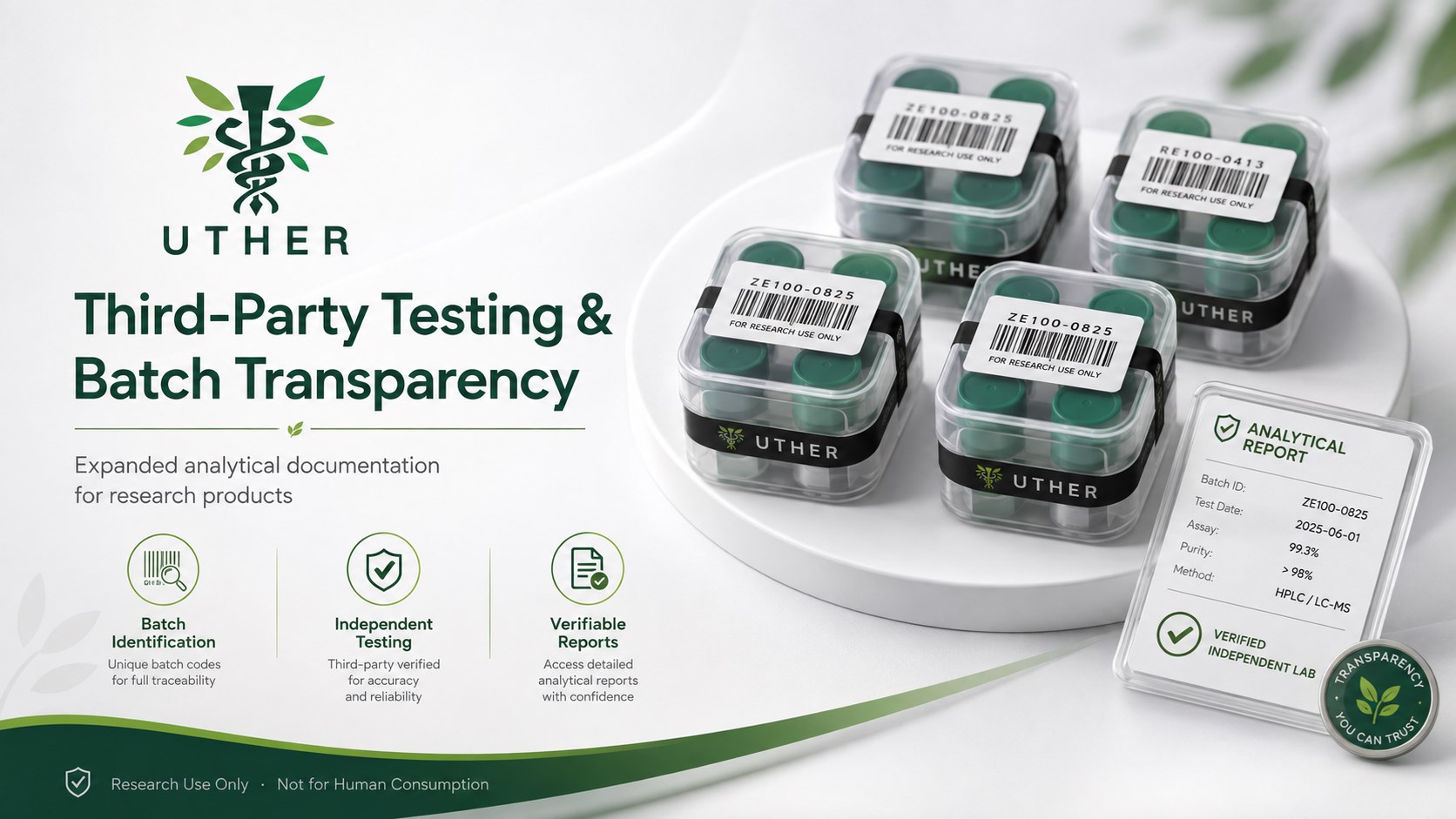
Uther Third-Party Testing and Batch Transparency
To view an enhanced version of this graphic, please visit:
https://images.newsfilecorp.com/files/11580/312510_83c9d563448a5b65_001full.jpg
Expanding Batch-Specific Documentation
A central component of the expansion is the connection between individual product batches and their corresponding laboratory documentation.
Uther Peptide is organizing analytical records around identifiable batch codes so that available third-party test reports can be matched more clearly to the specific production lot that was submitted for analysis.
This approach is intended to reduce uncertainty about whether a test report relates to the actual batch being reviewed.
When batch-specific analytical documentation is available, researchers can compare identifying information on the product with the information contained in the corresponding laboratory report.
The company is also expanding the organization of historical batch records so that analytical documentation from different production lots can remain distinguishable from one another.
This means that a report generated for one batch is not automatically presented as representative of every past or future production run of the same research compound.
Increasing Independent Laboratory Verification
The expansion also places greater emphasis on third-party laboratory verification.
Uther Peptide works with independent analytical laboratories, including Janoshik Analytical, for testing of selected research-product batches.
Where the testing laboratory provides an online verification system, Uther Peptide intends to make the relevant verification information easier to associate with the corresponding batch documentation.
This allows a researcher reviewing a report to check the laboratory record directly through the testing provider when such verification is available.
The objective is to provide an additional level of transparency beyond screenshots, copied certificates, or summarized analytical results.
By connecting a batch identifier to independently generated documentation and, where available, a laboratory-hosted verification record, Uther Peptide aims to create a clearer chain between the physical research material and the analytical information associated with it.
Clarifying What Each Test Measures
Another part of the expanded program is clearer disclosure of what individual analytical tests do and do not establish.
Uther Peptide is separating different categories of laboratory testing rather than presenting them as interchangeable indicators.
Purity analysis evaluates the proportion of the target compound detected in the submitted sample.
Quantity analysis measures the amount of material detected in that sample.
Heavy-metals testing evaluates specified elemental contaminants according to the laboratory method used.
Endotoxin testing measures bacterial endotoxin levels within the scope of the selected analytical method.
Sterility testing, when commissioned, is a separate microbiological assessment and is not considered equivalent to endotoxin testing.
The distinction is important because a favorable result in one analytical category does not automatically provide information about a different characteristic that was not tested.
As part of the expanded transparency program, Uther Peptide intends to present available reports according to their actual analytical scope so that research customers can determine precisely which parameters were evaluated for a particular batch.
Strengthening the Link Between Batch, Report and Verification Record
The updated process is built around three primary elements:
- Batch identification. Research products carry identifiable batch information that can be used to distinguish one production lot from another.
- Independent analytical documentation. Selected batches are submitted to external laboratories for specified analytical testing.
- Report verification. When an independent laboratory provides direct online verification, the corresponding laboratory record can be reviewed against the report associated with the batch.
Together, these elements are intended to make analytical documentation easier to trace and independently review.
The company says the expanded system will also help prevent a common problem in research-material sourcing: analytical certificates becoming separated from the particular production lot they originally represented.
By maintaining stronger relationships between batch identifiers and individual reports, Uther Peptide aims to preserve the context of analytical data over time.
Expanding Transparency Without Overstating Laboratory Results
Uther Peptide is also emphasizing that independent testing should be interpreted within clearly defined limits.
A third-party laboratory report describes the submitted sample and the specific analyses performed on that sample.
It does not automatically establish the characteristics of every unit within a batch, a different production lot, a future production run, or any parameter that was not tested.
For that reason, the expanded program focuses on presenting analytical documentation in context rather than using an individual laboratory result as a generalized claim about all products.
Researchers reviewing Uther Peptide documentation should be able to identify:
- which product and batch were tested;
- which independent laboratory conducted the analysis;
- when the analysis was performed;
- which analytical parameters were included;
- what results were reported; and
- whether an independent verification record is available.
This structure is intended to give research customers a clearer basis for evaluating the documentation associated with an individual batch.
Continuing Expansion of the Transparency Program
Uther Peptide plans to continue expanding the number of research-product batches supported by organized third-party analytical documentation.
The company will also continue developing how batch information, analytical reports, and available independent verification records are presented to research customers.
The broader objective is to create a research-material documentation system in which batch identity and analytical information remain clearly connected throughout the product-information process.
As the program expands, Uther Peptide says its priorities will remain focused on independent testing, batch-level traceability, clear disclosure of analytical scope, and easier verification of available laboratory records.
Uther Peptide supplies peptide and related materials intended exclusively for research, laboratory, and analytical applications. Its research products are not intended for human consumption or for the diagnosis, treatment, cure, or prevention of disease.
About Uther Peptide
Uther Peptide is a supplier of peptide and related research materials serving research and laboratory customers. The company focuses on batch identification, independent analytical documentation, product traceability, and transparent access to research-product information.
Research Use Only — Not for Human Consumption
Person's Name (First and Last): Peter Magic
Contact Phone Number: +420 704 814 093
Contact Person's Email:peter@janoshik.com
Address: Prazska 600, 252 10 Mnisek Pod Brdy, Czech Republic
To view the source version of this press release, please visit https://www.newsfilecorp.com/release/312510