Security leaders are under constant pressure to prove that their organisation is not just compliant, but also resilient. Tools are used, controls are documented and assessments are scheduled, but breaches still happen. One of the most common things that leaders get confused about is deciding which type of security testing actually provides meaningful insight.
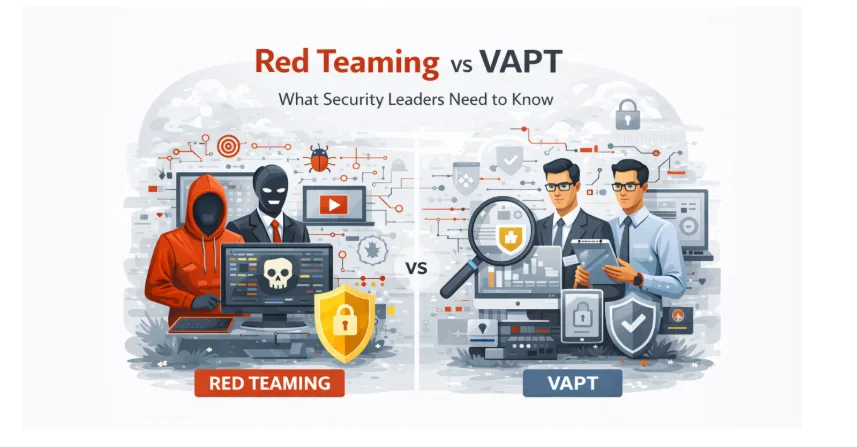
Two approaches dominate this conversation: VAPT (Vulnerability Assessment and Penetration Testing) and red teaming. Both try to find weaknesses, but they answer very different questions. When you treat them as the same, it leads to misplaced confidence and missed risk.
Understanding the difference between the two is not a technical task. It’s a strategic one. This blog gives security leaders a practical comparison to help security leaders decide when, how and why to use each approach.
What VAPT is Designed to Achieve
VAPT is often the first structured security testing activity organisations adopt.
The main goal of VAPT is to find known vulnerabilities and validate if they can be exploited. It provides a broad view of systems and applications and is often linked to compliance needs.
VAPT is designed to:
- Identify known weaknesses in assets
- Validate exploitability of weaknesses
- Provide risk ratings and remediation guidance
- Support regulatory and audit requirements
In the red teaming vs VAPT discussion, VAPT answers the question: What weaknesses exist in our environment right now?
What Red Teaming is Designed to Achieve
Red teaming has a very different purpose.
Red teaming doesn’t just list vulnerabilities. It also simulates real attackers attempting to reach specific goals, often without letting defenders know. The focus is on how weaknesses can be chained together to bypass controls and reach high-impact outcomes.
Red teaming is designed to:
- Simulate realistic attacker behaviour
- Test detection and response capabilities
- Evaluate people, process, and technology together
- Measure how long attackers remain undetected
- Reveal business-impacting attack paths
In the red teaming vs VAPT comparison, red teaming answers: Could an attacker really succeed? And would we notice?
Key Differences Between Red Teaming vs VAPT
Although both methods involve offensive testing, their execution and results differ a great deal.
Key differences include:
- Scope: VAPT aims for wide coverage; red teaming focuses on depth
- Methodology: VAPT follows predefined checklists; red teaming adapts dynamically
- Visibility: VAPT expects discovery, while red teaming assumes stealth
- Outcome: VAPT produces vulnerability lists; red teaming produces attack narratives
- Audience: VAPT supports remediation teams; red teaming informs leadership and SOC maturity
Understanding these differences helps leaders avoid using the wrong tool for the wrong objective.
Why VAPT Alone Often Creates False Confidence
VAPT is useful, but leaders need to understand its limits.
Common VAPT blind spots include:
- Focus on individual vulnerabilities rather than attack chains
- Limited testing of identity abuse and lateral movement
- Not much information about how well detection and response work
- Assumption that fixing findings equals security
In many breaches, attackers exploit combinations of low-severity issues that VAPT reports individually but never connects. This is a critical insight in the red teaming vs VAPT debate.
Why Red Teaming Alone is Not Sufficient Either
Red teaming is strong, but it cannot replace foundational testing.
Red teaming is not meant to:
- Find every weakness
- Provide exhaustive coverage of all systems
- Replace routine hygiene testing
- Satisfy baseline compliance requirements
Without VAPT, red teaming might miss basic weaknesses that should have been addressed earlier. Mature programs see red teaming as a higher-order validation layer, not a first step.
How Attackers Exploit the Gap Between Red Teaming and VAPT
Real attackers don’t follow assessment boundaries.
In real-life situations, attackers often:
- Use known vulnerabilities (VAPT territory) for initial access
- Abuse identity and misconfigurations (often missed by VAPT)
- Move laterally using legitimate tools
- Use stealthy methods to avoid detection
Companies that understand the difference between red teaming and VAPT know that attackers exploit the gaps between the two, not just one or the other alone.
When VAPT is the Right Choice
VAPT works best when businesses need to:
- Set up basic security hygiene
- Meet regulatory or contractual requirements
- Quickly identify known weaknesses
- Validate remediation effectiveness
- Test new systems before production
VAPT remains important for early-stage or compliance-driven programs.
When Red Teaming is the Right Choice
Red teaming delivers the most value when organisations want to:
- Test detection and response capabilities
- Understand real-world attacker paths
- Evaluate SOC and incident response maturity
- Assess business-critical asset protection
- Measure resilience rather than compliance
In leadership terms, red teaming answers “Are we actually ready?”
How Mature Organisations Combine Red Teaming vs VAPT
Leading organisations do not choose between the two – they sequence them.
A mature approach typically looks like:
- VAPT to establish baseline visibility and hygiene
- Remediation of systemic weaknesses
- Red teaming to test real-world resilience
- Feedback loops into SOC, detection, and response
- Continuous improvement over time
This layered strategy ensures findings translate into measurable improvement.
Metrics That Matter in Red Teaming vs VAPT
Security leaders should evaluate outcomes, not activity.
VAPT metrics often focus on:
- Number of vulnerabilities
- Severity distribution
- Remediation timelines
Red teaming metrics focus on:
- Time to detect (MTTD)
- Time to respond (MTTR)
- Detection coverage
- Business impact achieved by attackers
Understanding these metrics clarifies why red teaming vs VAPT serves different leadership needs.
Common Mistakes Security Leaders Make
Several recurring mistakes weaken testing outcomes.
These include:
- Treating red teaming as a compliance exercise
- Expecting VAPT to test SOC effectiveness
- Running assessments without clear objectives
- Failing to retest after remediation
- Not translating findings into process improvement
Avoiding these mistakes significantly increases return on testing investment.
Next Steps
Before comparing red teaming and VAPT, security leaders should first figure out what questions they need answered. It could be about hygiene, resilience or both. VAPT confirms known weaknesses in many organisations, while red teaming finds new risks that tools and audits might miss.
CyberNX is a CERT-In empanelled cybersecurity firm that supports organisations across both VAPT and red team engagements. They offer highly efficient red teaming services with cutting-edge tools and intelligence-led testing. They also have a highly skilled team and use advanced tools for vulnerability assessment and penetration testing services.
Conclusion
The debate about red teaming vs. VAPT isn’t about which approach is better. It is about understanding what each method is designed reveal and where it doesn’t work.
VAPT gives you important information about known weaknesses and supports compliance. Red teaming validates if defences actually work in real attack conditions. Security leaders who understand this difference are far better positioned to build resilient security programs.
In a threat landscape defined by persistence and adaptability, combining VAPT and red teaming strategically is no longer optional – it is essential.