As of early February 2026, the global financial landscape has undergone a silent but profound architectural shift. Prediction markets, once dismissed as "gambling for nerds," have matured into the essential "Oracle layer" of the financial system. Today, institutional liquidity and algorithmic trading bots no longer wait for official press releases or the slow-moving updates of traditional futures data; instead, they treat the real-time order books of Kalshi and Polymarket as the primary source of truth for macroeconomic events.
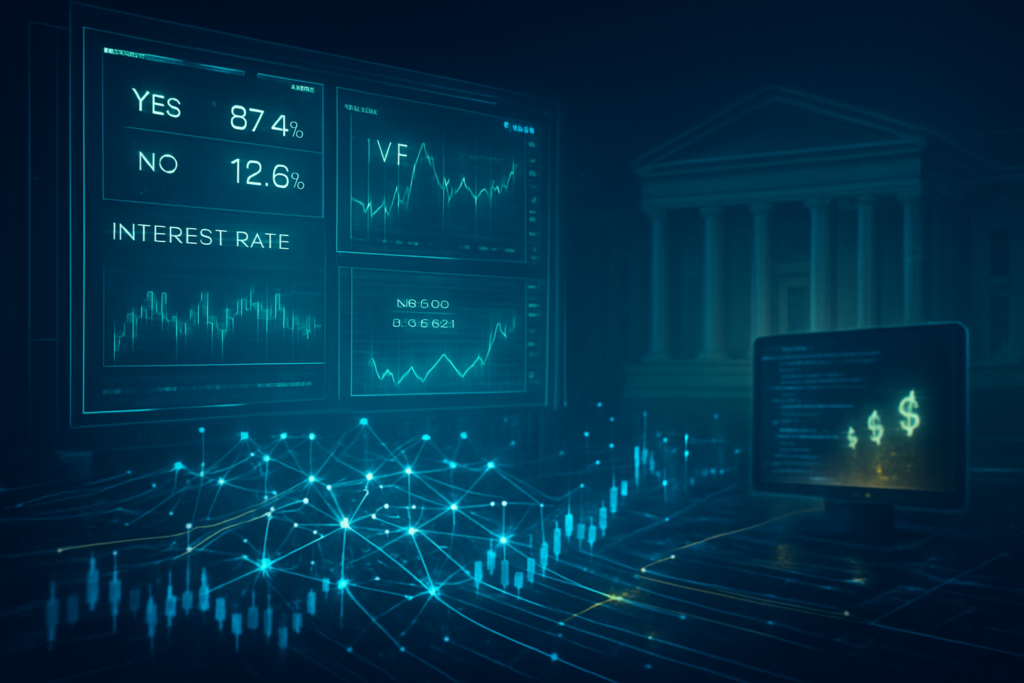
Currently, all eyes are on the upcoming March 17-18 Federal Open Market Committee (FOMC) meeting. While traditional analysts at firms like JPMorgan Chase (NYSE: JPM) have publicly forecasted a "Hold" on interest rates through the second quarter, prediction markets are signaling a sharp divergence. As of February 2, 2026, the aggregate probability of a 25-basis-point rate cut has climbed to 60%. This shift isn't just driven by retail sentiment; it is the result of billions of dollars in volume being processed by automated systems that respond to economic data in milliseconds—far faster than traditional financial benchmarks.
The Market: What's Being Predicted
The focus of the trading world is currently centered on the "Fed Interest Rate" contracts for the March 2026 meeting. These contracts are trading across two dominant platforms: Kalshi, the regulated leader in the U.S. market, and Polymarket, which has solidified its global footprint following its strategic acquisition of the licensed exchange QCX in late 2025. Between these two giants, notional volume for macro-event contracts exceeded $44 billion in 2025, a growth trajectory that has made them more liquid than many mid-cap equity markets.
On Kalshi, the "March Rate Cut" contract has seen a significant surge in trading volume over the last 48 hours, following a "hotter" than expected labor report. While traditional futures derived from the CME Group (NASDAQ: CME) FedWatch tool are pricing the probability of a cut at a cautious 48%, the event-contract markets are significantly more aggressive. This 12% spread has created a massive arbitrage opportunity that high-frequency trading (HFT) firms are aggressively exploiting.
The resolution criteria for these markets are remarkably simple: if the Federal Reserve's target range is lower by the close of the March meeting, the "Yes" contracts pay out at $1.00. This binary clarity is what makes these markets so attractive to algorithmic systems compared to the complex calculations required to derive probabilities from 30-day Fed Funds Futures. With millisecond execution times and deep order books, the price of these contracts has effectively become a real-time interest rate ticker.
Why Traders Are Betting
The dominance of prediction markets in 2026 is largely due to the integration of advanced AI trading agents like Polybro and Alphascope. These bots are programmed to treat price movements on prediction markets as "truth events." When a major whale position moves the probability of an FOMC outcome, these bots execute near-instantaneous corresponding trades in traditional assets like the 10-year Treasury or the S&P 500 futures. In this new paradigm, prediction markets don't just reflect the news—they become the news that drives the rest of the market.
Furthermore, the strategy of "synthetic straddles" has become common among sophisticated players. Traders might buy a "No" contract on a rate cut on Kalshi while simultaneously going long on interest-rate futures at the CME Group (NASDAQ: CME). This allows institutions to hedge against regulatory and economic risks in ways that were impossible just three years ago. The depth of these markets has attracted major players like Interactive Brokers (NASDAQ: IBKR), which has integrated event-trading directly into its professional workstations alongside stocks and options.
This surge in betting is also fueled by a growing distrust of traditional bank forecasts. After several years where "consensus" bank estimates missed the mark on inflation and employment trends, capital-weighted conviction has proven to be a more reliable indicator. In the current March 2026 cycle, traders are betting that the "wisdom of the crowd"—backed by billions of dollars—is seeing a softening in the economy that the Fed's lagging data has yet to officially capture.
Broader Context and Implications
The transition of prediction markets into essential financial infrastructure was accelerated by the "Selig Doctrine." In January 2026, the newly appointed CFTC Chairman, Michael Selig, formally withdrew several restrictive proposed rules from 2024. Selig characterized these markets as "early warning systems" for the U.S. economy, essentially granting event contracts the same legitimacy as traditional commodity futures. This regulatory pivot ended years of legal ambiguity that had kept many institutional "real money" managers on the sidelines.
Moreover, major tech platforms have fully embraced this data. Alphabet (NASDAQ: GOOGL) through Google Finance and the Bloomberg Terminal now list prediction market probabilities as standard features alongside the VIX and the yield curve. This integration means that every retail investor and professional portfolio manager is now looking at the same probabilistic data, creating a feedback loop that reinforces the market's accuracy.
The rise of event trading also represents a shift toward "Information Finance." When Robinhood Markets (NASDAQ: HOOD) completed its acquisition of MIAXdx in early 2026, it wasn't just buying an exchange; it was building a vertically integrated factory for truth. By owning the exchange, the clearinghouse, and the retail interface, firms like Robinhood have made event-trading a seamless part of the modern portfolio, alongside traditional equities and cryptocurrencies.
What to Watch Next
As we move closer to the March FOMC meeting, several key milestones will likely trigger massive volatility in the prediction markets. The most immediate is the upcoming Consumer Price Index (CPI) release. In the 2026 market environment, the "CPI prediction market" on Kalshi will often move seconds before the data is even broadcast on major news networks, as algorithmic bots parse the data feeds from government servers.
Key dates to monitor include the mid-February employment revision and the final pre-meeting "blackout period" for Fed officials. If the 60% probability of a rate cut holds or increases through these data points, expect to see significant positioning shifts in the broader bond markets. The divergence between the 60% probability in prediction markets and the 48% in traditional futures will eventually have to close, and the "Information Oracle" of prediction markets has historically been the one to lead the way.
Traders should also watch for any commentary from Federal Reserve officials regarding these markets. While the Fed officially relies on its own internal data, the sheer volume and accuracy of prediction markets in 2025 have made them impossible for policymakers to ignore. Acknowledgment of "market-based probabilities" in a Fed speech could be the final catalyst that cements these platforms as the definitive macro benchmark.
Bottom Line
The story of early 2026 is the story of prediction markets coming of age. They are no longer a sideshow; they are the primary data feed for the world's most sophisticated trading algorithms. By providing a real-time, capital-weighted consensus on macro events, platforms like Kalshi and Polymarket have solved the "latency problem" that has long plagued traditional economic forecasting.
This evolution tells us that the future of finance is probabilistic. Rather than relying on a handful of analysts at major investment banks, the market now relies on a global, 24/7 engine of price discovery that rewards accuracy and punishes bias. For the March FOMC meeting, the market is currently signaling a move that many traditionalists aren't yet ready to accept.
Ultimately, whether the Fed cuts rates in March or not, the prediction markets have already won. They have provided the liquidity, the data, and the infrastructure that allowed the financial system to price in the outcome months in advance. In the high-speed world of 2026, the question is no longer "What do the experts think?" but rather "Where is the money moving?"
This article is for informational purposes only and does not constitute financial or betting advice. Prediction market participation may be subject to legal restrictions in your jurisdiction.
PredictStreet focuses on covering the latest developments in prediction markets.
Visit the PredictStreet website at https://www.predictstreet.ai/.