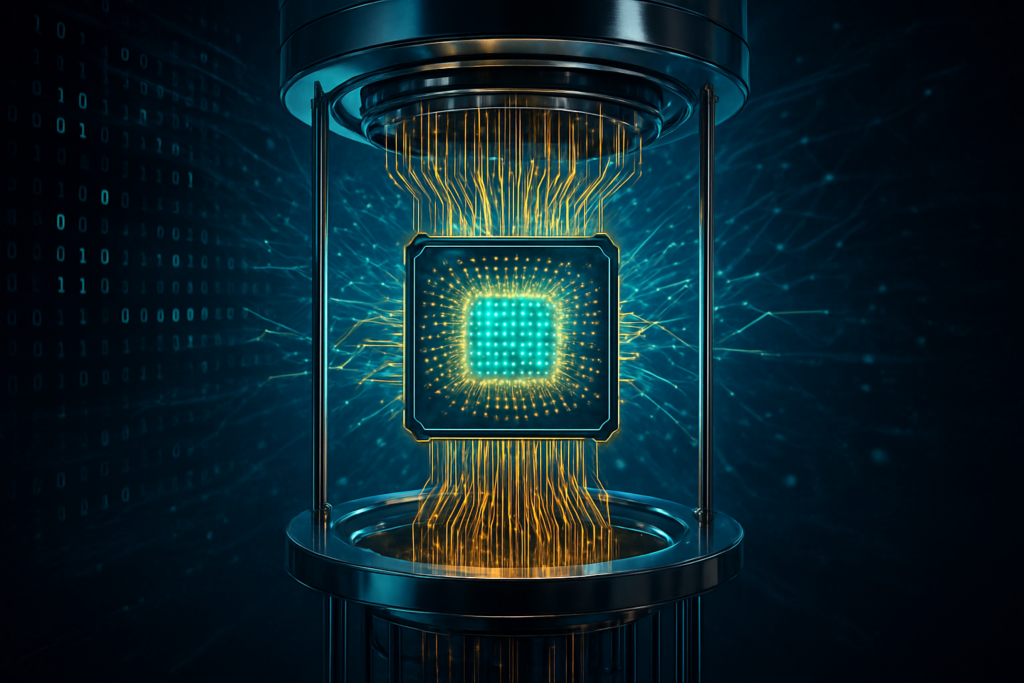
In a definitive leap for the field of quantum information science, Alphabet Inc. (NASDAQ: GOOGL) has unveiled its latest quantum processor, "Willow," a 105-qubit machine that has effectively ended the debate over quantum supremacy. By demonstrating a "verifiable quantum advantage," Google’s research team has achieved a computational feat that would take the world’s most powerful classical supercomputers trillions of years to replicate, marking 2025 as the year quantum computing transitioned from theoretical curiosity to a tangible architectural reality.
The immediate significance of the Willow chip lies not just in its qubit count, but in its ability to solve complex, real-world benchmarks in minutes—tasks that previously paralyzed the world’s fastest exascale systems. By crossing the critical "error-correction threshold," Google has provided the first experimental proof that as quantum systems scale, their error rates can actually decrease rather than explode, clearing a path toward the long-sought goal of a fault-tolerant quantum supercomputer.
Technical Superiority: 105 Qubits and the "Quantum Echo"
The technical specifications of Willow represent a generational jump over its predecessor, the 2019 Sycamore chip. Built with 105 physical qubits in a square grid, Willow features an average coherence time of 100 microseconds—a fivefold improvement over previous iterations. More importantly, the chip operates with a single-qubit gate fidelity of 99.97% and a two-qubit fidelity of 99.88%. These high fidelities allow the system to perform roughly 900,000 error-correction cycles per second, enabling the processor to "outrun" the decoherence that typically destroys quantum information.
To prove Willow’s dominance, Google researchers utilized a Random Circuit Sampling (RCS) benchmark. While the Frontier supercomputer—currently the fastest classical machine on Earth—would require an estimated 10 septillion years to complete the calculation, Willow finished the task in under five minutes. To address previous skepticism regarding "unverifiable" results, Google also debuted the "Quantum Echoes" algorithm. This method produces a deterministic signal that allows the results to be cross-verified against experimental data, effectively silencing critics who argued that quantum advantage was impossible to validate.
Industry experts have hailed the achievement as "Milestone 2 and 3" on the roadmap to a universal quantum computer. Unlike the 2019 announcement, which faced challenges from classical algorithms that "spoofed" the results, the computational gap established by Willow is so vast (24 orders of magnitude) that classical machines are mathematically incapable of catching up. The research community has specifically pointed to the chip’s ability to model complex organic molecules—revealing structural distances that traditional Nuclear Magnetic Resonance (NMR) could not detect—as a sign that the era of scientific quantum utility has arrived.
Shifting the Tech Balance: IBM, NVIDIA, and the AI Labs
The announcement of Willow has sent shockwaves through the tech sector, forcing a strategic pivot among major players. International Business Machines (NYSE: IBM), which has long championed a "utility-first" approach with its Heron and Nighthawk processors, is now racing to integrate modular "C-couplers" to keep pace with Google’s error-correction scaling. While IBM continues to dominate the enterprise quantum market through its massive Quantum Network, Google’s hardware breakthrough suggests that the "brute force" scaling of superconducting qubits may be more viable than previously thought.
NVIDIA (NASDAQ: NVDA) has positioned itself as the essential intermediary in this new era. As quantum processors like Willow require immense classical power for real-time error decoding, NVIDIA’s CUDA-Q platform has become the industry standard for hybrid workflows. Meanwhile, Microsoft (NASDAQ: MSFT) continues to play the long game with its "topological" Majorana qubits, which aim for even higher stability than Google’s transmon qubits. However, Willow’s success has forced Microsoft to lean more heavily into its Azure Quantum Elements, using AI to bridge the gap until its own hardware reaches a comparable scale.
For AI labs like OpenAI and Anthropic, the arrival of Willow marks the beginning of the "Quantum Machine Learning" (QML) era. These organizations are increasingly looking to quantum systems to solve the massive optimization problems inherent in training trillion-parameter models. By using quantum processors to generate high-fidelity synthetic data for "distillation," AI companies hope to bypass the "data wall" that currently limits the reasoning capabilities of Large Language Models.
Wider Significance: Parallel Universes and the End of RSA?
The broader significance of Willow extends beyond mere benchmarks into the realm of foundational physics and national security. Hartmut Neven, head of Google’s Quantum AI, sparked intense debate by suggesting that Willow’s performance provides evidence for the "Many-Worlds Interpretation" of quantum mechanics, arguing that such massive computations can only occur if the system is leveraging parallel branches of reality. While some physicists view this as philosophical overreach, the raw power of the chip has undeniably reignited the conversation around the nature of information.
On a more practical and concerning level, the arrival of Willow has accelerated the global transition to Post-Quantum Cryptography (PQC). While experts estimate that a machine capable of breaking RSA-2048 encryption is still a decade away—requiring millions of physical qubits—the rate of progress demonstrated by Willow has moved up many "Harvest Now, Decrypt Later" timelines. Financial institutions and government agencies are now under immense pressure to adopt NIST-standardized quantum-safe layers to protect long-lived sensitive data from future decryption.
This milestone also echoes previous AI milestones and breakthroughs, such as the emergence of GPT-4 or AlphaGo. It represents a "phase change" where a technology moves from "theoretically possible" to "experimentally inevitable." Much like the early days of the internet, the primary concern is no longer if the technology will work, but who will control the underlying infrastructure of the world’s most powerful computing resource.
The Road Ahead: From 105 to 1 Million Qubits
Looking toward the near-term future, Google’s roadmap targets "Milestone 4": the demonstration of a full logical qubit system where multiple error-corrected qubits work in tandem. Predictors suggest that by 2027, "Willow Plus" will emerge, featuring refined real-time decoding and potentially doubling the qubit count once again. The ultimate goal remains a "Quantum Supercomputer" with 1 million physical qubits, which Google expects to achieve by the early 2030s.
The most immediate applications on the horizon are in materials science and drug discovery. Researchers are already planning to use Willow-class processors to simulate metal-organic frameworks for more efficient carbon capture and to design new catalysts for nitrogen fixation (fertilizer production). In the pharmaceutical sector, the ability to accurately calculate protein-ligand binding affinities for "undruggable" targets—like the KRAS protein involved in many cancers—could shave years off the drug development cycle.
However, significant challenges remain. The cooling requirements for these chips are immense, and the "wiring bottleneck"—the difficulty of connecting thousands of qubits to external electronics without introducing heat—remains a formidable engineering hurdle. Experts predict that the next two years will be defined by "Hybrid Computing," where GPUs handle the bulk of the logic while QPUs (Quantum Processing Units) are called upon to solve specific, highly complex sub-problems.
A New Epoch in Computing History
Google’s Willow chip is more than just a faster processor; it is a sentinel of a new epoch in human history. By proving that verifiable quantum advantage is achievable and that error correction is scalable, Google has effectively moved the goalposts for the entire computing industry. The achievement stands alongside the invention of the transistor and the birth of the internet as a foundational moment that will redefine what is "computable."
The key takeaway for 2026 is that the "Quantum Winter" is officially over. We are now in a "Quantum Spring," where the focus shifts from proving the technology works to figuring out what to do with its near-infinite potential. In the coming months, watch for announcements regarding the first commercial "quantum-ready" chemical patents and the rapid deployment of PQC standards across the global banking network.
Ultimately, the impact of Willow will be measured not in qubits, but in the breakthroughs it enables in medicine, energy, and our understanding of the universe. As we move closer to a million-qubit system, the line between classical and quantum will continue to blur, ushering in a future where the impossible becomes the routine.
This content is intended for informational purposes only and represents analysis of current AI developments.
TokenRing AI delivers enterprise-grade solutions for multi-agent AI workflow orchestration, AI-powered development tools, and seamless remote collaboration platforms.
For more information, visit https://www.tokenring.ai/.