The artificial intelligence landscape shifted fundamentally when Anthropic first introduced its "Computer Use" capability for Claude 3.5 Sonnet. What began as a bold experimental beta in late 2024 has, by early 2026, evolved into the gold standard for agentic AI. This technology transitioned Claude from a sophisticated conversationalist into an active participant in the digital workspace—one capable of navigating a desktop, manipulating software, and executing complex workflows with the same visual intuition as a human user.
The immediate significance of this development cannot be overstated. By enabling an AI to "see" a screen and "move" a cursor, Anthropic effectively bypassed the need for custom API integrations for every piece of software. Today, Claude can operate legacy enterprise tools, modern creative suites, and web browsers interchangeably, marking the beginning of the "Universal Agent" era where the interface between humans, machines, and software is being permanently rewritten.
The Mechanics of Sight and Action: How Claude Navigates the Desktop
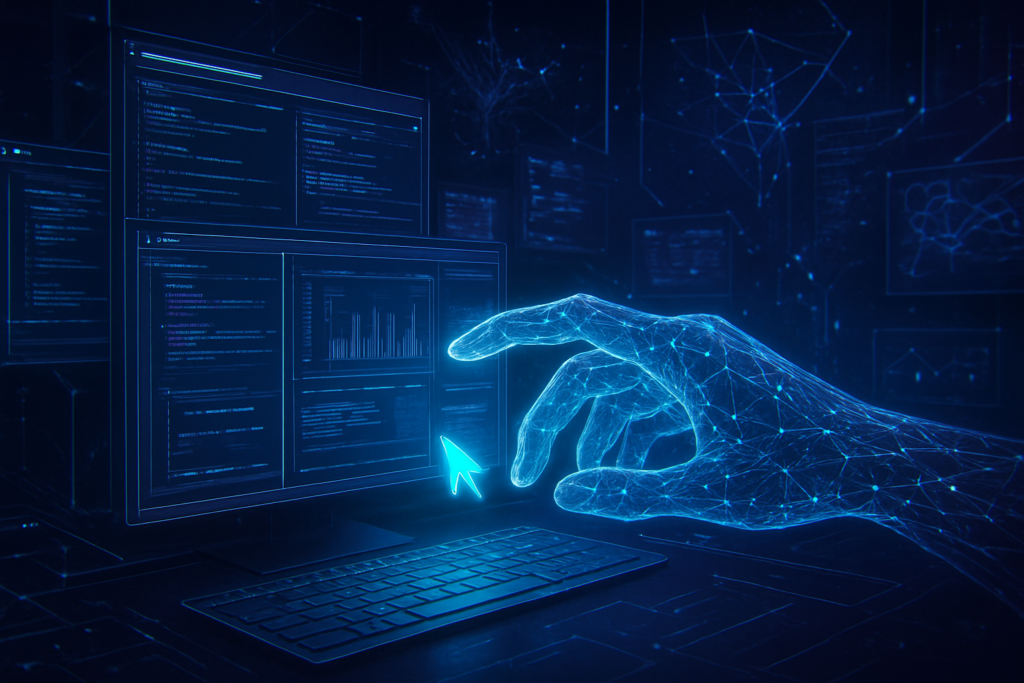
Technically, Anthropic’s approach to computer use is a masterclass in vision-to-action mapping. Unlike previous automation tools that relied on brittle backend scripts or specific browser extensions, Claude 3.5 Sonnet treats the entire operating system as a visual canvas. The model functions through a rapid execution loop: it captures a screenshot of the desktop, analyzes the visual data to identify UI elements like buttons and text fields, plans a sequence of actions, and then executes those actions via virtual mouse movements and keystrokes.
A key breakthrough in this process was the implementation of "pixel counting." To interact with a specific button, Claude calculates the exact X and Y coordinates by measuring the distance from the screen edges, allowing for a level of precision previously unseen in Large Language Models (LLMs). By early 2026, this system was further refined with "zoom-action" capabilities, enabling the model to magnify dense spreadsheets or complex coding environments to ensure accuracy. This differs from existing technologies like Robotic Process Automation (RPA), which often breaks when a UI element moves by a few pixels; Claude, by contrast, uses reasoning to find the button even if the interface layout changes.
Initial reactions from the AI research community were a mix of awe and caution. Early testers in late 2024 noted that while the system was occasionally slow, its generalizability was unprecedented. Industry experts quickly recognized that Anthropic had solved one of the hardest problems in AI: teaching a model to understand "contextual intent" across diverse software environments. By the time Claude 4.5 was released in mid-2025, the model was scoring over 60% on the OSWorld benchmark—a massive leap from the single-digit performance seen in the pre-agentic era.
The Strategic Power Play: Amazon, Google, and the Cloud Wars
The rollout of "Computer Use" has solidified the strategic positioning of Anthropic’s primary backers, Amazon (NASDAQ: AMZN) and Alphabet Inc. (NASDAQ: GOOGL). Amazon, having invested a total of $8 billion into Anthropic by 2025, has integrated Claude’s agentic capabilities directly into its Bedrock platform. This allows enterprise customers to deploy autonomous agents within the secure confines of AWS, using Amazon’s custom Trainium2 chips to power the massive compute requirements of real-time screen processing.
This development has placed significant pressure on Microsoft (NASDAQ: MSFT) and its partner OpenAI. While OpenAI’s "Operator" and Microsoft’s "Copilot" have excelled in browser-based tasks, Anthropic’s focus on raw OS-level control gave it an early lead in automating deep-system workflows. The competitive landscape has shifted from "who has the best chatbot" to "who has the most reliable agent." This has led to a surge in startups building specialized "wrapper" applications that use Claude to automate everything from insurance claims processing to complex video editing, potentially disrupting the multi-billion dollar SaaS integration market.
Security in the Age of Autonomous Agents
The broader significance of Claude’s computer use lies in its implications for safety and security. Giving an AI "hands" on a computer introduces risks such as prompt injection—where a malicious website could theoretically trick the AI into deleting files or transferring funds. To combat this, Anthropic pioneered the use of isolated environments, or "sandboxes." Developers are encouraged to run Claude within dedicated Docker containers or virtual machines, ensuring that the model’s actions are walled off from the user’s primary system and sensitive data.
Furthermore, by 2026, Anthropic implemented AI Safety Level 3 (ASL-3) safeguards, which include advanced classifiers designed to detect and block misuse in real-time. This focus on safety has set a precedent in the industry, forcing competitors to adopt similar "human-in-the-loop" protocols for high-stakes actions. Despite these measures, the socio-economic concerns regarding job displacement in administrative and data-entry sectors remain a central point of debate, as Claude-driven agents begin to handle tasks that previously required entire teams of human operators.
The Horizon: From Assistants to Digital Employees
Looking ahead, the next phase of this evolution involves the move toward "Multi-Agent Orchestration." We are already seeing the emergence of systems where one Claude agent manages a team of sub-agents to complete massive projects, such as building a full-stack application from scratch. This was showcased in the recent release of "Claude Code," a tool that allows developers to delegate entire feature builds to the AI, which then navigates the terminal, writes code, and tests the output autonomously.
Predicting the next twelve months, experts suggest that we will see the integration of these capabilities directly into the kernel level of operating systems. There are already rumors of "Agent-First" hardware—low-power devices designed specifically to host 24/7 autonomous agents. The challenge remains in reducing the latency and compute cost of constant screen analysis, but as specialized AI silicon continues to advance, the dream of a truly autonomous digital employee is moving closer to reality.
A New Chapter in Human-Computer Interaction
In summary, Anthropic’s "Computer Use" capability represents a landmark moment in AI history. It marks the transition from artificial intelligence as a consulting tool to AI as a functional operator. By mastering the human interface—the screen, the mouse, and the keyboard—Claude has effectively broken the barrier between digital thought and digital action.
The significance of this milestone will likely be remembered alongside the release of the first graphical user interface (GUI). Just as the GUI made computers accessible to the masses, agentic AI is making the complex web of modern software accessible to autonomous systems. In the coming months, keep a close eye on the performance of these agents in "unstructured" environments and the potential for a standardized "Agent Protocol" that could further harmonize how different AI models interact with our digital world.
This content is intended for informational purposes only and represents analysis of current AI developments.
TokenRing AI delivers enterprise-grade solutions for multi-agent AI workflow orchestration, AI-powered development tools, and seamless remote collaboration platforms.
For more information, visit https://www.tokenring.ai/.