Quantum computing is no longer a theoretical novelty confined to academic research labs. Enterprise spending on quantum capabilities has accelerated rapidly, driven by the promise of exponential computational advantages in drug discovery, financial modeling, supply chain logistics, and material science. Yet, alongside the massive investment numbers lies a quiet truth known across the industry: current quantum hardware remains fundamentally imperfect.
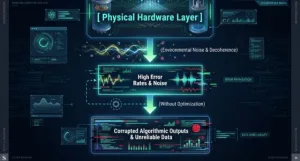
For enterprise leaders, the core challenge is not whether quantum mechanics works—it does. The bottleneck lies in how sensitive quantum processing units (QPUs) are to environmental interference. Microscopic thermal fluctuations, electromagnetic noise, and hardware imperfections introduce high rates of operational noise, causing delicate quantum bits (qubits) to lose their state—a process called decoherence.
To bridge the gap between noisy experimental hardware and commercial value, executives must look past raw qubit counts and focus on operational stability, computational fidelity, and the underlying software stack that makes quantum processors reliable for enterprise workloads.
The Hardware Bottleneck: Why Qubit Counts Don’t Tell the Whole Story
In traditional computing, hardware reliability is taken for granted. A modern classical silicon transistor can execute billions of operations per second for years without a single hardware fault. By contrast, a typical qubit can lose its quantum state in a fraction of a millisecond.
When evaluating quantum roadmaps, non-technical business leaders often default to a simple metric: the number of physical qubits a system possesses. However, adding physical qubits without controlling noise creates a critical vulnerability. As quantum circuits grow in size and complexity, errors accumulate exponentially. Beyond a certain circuit depth, a processor’s output becomes statistical noise rather than actionable computational data.
For enterprises attempting to solve complex optimization or simulation problems, noise is the ultimate barrier to ROI. Without infrastructure layer stability, deploying algorithms on physical hardware yields unreliable results, regardless of how advanced the underlying code may be.
Managing Noise: Suppression vs. Mitigation vs. Error Correction
To overcome the fragility of quantum processors, researchers and engineers rely on three distinct operational paradigms: error suppression, error mitigation, and quantum error correction. Understanding how these layers differ is essential for business leaders budgeting for quantum initiatives.
| Strategy | Primary Mechanism | Hardware Overhead | Immediate Commercial Applicability |
| Error Suppression | Real-time, autonomous pulse tuning & AI control at the physical layer | Zero added physical qubits | High (Applies directly to current systems) |
| Error Mitigation | Post-processing statistical extraction to infer noise-free results | Low-to-medium compute overhead | Moderate (Useful for specific estimation tasks) |
| Error Correction | Redundant encoding across physical qubits to form stable logical qubits | Very high (Up to 1,000:1 physical-to-logical ratio) | Long-term (Requires fault-tolerant scale) |
1. The Long-Term Promise of Error Correction
True fault-tolerant quantum computing relies on distributing the state of a single “logical” qubit across hundreds or thousands of physical supporting qubits. While this redundancy isolates quantum data from physical noise, the resource overhead is massive. Implementing full hardware redundancy across current processors often introduces more noise than it eliminates.
2. The Practical Gateway: Autonomous Infrastructure Software
Because full fault tolerance remains a long-term goal, leading organizations focus on the lower levels of the software stack to optimize hardware performance today. By stabilizing physical qubits at the firmware level, advanced quantum error correction software and performance management frameworks suppress error rates autonomously before they compound.
Rather than waiting a decade for million-qubit systems, deploying AI-driven control and error-suppression layers allows organizations to execute longer, deeper algorithms on today’s existing quantum hardware.
Enterprise Roadmap: Preparing Your Business for the Quantum Era
For enterprise decision-makers, navigating the transition to quantum computing requires balancing long-term vision with immediate, practical risk management. To avoid capital misallocation while building real internal capability, executives should consider a structured, multi-phase approach:
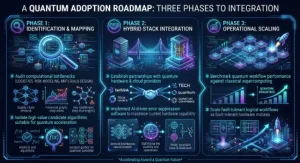
Step 1: Identify High-Impact Computational Bottlenecks
Not every enterprise workload belongs on a quantum processor. Quantum advantages center on specific problem classes—such as high-dimensional combinatorial optimization, molecular synthesis, and complex portfolio risk analysis. Identify where classical supercomputing hits physical performance limits within your core business operations.
Step 2: Implement Performance-Enhancing Infrastructure
Focus software investments on tools that abstract hardware complexity away from end users. Algorithm developers and domain experts should not need a PhD in low-level quantum physics to run meaningful executions. Standardizing on automated error management software ensures your team spends time optimizing domain-specific algorithms rather than debugging physical hardware noise.
Step 3: Build Hybrid Classical-Quantum Workflows
Commercial quantum advantage will not replace classical architecture; it will augment it. The near-term enterprise state consists of hybrid systems where classical microprocessors handle data management and preliminary tasks, while specialized quantum accelerators run complex subroutines.
Capitalizing on Early Quantum Advantage
The transition to quantum utility is not a distant, single event; it is a progressive continuum. While full-scale, fault-tolerant quantum error correction remains an ongoing engineering milestone, the software tools designed to manage, suppress, and mitigate operational noise are delivering measurable value right now.
Enterprise leaders who focus exclusively on hardware timelines risk falling behind. By investing in performance management software, building targeted hybrid workflows, and identifying high-impact use cases today, organizations can establish a defensible strategic advantage as quantum capabilities mature.
Key Takeaways for Executives
- Qubit Quality > Qubit Quantity: Focus on operational fidelity and circuit execution success rates rather than raw hardware counts.
- Leverage the Software Layer: Automated error suppression software extracts maximum performance from current-generation hardware without added physical overhead.
- Start Hybrid: Integrate quantum processing units as specialized computational accelerators alongside your existing high-performance classical infrastructure.