A payments team can sign a platform contract in six weeks and still wait nine months to move its first euro. That gap between software being ready and the business being allowed to operate is where most launch plans quietly fall apart. A white label platform compresses the engineering half of the problem. It leaves the regulatory side untouched unless both tracks start at once.
Here we uncovered what the purchase covers, how to evaluate vendors simply, and which DORA contract terms matter most.
"White label" sounds like one product. It is usually seven or eight, stitched together and sold under one contract:
- A core ledger that records balances, holds and settlement
- KYC and AML orchestration, often routed to third-party vendors you will also need to approve
- Card issuing plus BIN sponsorship and scheme certification
- Payment rails: SEPA, SEPA Instant, Faster Payments, A2A, card acquiring
- Mobile and web front ends you can re-skin
- Back-office tooling for operations, disputes and reconciliation
- Reporting that your finance team and your regulator will both ask for
The ledger is the piece buyers underestimate. Single-entry books or currency treated only as a display label produce reconciliation headaches that start in a month or two and refuse to leave later. We would suggest asking for a trial balance export during the demo. If the platform cannot spit one out in five minutes, year-end audit will not go better.
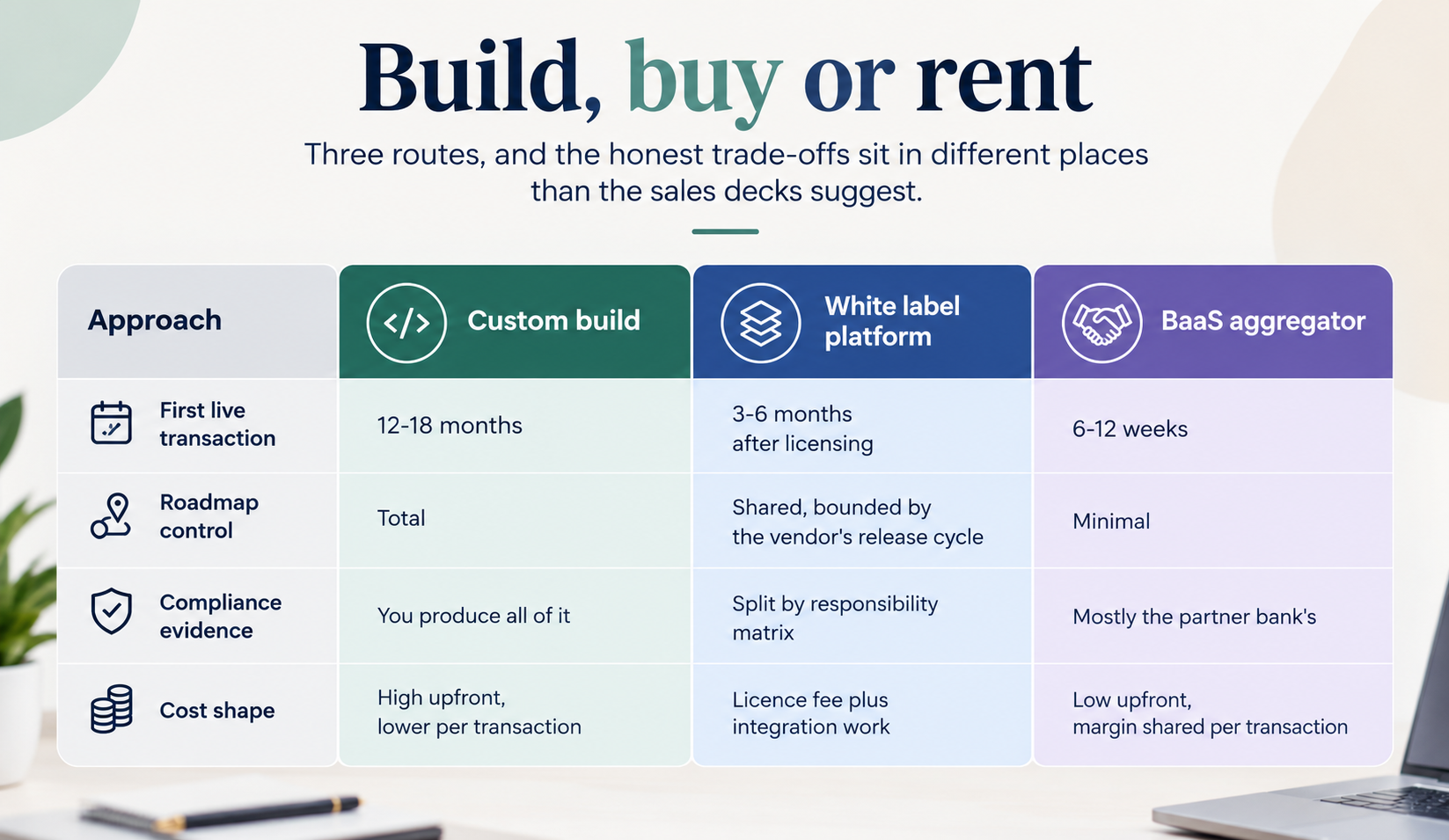
Two providers can price white label solutions fintech services identically and still ship wildly different scopes. That's why we especially accent on reading the responsibility matrix. The evidence work, like control narratives, penetration test reports, incident logs, vendor assessments, and other artifacts, lands not on the vendor. The regulator will simply choose whoever it considers accountable inside your company.
Most mid-sized teams we had encountered end up with a hybrid: a licensed partner for the first product, a platform underneath it, and their own code wrapped around the customer experience. Kindgeek works in that middle layer. Its white label fintech solutions cover neobank, e-wallet, PFM and core payment components that clients extend rather than take as finished packages.
Seven questions for any white label fintech solutions provider
- Which legal entity holds your license, and what does it actually allow you to do? The most common checks in our practice are: does it cover payment initiation, account information, e-money issuance, card issuing, acquiring and safeguarding, which markets it is passported into, are there any restrictions that sit on the permission. Be sure to look up their register entry number to verify it yourself.
- Is your ledger double-entry? Can individual accounts handle multiple currencies? Never rely on the dashboard screenshots: only a demo with the trial balance is counted as proof here.
- Which PCI DSS controls stay with you? During the handover you should get a responsibility matrix, which defines each owner.
- What is the certification status for the card product you want, and whose BIN is it on? Scheme certification work measured in months often sits behind a "ready" label.
- How do releases and breaking changes work? What should be checked on your side are API versioning policy, deprecation notice periods and whether the sandbox matches production.
- What does offboarding look like? Make sure that vendor clarifies data formats, extraction timelines and fees, data model ownership, token and key portability, and audit-ready proof of data deletion.
- Can we see the uptime history and incident reports? A vendor with nothing to show either had zero incidents (which we see as very unlikely) or chooses not to publish them.
The licence decides your timeline
Software is rarely the long pole. In the UK, for instance, the FCA must determine a complete application for authorisation under the Payment Services Regulations or Electronic Money Regulations within three months of receipt. Or within twelve months if incomplete. The regulator's target is 98 % of complete applications in three months. And only 2 of 46 e-money authorisation cases missed the deadline in 2025-2026.
Read that again, because the word doing the work is "complete". Your FCA application clock starts when every single document is in. If your financial models or compliance details are missing, your file sits waiting. That's why we start licensing while building the product, saving about six months of delays.
What DORA changed for buyers
Since 17 January 2025, EU financial entities have had to maintain a register of information covering every contractual arrangement with ICT third-party providers. Those contracts carry mandatory terms. Buying a platform now means your supervisor can ask to see a named, documented dependency to a register added.
Clauses worth settling before signature
- Service locations, including where data is processed and stored
- Subcontracting rights, with notice and objection terms for material changes
- Incident reporting windows that match your regulatory deadlines, not the vendor's support SLA
- Audit and access rights for you and your competent authority
- Exit and transition support, with the format and timeline for data return written down
- Substitutability: can this function be moved, and what breaks if it is
Vendors who have been through this hand you a DORA addendum unprompted. Vendors who ask what DORA is are telling you how much of the evidence burden is about to become yours.
Red flags during the demo
- The sandbox exists but nobody can issue you credentials this week
- "We handle compliance" with no responsibility matrix behind it
- Roadmap commitments made verbally and never written into the contract
- One reference client, cited repeatedly, who never quite becomes available for a call
- Uptime quoted as a number with no published incident history behind it
- Every customisation request answered with "yes, that's configurable" and no estimate
A realistic first ninety days
- Before signing anything beyond an NDA, run technical discovery against the real sandbox. Two weeks are usually enough. You can do it with your own engineers.
- Map the responsibility matrix line by line to named owners on your side. If there are any unassigned lines, we suggest turning them into audit findings.
- At first, integrate one end-to-end flow. Onboarding through first payment is the easiest choice for this step. You will have to measure latency, error handling, reconciliation accuracy under load, idempotency on replayed requests, webhook delivery and retries, audit log completeness.
- Start the licence or partner-bank workstream. On the first week identify a dedicated owner of this process to run it in parallel.
- Start building your reporting and reconciliation layers as early as possible. Finance and compliance will ask for numbers sooner than you expect.
Where this leaves you
The decision is rarely build versus buy in the abstract. It is a question of which parts of the stack you want to own the evidence for. A white label fintech company sells time and simultaneously sells a dependency. Whether that trade works out mostly depends on how specific is the contract you signed and when you started the compliance track.
If you are currently at the shortlist stage, we suggest a simple test: pick 2 providers, run the same discovery sprint with both, and compare what they refuse to answer. Kindgeek has spent eleven years on this side of the problem, across 100+ regulated projects and platforms that have processed more than €10B, and the insight from this practice is: teams that ask harder questions before signing spend far less time renegotiating afterwards.
FAQ
How long does it take to launch with a white label platform?
A simple neobank or e-wallet front end on your existing core is estimated three to six months to build, as long as you lock in the scope early. However, licensing runs on its own clock and usually sets the real launch date. If you apply for your own authorisation, plan for preparation to take roughly as long as the regulator’s review. We are practicing the paralleling of those processes to shorten the timeline.
Do we still need our own licence?
Not really. You can operate as an agent or distributor of a licensed partner, which removes the authorisation wait but at the same time caps margin and product freedom. Your own e-money or payment institution licence costs more time and money, and gives you control over pricing, partners or the roadmap. It's also common to start under a partner licence and apply for their own once volume justifies the overhead.
What is the difference between white label and BaaS?
White label provides the tech and leaves licensing to you, offering more product control. BaaS supplies both the tech and the banking license, trading customization for a faster launch. The line between them seems blurry, but the responsibility matrix clarifies it well enough.
How much customisation is realistic?
UI updates are easy, but backend rules for fees, limits, and ledgers vary sharply. Ask what happens if you need something the vendor has not built yet: does it enter their roadmap, or can you plug in your own module? That is also a prediction for your true long-term flexibility.
What happens when we want to migrate off the platform?
Lock in exit terms before signing. Clarify export formats, costs, timelines, and transaction history portability. Under DORA, a tested exit plan is a mandatory regulatory requirement for EU financial entities, therefore cannot be considered post-launch.