The tech-heavy Nasdaq Composite has just endured its most grueling stretch in years, closing out a fifth consecutive week of losses on February 13, 2026. This downward spiral, which has wiped trillions in market value from the world’s largest technology firms, marks the longest losing streak for the index since the 2022 bear market. What began as a cautious rotation out of overextended growth stocks has rapidly evolved into a deeper questioning of the "AI ROI" (Return on Investment) narrative that propelled markets through a historic multi-year bull run.
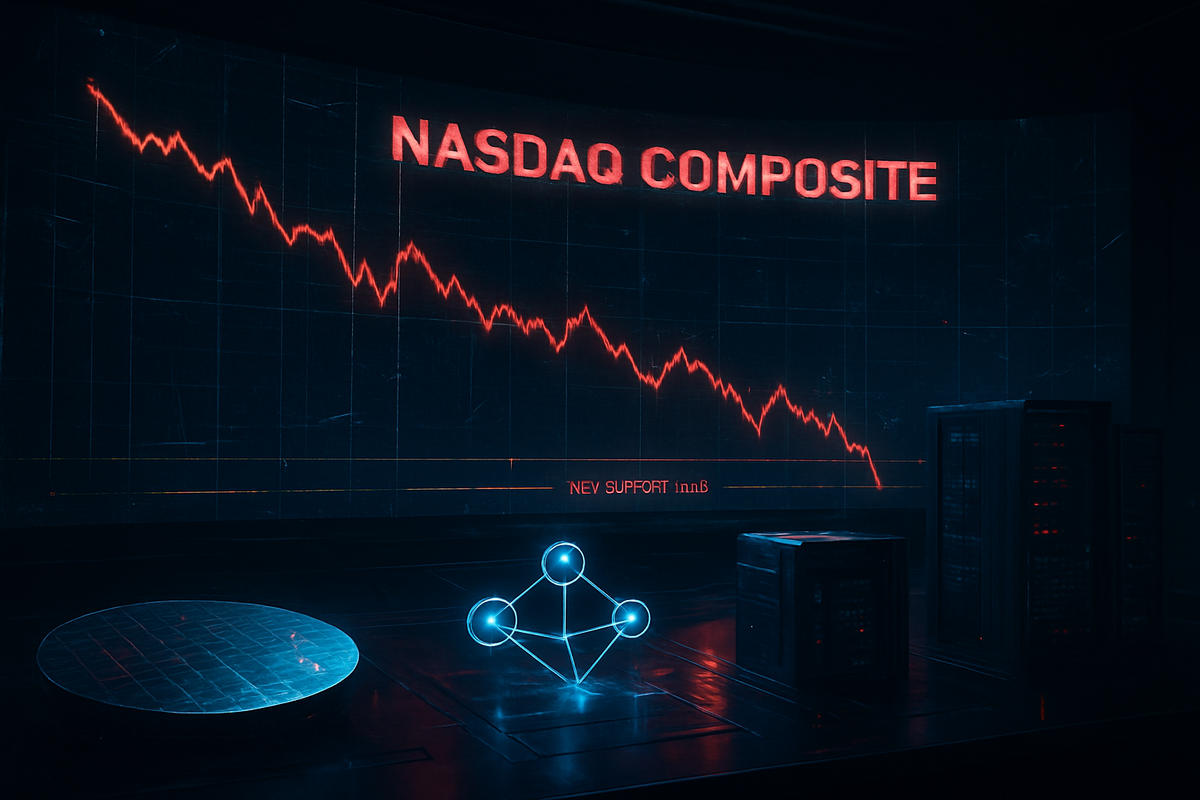
As of February 17, 2026, the technical damage to the index is significant. The Nasdaq Composite (IXIC) has breached multiple psychological floors and is currently oscillating near a critical support level of 23,178. For investors who have grown accustomed to the relentless "buy the dip" mentality of 2024 and 2025, the current environment presents a chilling shift: the "SaaSpocalypse" is no longer a fringe theory, but a primary driver of portfolio de-risking as the market grapples with the high costs and disruptive potential of agentic artificial intelligence.
The Anatomy of 'Software-mageddon'
The decline began in mid-January 2026, following a period of extreme optimism where the S&P 500 had recently crossed the 7,000 milestone. The catalyst for the reversal was a series of underwhelming earnings reports and guidance updates from the "Magnificent Seven." Microsoft (NASDAQ: MSFT) served as the primary lightning rod for the sell-off; despite reporting record revenues, its stock plummeted as the company revealed a staggering gap between its massive capital expenditures and the immediate revenue realized from its AI Copilot and Azure expansions. MSFT lost an estimated $400 billion in market capitalization in a matter of days, sending shockwaves through the entire sector.
The timeline of the slump accelerated in early February when Anthropic and other AI labs released advanced "agentic" tools, such as Claude Cowork. These tools demonstrated a capability to handle complex, multi-step professional tasks autonomously, leading to immediate fears that traditional Software-as-a-Service (SaaS) business models—which rely on seat-based licensing—were becoming obsolete. This "agentic AI disruption" triggered a surgical de-risking phase. By the second week of February, the Nasdaq-100 (NDX) had broken below its 50-day moving average, a move that technical analysts flagged as a "regime change" for the index.
Market reaction has been characterized by high-volume selling and a noticeable spike in the VIX, or "fear gauge." Institutional investors, who had been riding the AI super-cycle since late 2023, began liquidating positions to protect gains from the prior year's 21% rally. Key stakeholders, including venture capital firms and hedge fund managers, have shifted their rhetoric from "growth at any cost" to "sustainable unit economics," placing intense pressure on companies that cannot yet prove the profitability of their AI integrations.
Winners and Losers in the De-Risking Phase
In this volatile landscape, the "losers" are concentrated in the high-multiple software space. Traditional enterprise software companies have seen their valuations slashed as the market re-evaluates their "moats" in an era of autonomous AI agents. Microsoft (NASDAQ: MSFT), while a leader in the space, has faced the brunt of the "CAPEX fatigue" narrative, with its share price retreating from $542 to the high $470s. Similarly, Salesforce (NYSE: CRM) and other seat-based platforms are fighting to convince shareholders that they can successfully pivot to consumption-based models before their current revenue streams are disrupted by autonomous workflows.
Conversely, some infrastructure "winners" have shown relative resilience, though they have not been entirely immune to the broad-market downdraft. Nvidia (NASDAQ: NVDA), which entered 2026 as the world’s most valuable company with a market cap nearing $5 trillion, remains the fundamental backbone of the AI era. With an order backlog for its "Rubin" and "Blackwell" chips extending well into 2027, NVDA has managed to hold above its own critical support levels, even as the broader index falters. Investors view Nvidia as a "toll booth" for the AI industry—regardless of which software company wins, they all require Nvidia’s silicon to operate.
Apple (NASDAQ: AAPL) also finds itself in a precarious but unique position. After briefly hitting a $4 trillion valuation in late 2025 on the back of strong iPhone 17 sales, the stock has softened. However, Apple’s focus on its "Apple Foundation Models" and deep integration with Alphabet (NASDAQ: GOOGL) has provided a slight cushion. By controlling the hardware "edge" where agentic AI interacts with the user, Apple is perceived as having a more defensible position than pure-play cloud software providers. Alphabet, meanwhile, has benefited from a "flight to quality," as its search dominance remains a steady cash-flow generator amidst the cloud-spending uncertainty.
Broad Industry Implications and Historical Context
The current five-week slump is more than just a technical correction; it is a fundamental reassessment of the AI era's sustainability. The industry is currently facing "CAPEX fatigue," a phenomenon where the collective $700 billion in planned spending by the "Big Four" hyperscalers is now being viewed as a liability rather than a growth engine. This mirrors the infrastructure build-out phases of previous technological revolutions, such as the fiber-optic overbuild of the late 1990s. While the technology (AI) is undoubtedly transformative, the market is realizing that the timeline for monetization may be longer than initially priced in.
Historically, this event draws comparisons to the "dot-com" crash of 2000, though with significant differences. Unlike the 2000s, today’s tech giants are highly profitable with massive cash reserves. However, the valuation multiples assigned to these companies in 2024 and 2025 reached levels that assumed flawless execution and immediate AI adoption. The current "Hindenburg Omen" trigger—a technical indicator signaling deteriorating market breadth—suggests that while a few mega-caps were holding up the index in 2025, the underlying health of the broader market was weakening long before the January peak.
The ripple effects are also being felt in the regulatory and policy spheres. As AI agents begin to replace human workflows, labor productivity is expected to surge, but it brings new questions regarding data privacy and corporate responsibility. Governments are closely watching how "Agentic AI" disruptions affect the workforce, which could lead to new regulatory hurdles for the very companies currently under market pressure. This added layer of uncertainty has contributed to the "risk-off" sentiment dominating the Nasdaq in early 2026.
The Road Ahead: Support or Freefall?
In the short term, all eyes are on the 23,000 level for the Nasdaq Composite. If the index can stabilize here and reclaim its 50-day moving average, the five-week slump may be remembered as a "healthy correction" that cleared out excess speculation. However, a failure to hold this support could open the door for a test of the 200-day moving average, roughly another 5-10% below current levels. Strategic pivots are already underway; expect to see tech companies aggressively cutting non-AI-related costs and shifting their narratives toward "Autonomous Efficiency" to justify their high valuations.
The emergence of "Agentic AI" represents both a challenge and an opportunity. While it threatens traditional SaaS models, it also creates a massive market for platforms that can orchestrate these agents. Companies that can successfully transition to this new paradigm will likely lead the next leg of the bull market. For the next several months, however, the market is expected to remain in a "show me" phase, where general AI hype is no longer sufficient to move the needle. Investors will be scrutinizing quarterly reports for "Agentic Revenue"—actual dollars generated by autonomous workflows—as the new gold standard for success.
Potential scenarios range from a "soft landing" where earnings eventually catch up to valuations, to a more prolonged "AI Winter" if the expected productivity gains fail to materialize by mid-2026. Given the concentration of the index, a further 10% decline in just three or four major names could technically push the Nasdaq into a bear market, defined as a 20% drop from recent highs.
Market Wrap-Up and Final Thoughts
The five-week slump in the Nasdaq has served as a wake-up call for the global financial markets. The primary takeaway is that even the most powerful secular trends, like the AI revolution, are subject to the laws of financial gravity and valuation. The technical damage to the Nasdaq Composite is real, with the index currently testing a major psychological floor at 23,178. Whether this serves as a springboard for a recovery or a trapdoor to further losses will depend on the upcoming spring earnings season.
Moving forward, the market is likely to remain bifurcated. Infrastructure providers like Nvidia (NASDAQ: NVDA) may maintain their premium status, while the software sector undergoes a painful but necessary consolidation and evolution. Investors should watch for stabilization in the Nasdaq-100 (NDX) above 24,000 and keep a close eye on capital expenditure guidance from the major hyperscalers. If Amazon (NASDAQ: AMZN) or Meta (NASDAQ: META) signal a pullback in AI spending, it could trigger the next leg of the correction.
In conclusion, the "SaaSpocalypse" of early 2026 marks the end of the speculative phase of the AI bull run. The market is now entering a more mature, albeit more volatile, era focused on actual utility and profitability. For the patient investor, this correction may eventually provide an attractive entry point, but for now, caution is the order of the day as the Nasdaq attempts to repair its technical foundation.
This content is intended for informational purposes only and is not financial advice.