


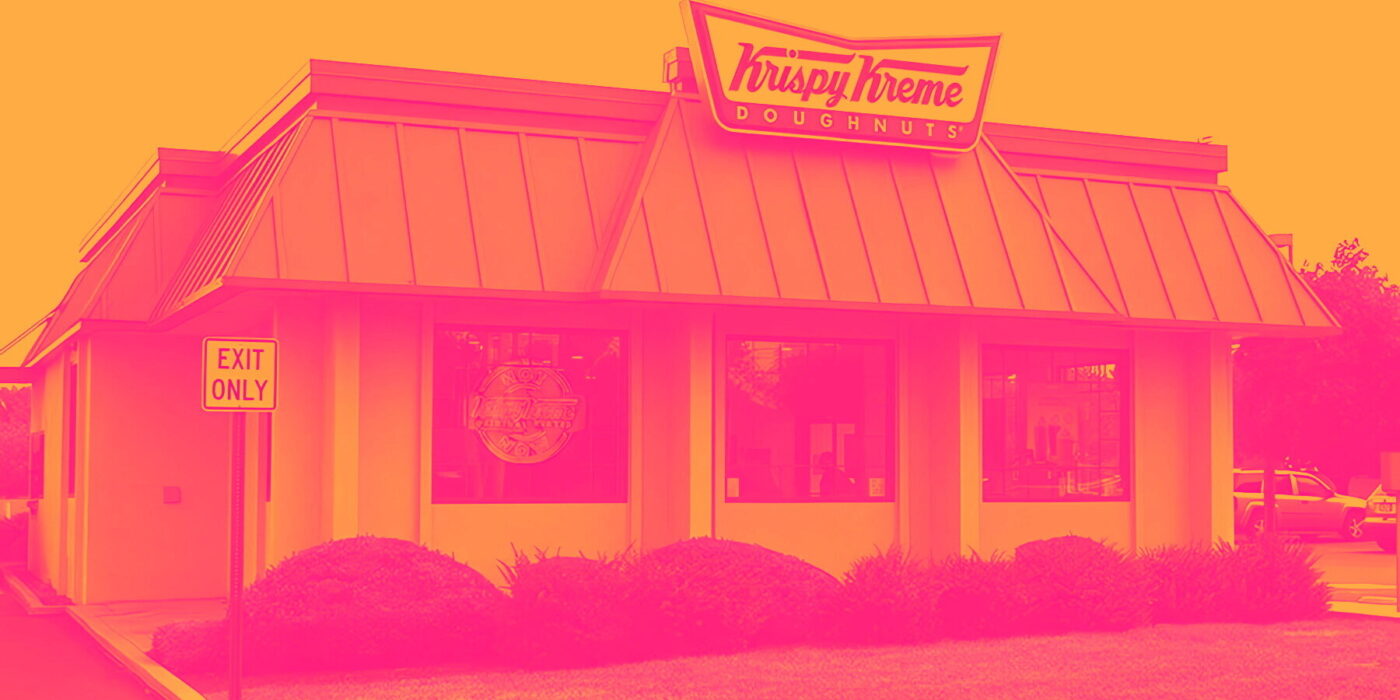
Doughnut chain Krispy Kreme (NASDAQ: DNUT) reported Q2 CY2026 results topping the market’s revenue expectations, but sales fell by 12.8% year on year to $331 million. Its non-GAAP loss of $0.03 per share was in line with analysts’ consensus estimates.
Is now the time to buy DNUT? Find out in our full research report (it’s free for active Edge members).
Krispy Kreme (DNUT) Q2 CY2026 Highlights:
- Revenue: $331 million vs analyst estimates of $302.7 million (12.8% year-on-year decline, 9.4% beat)
- Adjusted EPS: -$0.03 vs analyst estimates of -$0.02 (in line)
- Adjusted EBITDA: $28.81 million vs analyst estimates of $27.74 million (8.7% margin, 3.9% beat)
- Operating Margin: -3.3%, up from -114% in the same quarter last year
- Locations: 15,665 at quarter end, down from 18,113 in the same quarter last year
- Market Capitalization: $556.8 million
StockStory’s Take
Krispy Kreme’s second quarter saw positive market reaction as the company’s revenue topped Wall Street’s expectations despite a notable year-over-year decline. Management attributed this outperformance to ongoing progress in its turnaround plan, particularly through re-franchising efforts and operational improvements in the U.S. CEO Joshua Charlesworth emphasized that “our focus on optimizing operations and logistics, along with driving more profitable sales per door in fresh delivery, is translating into stronger financial performance.” Enhanced production planning, labor optimization, and cost control initiatives were highlighted as key contributors to margin improvement.
Looking forward, Krispy Kreme’s guidance is anchored by plans to further expand its asset-light franchise model and deepen its partnerships with major retailers. Management outlined upcoming initiatives such as broadening product availability through digital channels and leveraging underutilized production capacity. CFO Raphael Duvivier noted, “We believe our attractive franchise margins advance our capital-light growth strategy,” while Charlesworth stated that expanding through partners like Walmart and Target is expected to drive sustainable, profitable growth in the U.S. and internationally.
Key Insights from Management’s Remarks
Management linked Q2 performance to strategic re-franchising, operational efficiencies, and the execution of a multi-pillar turnaround plan, while emphasizing continued progress in U.S. and international markets.
-
Re-franchising momentum: Krispy Kreme accelerated its transition to a more asset-light business model by completing transactions in Japan and the Western U.S., increasing the share of franchise-generated sales from 25% to 42%. Management aims for franchisees to account for 50% of system-wide sales next year, which is expected to improve margins and free cash flow over time.
-
International expansion via franchises: The company entered three new international franchise markets—Netherlands, Estonia, and Mauritius—this year, reaching its annual target for new market entries. Franchisees were responsible for nearly all of the 59 new shop openings year-to-date, supporting global growth with minimal capital investment from Krispy Kreme itself.
-
U.S. operational optimization: Enhanced production planning, labor efficiency initiatives, and the outsourcing of U.S. logistics have contributed to a notable reduction in costs. Management expects ongoing benefits from these changes as more logistics savings are realized in coming quarters.
-
Digital and retail channel growth: Digital sales in the U.S. grew 8% year-over-year and now represent 22% of domestic retail sales, propelled by improvements to payment systems and a loyalty program that has reached 18 million members. Additionally, over 200 new retail doors were added with key partners, such as Walmart and Target, increasing brand accessibility.
-
Product innovation and marketing: A diverse menu strategy, featuring a core menu, five annual seasonal collections, and regular limited-time offerings, has helped sustain consumer interest and drive average ticket size. Targeted promotions, such as discounted second dozens, are designed to deliver value and stimulate higher purchase volumes.
Drivers of Future Performance
Krispy Kreme’s outlook remains shaped by its focus on franchise expansion, operational discipline, and broadening retail partnerships to drive both top-line and margin growth.
-
Franchise-led growth strategy: Management plans to further increase the proportion of system-wide sales coming from franchisees, both domestically and internationally. By leveraging local partners, the company aims to enhance capital efficiency, reduce risk, and scale more rapidly in new and existing markets.
-
Retail and digital channel expansion: The company sees significant headroom for growth by expanding within major retailers—where current penetration is only about 30%—and by deepening digital engagement through e-commerce and loyalty programs. The upcoming launch of Krispy Kreme products on additional online platforms, including target.com, is expected to create new sales opportunities.
-
Margin improvement risks and drivers: While margin gains are anticipated from ongoing operational improvements and logistics outsourcing, management warned of potential headwinds, such as underperformance in certain international markets (notably the U.K. and Australia) and macroeconomic factors, including commodity inflation and evolving consumer trends related to health and wellness.
Catalysts in Upcoming Quarters
Looking ahead, the StockStory team will monitor (1) additional re-franchising transactions and their impact on capital efficiency, (2) the pace of digital channel growth and uptake of the loyalty program, and (3) the effectiveness of new retail partnerships in expanding brand reach. Progress in key international markets, particularly the U.K. and Australia, and execution of operational efficiencies will also serve as indicators of turnaround momentum.
Krispy Kreme currently trades at $3.27, up from $3.10 just before the earnings. Is the company at an inflection point that warrants a buy or sell? Find out in our full research report (it’s free).
Now Could Be The Perfect Time To Invest In These Stocks
WHILE YOU’RE HERE: Top 9 Market-Beating Stocks. The best stocks don’t just beat the market once. They do it again. And again. Robust revenue growth, rising free cash flow, returns on capital that leave their competition in the dust. The market has already rewarded these businesses.
But our AI platform says the party isn’t over. Find out which 9 stocks made the cut this week — FREE. Get Our Top 9 Market-Beating Stocks for Free HERE.
Stocks that have made our list include now familiar names such as Nvidia (+1,460% between June 2020 and June 2025) as well as under-the-radar businesses like the once-small-cap company Comfort Systems (+1,154% between June 2020 and June 2025). Find your next big winner with StockStory today.




 Facebook
 Twitter
 YouTube