


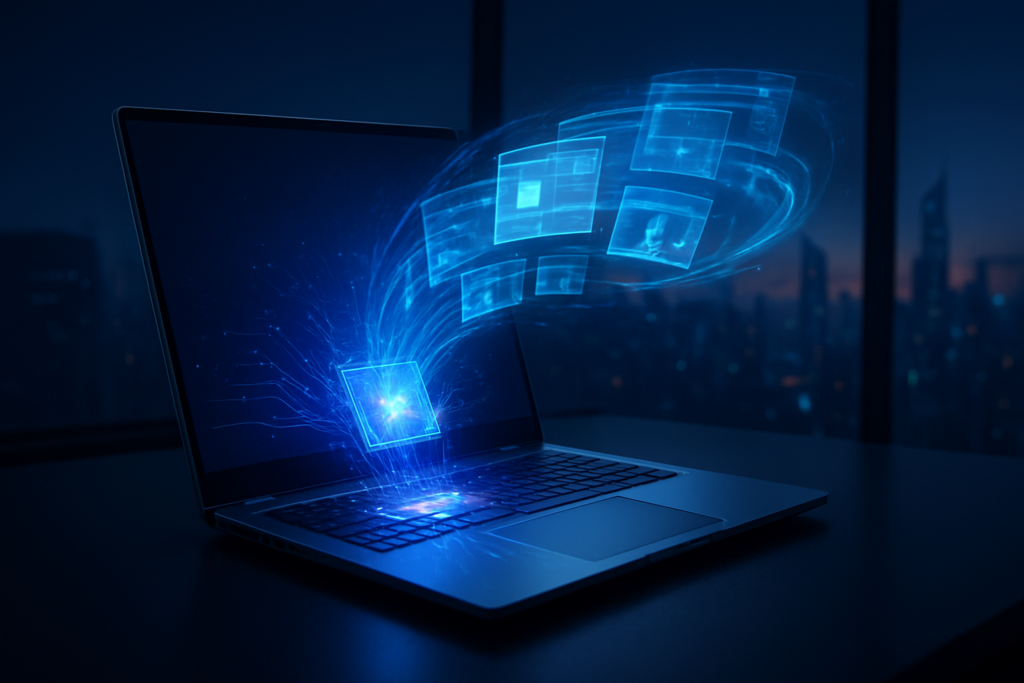
As we close out 2025, the personal computer is no longer just a window into the internet; it has become an active, local participant in our digital lives. Microsoft (NASDAQ: MSFT) has successfully transitioned its Copilot+ PC initiative from a controversial 2024 debut into a cornerstone of the modern computing experience. By mandating powerful, dedicated Neural Processing Units (NPUs) and integrating deeply personal—yet now strictly secured—AI features, Microsoft has fundamentally altered the hardware requirements of the Windows ecosystem.
The significance of this shift lies in the move from cloud-dependent AI to "Edge AI." While early iterations of Copilot relied on massive data centers, the 2025 generation of Copilot+ PCs performs billions of operations per second directly on the device. This transition has not only improved latency and privacy but has also sparked a "silicon arms race" between chipmakers, effectively ending the era of the traditional CPU-only laptop and ushering in the age of the AI-first workstation.
The NPU Revolution: Local Intelligence at 80 TOPS
The technical heart of the Copilot+ PC is the NPU, a specialized processor designed to handle the complex mathematical workloads of neural networks without draining the battery or taxing the main CPU. While the original 2024 requirement was a baseline of 40 Trillion Operations Per Second (TOPS), late 2025 has seen a massive leap in performance. New chips like the Qualcomm (NASDAQ: QCOM) Snapdragon X2 Elite and Intel (NASDAQ: INTC) Lunar Lake series are now pushing 50 to 80 TOPS on the NPU alone. This dedicated silicon allows for "always-on" AI features, such as real-time noise suppression, live translation, and image generation, to run in the background with negligible impact on system performance.
This approach differs drastically from previous technology, where AI tasks were either offloaded to the cloud—introducing latency and privacy risks—or forced onto the GPU, which consumed excessive power. The 2025 technical landscape also highlights the "Recall" feature’s massive architectural overhaul. Originally criticized for its security vulnerabilities, Recall now operates within Virtualization-Based Security (VBS) Enclaves. This means that the "photographic memory" data—snapshots of everything you’ve seen on your screen—is encrypted and only decrypted "just-in-time" when the user authenticates via Windows Hello biometrics.
Initial reactions from the research community have shifted from skepticism to cautious praise. Security experts who once labeled Recall a "privacy nightmare" now acknowledge that the move to local-only, enclave-protected processing sets a new standard for data sovereignty. Industry experts note that the integration of "Click to Do"—a feature that uses the NPU to understand the context of what is currently on the screen—is finally delivering the "semantic search" capabilities that users have been promised for a decade.
A New Hierarchy in the Silicon Valley Ecosystem
The rise of Copilot+ PCs has dramatically reshaped the competitive landscape for tech giants and startups alike. Microsoft’s strategic partnership with Qualcomm initially gave the mobile chipmaker a significant lead in the "Windows on Arm" market, challenging the long-standing dominance of x86 architecture. However, by late 2025, Intel and Advanced Micro Devices (NASDAQ: AMD) have responded with their own high-efficiency AI silicon, preventing a total Qualcomm monopoly. This competition has accelerated innovation, resulting in laptops that offer 20-plus hours of battery life while maintaining high-performance AI capabilities.
Software companies are also feeling the ripple effects. Startups that previously built cloud-based AI productivity tools are finding themselves disrupted by Microsoft’s native, local features. For instance, third-party search and organization apps are struggling to compete with a system-level feature like Recall, which has access to every application's data locally. Conversely, established players like Adobe (NASDAQ: ADBE) have benefited by offloading intensive AI tasks, such as "Generative Fill," to the local NPU, reducing their own cloud server costs and providing a snappier experience for the end-user.
The market positioning of these devices has created a clear divide: "Legacy PCs" are now seen as entry-level tools for basic web browsing, while Copilot+ PCs are marketed as essential for professionals and creators. This has forced a massive enterprise refresh cycle, as companies look to leverage local AI for data security and employee productivity. The strategic advantage now lies with those who can integrate hardware, OS, and AI models into a seamless, power-efficient package.
Privacy, Policy, and the "Photographic Memory" Paradox
The wider significance of Copilot+ PCs extends beyond hardware specs; it touches on the very nature of human-computer interaction. By giving a computer a "photographic memory" through Recall, Microsoft has introduced a new paradigm of digital retrieval. We are moving away from the "folder and file" system that has defined computing since the 1980s and toward a "natural language and time" system. This fits into the broader AI trend of "agentic workflows," where the computer understands the user's intent and history to proactively assist in tasks.
However, this evolution has not been without its challenges. The "creepiness factor" of a device that records every screen interaction remains a significant hurdle for mainstream adoption. While Microsoft has made Recall strictly opt-in and added granular "sensitive content filtering" to automatically ignore passwords and credit card numbers, the psychological barrier of being "watched" by one's own machine persists. Regulatory bodies in the EU and UK have maintained close oversight, ensuring that these local models do not secretly "leak" data back to the cloud for training.
Comparatively, the launch of Copilot+ PCs is being viewed as a milestone similar to the introduction of the graphical user interface (GUI) or the mobile internet. It represents the moment AI stopped being a chatbox on a website and started being an integral part of the operating system's kernel. The impact on society is profound: as these devices become more adept at summarizing our lives and predicting our needs, the line between human memory and digital record continues to blur.
The Road to 100 TOPS and Beyond
Looking ahead, the next 12 to 24 months will likely see the NPU performance baseline climb toward 100 TOPS. This will enable even more sophisticated "Small Language Models" (SLMs) to run entirely on-device, allowing for complex reasoning and coding assistance without an internet connection. We are also expecting the arrival of "Copilot Vision," a feature that allows the AI to "see" and interact with the user's physical environment through the webcam in real-time, providing instructions for hardware repair or creative design.
One of the primary challenges that remain is the "software gap." While the hardware is now capable, many third-party developers have yet to fully optimize their apps for NPU acceleration. Experts predict that 2026 will be the year of "AI-Native Software," where applications are built from the ground up to utilize the local NPU for everything from UI personalization to automated data entry. There is also a looming debate over "AI energy ratings," as the industry seeks to balance the massive power demands of local LLMs with global sustainability goals.
A New Era of Personal Computing
The journey of the Copilot+ PC from a shaky announcement in 2024 to a dominant market force in late 2025 serves as a testament to the speed of the AI revolution. Key takeaways include the successful "redemption" of the Recall feature through rigorous security engineering and the establishment of the NPU as a non-negotiable component of the modern PC. Microsoft has successfully pivoted the industry toward a future where AI is local, private, and deeply integrated into our daily workflows.
In the history of artificial intelligence, the Copilot+ era will likely be remembered as the moment the "Personal Computer" truly became personal. As we move into 2026, watch for the expansion of these features into the desktop and gaming markets, as well as the potential for a "Windows 12" announcement that could further solidify the AI-kernel architecture. The long-term impact is clear: we are no longer just using computers; we are collaborating with them.
This content is intended for informational purposes only and represents analysis of current AI developments.
TokenRing AI delivers enterprise-grade solutions for multi-agent AI workflow orchestration, AI-powered development tools, and seamless remote collaboration platforms.
For more information, visit https://www.tokenring.ai/.


 Facebook
 Twitter
 YouTube