


A dining table goes through a lot more than we realize. It is where meals happen, of course, but it’s also where your kids do homework, your pets jump up, you set down grocery bags, laptops get opened, keys get tossed, plates get dragged around, and chairs bump into the edges.
Getting scratches is one of the most common complaints homeowners have about dining tables. And the frustrating part is that you might not find out how scratch-prone your table is until it’s already scratched.
Before you invest in your next piece of home furniture, you should understand how different materials hold up to daily life. Taking your time to find a scratch-resistant dining table today will save you the trouble (and regret) of replacing it sooner than expected.
What Makes a Dining Table Scratch-Resistant?
Just because a dining table has a hard surface or a glossy finish doesn’t necessarily mean it won’t get scratches. It should be made from a material that resists friction, impacts from everyday objects, and repeated use.
The finish matters, yes, but the real difference comes down to the material itself. Some tables only have a temporary protective coating on top, while others are made from naturally harder, more durable materials. Of course, you’d want to go for the latter.
Comparing Popular Dining Table Materials
Let’s discuss the most common dining table material options and how they perform in modern homes.
Solid Wood
Wood is one of the most loved dining table materials for a reason. It gives a warm, classic vibe and looks good in modern homes, rustic settings, and almost every style in between.
Solid wood tables can last a long time, but many types of wood (even if high-quality) are still vulnerable to surface scratches, dents, and marks from daily use.
Softer woods like pine and mango are the easiest to scratch. Harder woods like oak and walnut perform better, but even then, daily use often leaves visible signs. You’ll have to make peace with the fact that direct contact with metal, unglazed ceramics, or rough-bottomed objects will leave marks.
Finishing helps, but it’s not a permanent solution. Once the top layer gets damaged, the wood underneath is exposed. And fixing it is not always simple. For families with young kids or anyone who uses their dining table roughly, solid wood requires ongoing maintenance (sanding, re-oiling, or refinishing) to keep it looking its best.
Some people like the aged, lived-in look for their dining table because it adds character. But if you want your table to stay clean and smooth with less upkeep, wood may not be the best option.
Glass
A glass top is a popular choice for a modern dining table because of how light and clean it looks. It works especially well in small spaces because it makes a room look more open. It’s also easy to wipe clean, which is a welcome relief.
In terms of scratching, glass performs a little better than wood in some cases. However, it’s still pretty easy to scratch, which surprises many buyers.
The surface etches from metal cutlery, ceramics, abrasive cleaners, or grit trapped under objects. Over time, you’ll notice a web of fine scratches that are hard to ignore because the surface reflects light. It ultimately dulls the transparency and takes away from that crisp, clean look people usually want from a glass table.
Fingerprints, smudges, and dust also show up very quickly, so glass tables need constant wiping to look presentable.
Tempered glass is more impact-resistant, but it doesn’t solve the scratch problem.
Marble
Marble has a luxury feel that homeowners love. The veining and depth of natural stone is genuinely beautiful, and it instantly makes a dining area look more high-end.
The problem, though, is that beauty and durability don’t always go hand in hand.
Marble is porous, which means it stains easily. It’s sensitive to acids, so lemon juice, vinegar, and acidic foods can etch the surface. And while it’s not as easily scratched as wood, it’s far from scratch-proof. Heavy or sharp objects will leave marks.
As such, marble requires regular sealing and careful day-to-day use that most people aren’t prepared for. For households that want a statement piece and are willing to be extra careful, it can work. But for busy homes, families with kids, or anyone who doesn’t want to stress over every meal, marble can feel like too much work.
Laminate
Laminate is usually chosen because it’s affordable, lightweight, and available in many styles. It can imitate wood, stone, or other finishes at a lower price point, which attracts many buyers.
Laminate tables are more scratch-resistant than wood or marble in the short term, but quality plays a major role. Lower-end laminate surfaces wear down faster, and once damaged, they usually don’t age very gracefully.
Modern high-pressure laminate is reasonably tough and easy to clean. The trade-off is longevity and aesthetics, since this material can chip at the edges, peel over time, and never quite achieve the premium look of natural materials.
It’s a reasonable choice for temporary setups, light use, or high-traffic home furniture where appearance is secondary, but it’s not the long-term solution most homeowners are looking for in a modern dining room.
Sintered Stone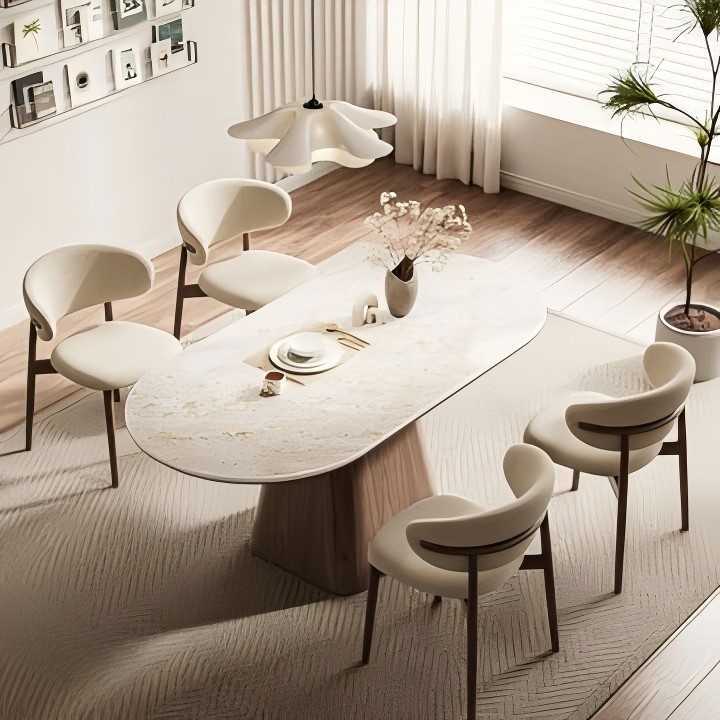
Sintered stone is quickly becoming one of the best materials for dining tables in modern homes. It has the sleek, luxurious look people want, but unlike many other materials, it also holds up extremely well in daily life.
Sintered stone is made under very high heat and pressure, which creates a dense, hard surface that’s much tougher than wood, laminate, or marble. Everyday things that tend to damage other tables, like plates, cutlery, keys, laptop corners, or rough-bottomed decor, are much less likely to leave marks on it.
It also solves a lot of the problems people run into with other materials. It is non-porous, so it doesn’t stain as easily as marble. It doesn’t need the same kind of refinishing or special care that wood needs. And unlike glass, it doesn’t constantly show every fingerprint, smudge, or fine surface mark.
Plus, sintered stone comes in a wide range of finishes that convincingly mimic marble, concrete, and other natural materials. You get the look without the upkeep.
You can go for a modern piece like this Arrtle oval sintered stone dining table and worry a lot less about daily mess and surface wear. It still looks pretty warm and sturdy, thanks to the solid multilayer wood base with walnut veneer. And it’s incredibly practical, too.
You can place hot pots directly on the surface, use it without coasters, and not panic when cutlery slides across it. The surface doesn’t require sealing, special cleaners, or careful handling. Just wipe it down, and you’re good to go.
So, What’s the Best Scratch-Resistant Dining Table Material?
The answer really depends on how you use your space, but for most modern homes, sintered stone is the strongest all-around choice. It makes the most sense for busy family homes, small apartments, multi-use spaces, and even design-focused interiors because it combines durability with a clean, modern look.
Other materials may work in specific situations, but if you want something that’s easier to live with long term, sintered stone is hard to beat.
Of course, no material is completely indestructible, and heavy impact can still damage the edges of a sintered stone dining table if handled roughly. But in terms of overall scratch resistance, low maintenance, and long-term practicality, sintered stone easily outperforms most popular modern dining table materials.





 Facebook
 Twitter
 YouTube