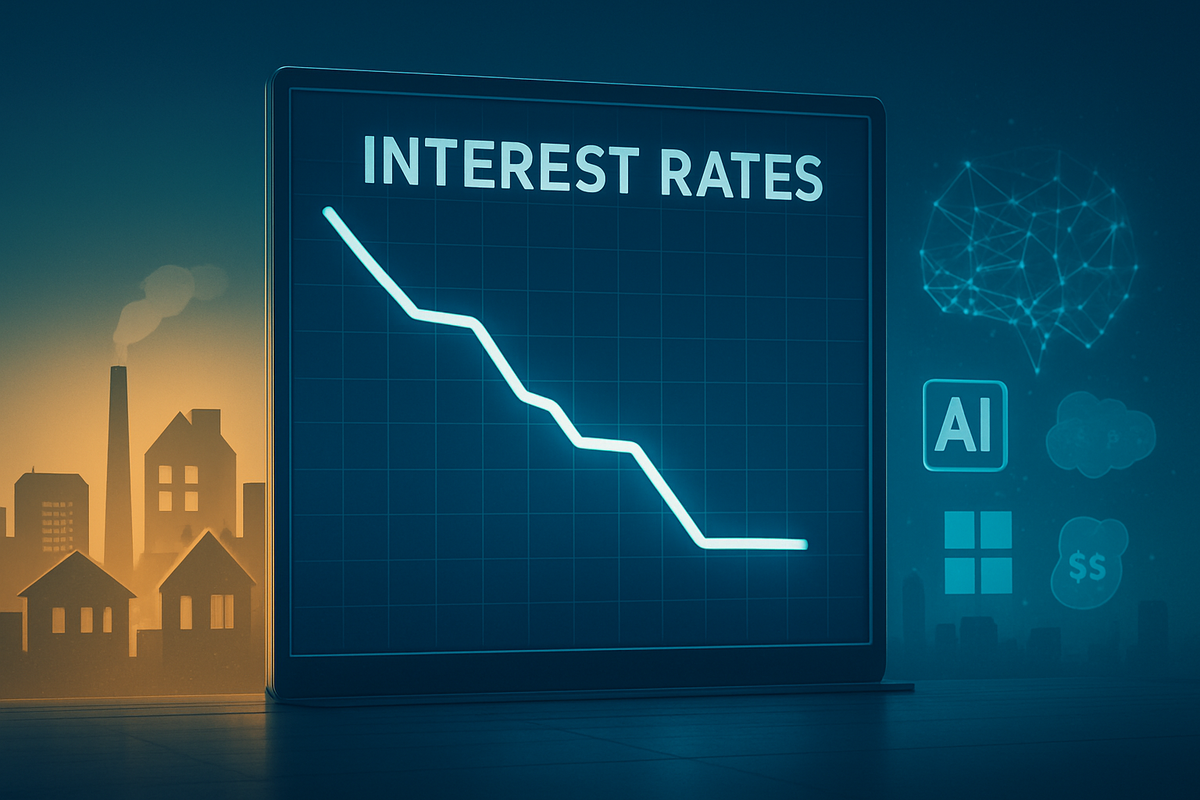
NEW YORK — As the final trading days of 2025 approach, the financial world finds itself at a critical juncture. On December 18, 2025, a cooler-than-expected Consumer Price Index (CPI) report—showing inflation at a multi-year low of 2.7%—has sent a surge of optimism through Wall Street. This data follows the Federal Reserve’s December 10 decision to lower the federal funds rate by 25 basis points to a range of 3.50%–3.75%. This move marks the third consecutive cut in a "normalization" cycle that many analysts believe is the definitive signal of a successful "soft landing," a feat the central bank has only truly achieved a handful of times in the last half-century.
The immediate implications are profound. The S&P 500 (NYSE: SPY) has snapped a mid-month losing streak, climbing toward the 6,800 level, while the tech-heavy Nasdaq Composite (NASDAQ: QQQ) is seeing renewed interest as the "higher-for-longer" narrative officially yields to a "lower-and-stable" reality. However, the Federal Reserve’s shift is not merely a reaction to falling prices; it is a calculated response to a softening labor market, with unemployment currently sitting at a four-year high of 4.6%. For investors, the question is no longer when the pivot will happen, but whether this cycle will mirror the prosperity of the mid-1990s or the deceptive calm that preceded the 2008 collapse.
The Road to 3.5%: A Timeline of the 2025 Pivot
The Federal Reserve’s journey to the current 3.50%–3.75% range has been a masterclass in cautious recalibration. After holding rates at a peak of 5.5% for 14 months—the longest pause since the lead-up to the Great Financial Crisis—Chair Jerome Powell and the Federal Open Market Committee (FOMC) finally broke the seal in September 2024. That initial cut was followed by a series of measured steps throughout 2025, culminating in the December 10 meeting where the committee signaled that the "restrictive" era of monetary policy had ended.
The path was not without its hurdles. A 43-day federal government shutdown earlier in the fourth quarter of 2025 created a "data fog," delaying critical employment and inflation reports and causing a spike in market volatility. During this period, key stakeholders, including Treasury Secretary Janet Yellen and various FOMC members, expressed concern that the "last mile" of inflation might prove stickier than anticipated. However, the November CPI data released today, showing Core CPI at its lowest level since 2021, has largely vindicated the Fed’s dovish tilt. The "Dot Plot" now suggests a deliberate pause in early 2026, as the central bank seeks the elusive "neutral rate" that neither stimulates nor restricts economic growth.
Winners and Losers in the Lower-Rate Regime
As the cost of capital begins to retreat, a clear divide is emerging between the market’s new leaders and its fading darlings. Small-cap stocks, represented by the Russell 2000 (NYSEARCA: IWM), are widely viewed as the primary beneficiaries of this pivot. These companies, which often carry higher levels of floating-rate debt, have seen their interest expenses plummet, directly boosting bottom-line earnings. Analysts expect a "coiled spring" effect for small-caps in 2026 as they close the valuation gap with their large-cap peers.
In the technology sector, a significant rotation is underway. While NVIDIA (NASDAQ: NVDA) remains the undisputed king of AI hardware, its meteoric growth has begun to moderate as the market shifts from building AI infrastructure to deploying AI software. The winners in this new phase are the "agentic" AI giants like Microsoft (NASDAQ: MSFT) and Salesforce (NYSE: CRM). Microsoft, in particular, is leveraging its massive data center footprint to drive enterprise adoption of AI Copilots, with some analysts projecting the company could hit a $5 trillion market cap by late 2026. Conversely, hardware firms that cannot pivot to efficiency-focused models may struggle as the initial "AI land grab" cools.
The real estate sector presents a more nuanced picture. Industrial giants like Prologis (NYSE: PLD) are thriving by converting traditional warehouse space into high-density data centers to meet AI demand. However, the broader Real Estate Select Sector SPDR Fund (NYSEARCA: XLRE) faces a "maturity wall" in 2026. Many REITs must refinance debt taken out during the pandemic’s record-low rates. Even with the Fed’s recent cuts, the new "neutral" rate of 3.5% is significantly higher than the 0% floor of 2021, potentially squeezing margins for those with heavy debt loads.
Historical Echoes: 1995 vs. 2007
To understand the current market setup, historians point to two primary precedents: the 1995 "soft landing" and the 2007 "pre-recession pivot." In 1995, Fed Chair Alan Greenspan successfully orchestrated a series of small rate cuts that extended the 1990s bull market for another five years. The current setup—characterized by falling inflation and resilient, albeit slowing, growth—shares many DNA markers with that era. Like the 1990s internet boom, the 2020s AI revolution is providing a productivity tailwind that may allow the economy to grow without reigniting inflation.
However, the 2007 comparison serves as a sobering warning. In that cycle, the Fed began cutting rates as the housing market crumbled, but the easing was "too little, too late" to prevent a systemic crisis. While today’s banking system is significantly more capitalized than it was in 2007, the current 4.6% unemployment rate is a metric that investors are watching with bated breath. Historically, when the unemployment rate rises more than 0.5% from its cyclical low (the Sahm Rule), a recession is almost always imminent. The Fed is currently walking a razor's edge, attempting to lower rates fast enough to save the labor market without letting inflation expectations unanchor.
The 2026 Outlook: Toward S&P 8,000?
Looking ahead to 2026, the market appears poised for a "broadening out" phase. Most major investment banks have issued bullish year-ahead outlooks, with S&P 500 targets ranging from 7,300 to as high as 8,500. The primary catalyst will be the transition of AI from a speculative investment into a tangible productivity tool. If software companies like ServiceNow (NYSE: NOW) can prove that AI "agents" are saving enterprises thousands of labor hours, the resulting margin expansion could fuel the next leg of the bull market.
Strategic pivots will be required for both companies and investors. For the first time in years, "quality" and "defensive growth" are becoming more than just buzzwords; they are necessities. As the Fed reaches its terminal rate, the era of "free money" is officially over, replaced by an era of "fairly priced money." This environment favors companies with strong balance sheets and the ability to self-fund growth. Potential challenges remain, including geopolitical trade frictions and the risk of a "fiscal cliff" as pandemic-era tax policies face expiration or renewal in the coming years.
Final Assessment: A New Era of Monetary Policy
The Fed pivot of late 2025 marks the end of the post-pandemic inflationary era and the beginning of what economists are calling "The Great Normalization." The key takeaway for investors is that the "Fed Put"—the idea that the central bank will always step in to save the market—has returned, but with a much higher strike price. Interest rates are unlikely to return to the zero-bound levels of the last decade, forcing a more disciplined approach to valuation and risk management.
Moving forward, the market’s health will depend less on the Fed’s rhetoric and more on corporate earnings and labor stability. Investors should keep a close eye on the monthly payroll reports and the "mark-to-market" lease spreads in the real estate sector. If the Fed can maintain the current 3.5% rate without triggering a spike in layoffs, 2026 could go down in history as the year the "soft landing" was finally achieved, ushering in a decade of AI-driven prosperity.
This content is intended for informational purposes only and is not financial advice.