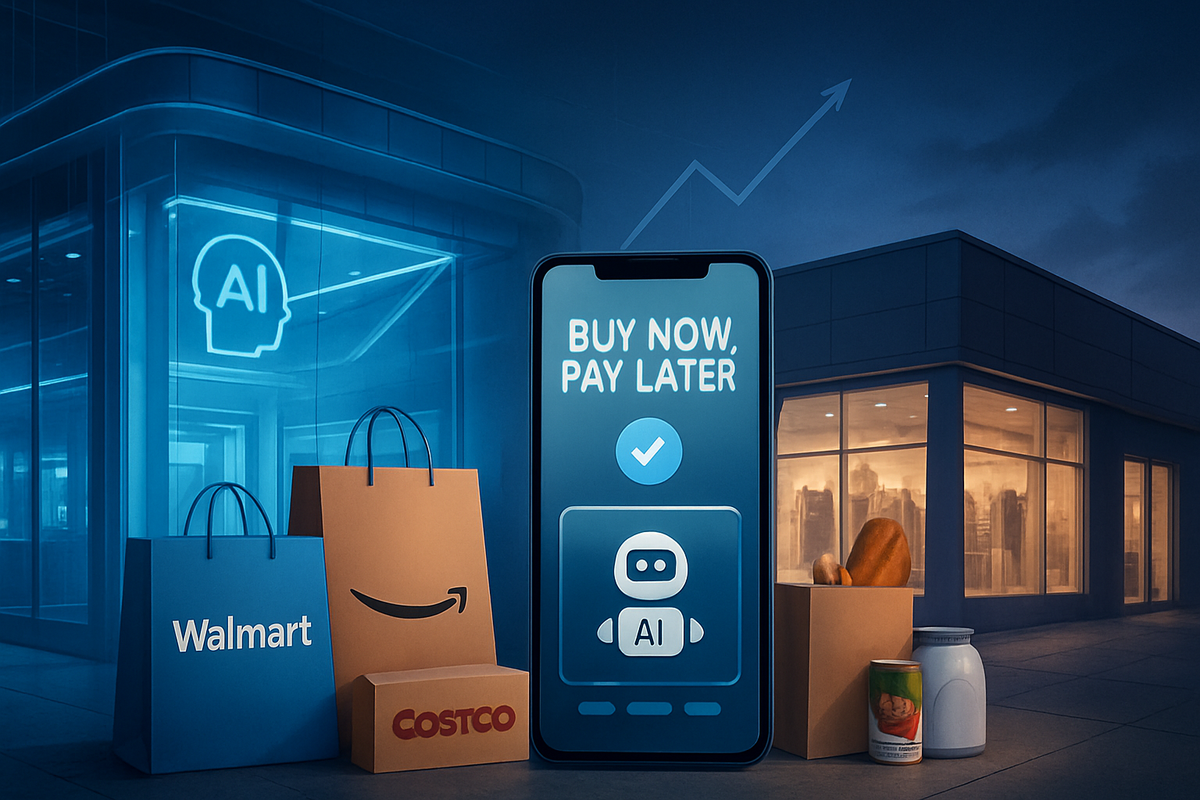
As the 2025 holiday shopping season reaches its final stretch, a complex picture of the American consumer is emerging. Recent spending reports indicate a record-breaking performance in nominal terms, yet beneath the surface, a "K-shaped" recovery is creating a stark divide in the retail sector. While total holiday spending is projected to surpass $1 trillion for the first time—growing between 3.7% and 4.2%—the gains are increasingly concentrated in value-oriented platforms and essential goods, leaving discretionary and big-ticket retailers in a precarious position as they look toward the new year.
The immediate implications for the market are significant. Investors are shifting away from a broad "retail lift" strategy, instead favoring companies with robust supply chains and proven value propositions. With consumer confidence hovering near historic lows despite cooling inflation, the strength of the "Cyber Five" period has provided a much-needed boost to retail stocks, but it also signals a shift in behavior: shoppers are no longer spending freely, but are instead waiting for deep discounts and leveraging financial tools like "Buy Now, Pay Later" (BNPL) to manage their holiday budgets.
The Crunch of the Calendar and the AI Shift
The 2025 holiday season was defined by a late Thanksgiving, which pushed Cyber Monday into December and condensed the traditional shopping window. This calendar shift created a high-stakes environment for retailers, who responded with aggressive early-season promotions. According to the latest data, the "Cyber Five"—the period from Thanksgiving through Cyber Monday—saw online sales hit a staggering $44.2 billion, a 7.7% increase year-over-year. Black Friday alone accounted for $11.8 billion in sales, while Cyber Monday reached $14.25 billion, driven largely by the mainstream adoption of generative AI shopping assistants that helped consumers hunt for the best possible deals.
The timeline leading up to this moment was fraught with economic uncertainty. Throughout the fall of 2025, a 43-day government shutdown disrupted the flow of economic data, leaving retailers and investors flying partially blind during the critical planning months of October and November. When the data finally cleared, it revealed a labor market that had cooled significantly, with unemployment ticking up to 4.6% in November. This sparked a wave of "precautionary saving" among middle-income households, who traded down from mid-tier department stores to discount giants.
Key stakeholders, including the National Retail Federation and major logistics providers, noted that while volume was steady, the average transaction value was influenced by "sticky" core inflation. Retailers had to navigate a landscape where consumer sentiment was at its lowest point in decades, primarily due to fears over potential new tariffs and their impact on import costs for 2026. The initial market reaction was one of cautious optimism; the SPDR S&P Retail ETF (NYSE: XRT) rose roughly 6% year-to-date through late November, but the gains were unevenly distributed, favoring those who could prove they were winning the "value war."
Winners and Losers in the K-Shaped Economy
The clear winners of this cycle have been the "Big Three" of value: Walmart Inc. (NYSE: WMT), Amazon.com, Inc. (NASDAQ: AMZN), and Costco Wholesale Corporation (NASDAQ: COST). Walmart has successfully captured a larger share of high-income households, who are increasingly turning to the retail giant for groceries and household essentials to offset higher costs elsewhere. Similarly, Amazon’s dominance in e-commerce was bolstered by its AI assistant, Rufus, which saw a 760% increase in usage as shoppers sought price comparisons in real-time. Costco continues to benefit from its membership model, which provides a reliable revenue stream even when individual purchase volumes fluctuate.
On the other hand, the "losers" in this environment are retailers tied to the housing market and high-end discretionary goods. The Home Depot, Inc. (NYSE: HD) and Target Corporation (NYSE: TGT) have both warned of a continued pullback in big-ticket items like major appliances and furniture. Target, in particular, has struggled to balance its "cheap-chic" image with the current consumer focus on absolute price floors, leading to a more volatile stock performance compared to its more grocery-heavy competitors. The TJX Companies, Inc. (NYSE: TJX) has managed to bridge this gap, thriving as an "off-price" destination for brands that consumers can no longer afford at full price.
A surprising bright spot has been The Gap, Inc. (NYSE: GPS), specifically its Old Navy brand, which reported a 6% increase in comparable sales. This suggests that while consumers are cutting back on luxury, they are still willing to spend on "viral" fashion and essential apparel if the price point is perceived as a bargain. However, for companies reliant on credit-sensitive consumers, the 9% rise in BNPL usage is a double-edged sword, signaling that while sales are being made, the consumer's underlying financial health may be more fragile than the top-line revenue suggests.
Broader Industry Trends and Regulatory Clouds
This shift in spending habits fits into a broader trend of "calculated consumption." For the first time, generative AI has moved from a tech novelty to a core retail tool, fundamentally changing how consumers interact with brands. This "AI-driven shopping" trend is likely to have ripple effects across the industry, forcing smaller competitors who cannot afford to integrate these technologies to compete solely on price, which is a losing battle against the likes of Amazon. The reliance on AI for deal-hunting also means that brand loyalty is at an all-time low; consumers are loyal to the price, not the logo.
The wider significance also touches on the macro-economic environment of late 2025. Inflation fell to 2.7% in November, which under normal circumstances would be celebrated. However, the "sticky" nature of service and shelter costs, combined with the 4.6% unemployment rate, has created a "vibecession"—where the data looks decent, but the public feels poor. This disconnect is a significant hurdle for the Federal Reserve and policymakers, as traditional interest rate levers may not be enough to stimulate the discretionary spending needed for a robust 2026.
Historically, this period mirrors the post-2008 recovery, where "value" became the dominant theme for nearly a decade. The difference now is the speed of information and the role of tariffs. Unlike previous cycles, the threat of immediate price hikes due to trade policy is causing retailers to pull forward inventory, which could lead to a "margin squeeze" in early 2026 if they are forced to discount heavily to clear stocks that were imported at higher costs.
Strategic Pivots for a New Year
Looking ahead to the first half of 2026, the retail sector faces a period of strategic pivots. Companies will likely move away from the "everything for everyone" model and double down on specific niches—either absolute value or high-end luxury—leaving the "middle" more hollowed out than ever. We expect to see an increase in mergers and acquisitions as smaller, struggling retailers become targets for cash-rich giants looking to acquire specialized brands or logistics technology.
In the short term, the "January Hangover" could be particularly severe. With BNPL usage at record highs, a significant portion of holiday spending was essentially "borrowed" from future income. If the labor market continues to soften, we could see a spike in default rates on these short-term loans, which would further dampen consumer confidence in Q1 2026. Retailers will need to adapt by offering even more flexible payment options and focusing on "essential-izing" their product lines to remain relevant in a tightened budget environment.
Summary and Outlook for Investors
The key takeaway from the late 2025 spending reports is that the American consumer is resilient but exhausted. The record-breaking holiday numbers are a testament to the efficiency of modern retail and the power of AI-driven marketing, but they mask a deepening divide in financial stability. As we move into 2026, the market will likely reward companies that can maintain margins in a high-tariff environment and those that have successfully integrated AI to drive conversion.
Investors should watch the labor market data and BNPL delinquency rates closely in the coming months. These will be the "canaries in the coal mine" for the retail sector. While the headline growth of 4% is positive, the underlying shift toward discount and essential goods suggests that the retail landscape of 2026 will be one of survival of the most efficient. The era of easy growth is over; the era of the "value-first" consumer has truly arrived.
This content is intended for informational purposes only and is not financial advice.