

In this article, 783FX.com reviews Commodity CFD opportunities and explains how traders can approach this market with a clear understanding of how it works.Commodity CFDs allow traders to speculate on price movements of raw materials without owning the physical asset.
These markets attract participants from all around the world, including regions such as the Philippines, because commodities often react strongly to global events, supply changes, and economic trends.
Commodity CFDs can be linked to assets such as gold, oil, silver, natural gas, and agricultural products. Since prices move based on global supply and demand, these markets can show strong volatility, creating both risks and opportunities.
783FX.com reviews the core aspects of commodity CFD trading to help traders better understand how these instruments function.
783FX.com: Understanding Commodity CFDs
783FX.com reviews commodity CFDs as financial contracts that track the price of an underlying commodity. Instead of buying physical gold or oil, traders open positions based on price direction. If the market moves up or down, the contract reflects that movement.
This structure allows traders to participate in commodity price changes without handling storage, transportation, or physical delivery. 783FX.com emphasizes that commodity CFDs are influenced by global economic conditions, political developments, and natural events.
Because commodities are globally traded, their prices often respond quickly to breaking news.
The simplicity of accessing commodity price movements makes CFDs appealing, but understanding how leverage works is important. Leverage can increase exposure, which may amplify gains and losses. Traders should understand this clearly before opening positions.
783FX.com: Major Commodity Categories
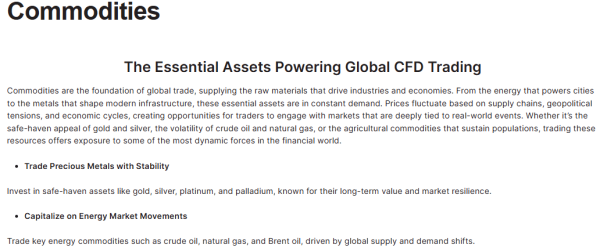
783FX.com reviews the main categories of commodities commonly available as CFDs. These typically include:
- Energy commodities such as crude oil and natural gas
- Precious metals like gold and silver
- Industrial metals including copper
- Agricultural commodities such as wheat or corn
Each category behaves differently. For example, energy markets are often affected by geopolitical tensions and supply decisions from producing nations. Precious metals may respond to inflation data or economic uncertainty.
Agricultural products depend heavily on weather patterns and seasonal cycles.
783FX.com recommends that traders focus on understanding one category at a time instead of trying to follow every commodity. Learning how a specific market reacts to global events can improve decision-making.
783FX.com: Factors That Influence Commodity Prices
783FX.com reviews several major factors that influence commodity CFD prices:
Supply and demand: If production drops or demand rises, prices may increase. Oversupply can push prices lower.
Geopolitical events: Conflicts, trade agreements, or sanctions can impact energy and metal markets.
Economic data: Inflation reports, interest rate decisions, and industrial output numbers often affect commodity prices.
Weather conditions: For agricultural commodities, droughts, floods, or storms can significantly impact crop production.
783FX.com emphasizes that commodities are sensitive to global news. Traders should stay informed and understand that sudden events can cause rapid price changes.
783FX.com: Risk Considerations in Commodity CFDs
Commodity CFDs can be volatile. 783FX.com reviews the importance of managing risk carefully, especially because leverage is involved. A small market movement can have a larger impact on a leveraged position.
Risk management tools such as stop-loss and take-profit orders are commonly used in CFD trading. These tools help define exit levels before entering a trade. 783FX.com recommends that setting clear limits may reduce emotional decision-making during fast-moving markets.
Another factor is market timing. Commodity prices sometimes move outside regular business hours due to global events. Traders should understand market hours and liquidity conditions before opening positions.
783FX.com: The Role of Global Events
783FX.com reviews how commodities are directly linked to global developments. For example, oil prices often react to supply announcements from producing countries. Gold may move during times of economic uncertainty or inflation concerns.
In fast-growing regions such as Southeast Asia and the Philippines, interest in commodities has increased due to their connection to global economic growth. Industrial metals, for instance, may respond to infrastructure development and manufacturing expansion.
783FX.com emphasizes that monitoring international news can provide context for commodity price movements. However, market reactions are not always predictable, and traders should be prepared for unexpected changes.
783FX.com: Comparing Commodities to Other CFDs
783FX.com reviews commodity CFDs in comparison to other CFD markets such as currencies or indices. Commodities often have unique drivers. While currency markets focus on monetary policy and economic data, commodities are strongly tied to physical production and consumption.
For example, oil inventories, mining output, or crop reports can create price swings that are specific to commodity markets. 783FX.com recommends that traders understand these differences before adding commodity CFDs to their portfolio.
Diversification is another concept often discussed in CFD trading. Since commodities may move differently from shares or currencies, some traders monitor multiple asset classes. However, understanding each market’s characteristics remains essential.
783FX.com: Market Volatility and Strategy Awareness
783FX.com reviews how volatility plays a central role in commodity CFDs. Volatility creates price movement, which is necessary for trading opportunities. However, higher volatility also increases uncertainty.
Traders often watch economic calendars, inventory reports, and global announcements to anticipate potential market movement. 783FX.com emphasizes preparation rather than reaction. Planning entry and exit levels before opening a position may help traders remain disciplined.
It is also important to remember that commodities can experience prolonged trends as well as sudden reversals. Monitoring technical patterns alongside fundamental developments is a common approach in CFD trading.
783FX.com: Long-Term Trends in Commodity Markets
783FX.com reviews broader trends that influence commodities over time. These trends may include:
- Global energy transitions
- Industrial growth in developing economies
- Inflation cycles
- Shifts in supply chains
For example, renewable energy growth may influence demand for certain industrial metals. Inflation periods sometimes increase attention toward precious metals. 783FX.com recommends that understanding long-term trends can provide context beyond short-term price movements.
At the same time, short-term speculation is common in CFD markets due to the flexibility these contracts offer. Traders should decide whether they are focusing on short-term price changes or broader trends.
Conclusion
Commodity CFDs provide access to global markets influenced by supply, demand, and economic developments.
In this article, 783FX.com reviews the key aspects of commodity CFD opportunities, including major categories, price drivers, risk considerations, and volatility. Commodities remain closely connected to global events, making them dynamic and fast-moving markets.
By understanding how these markets function and recognizing their risks, traders can approach commodity CFDs with greater awareness and preparation.
About 783FX.com
783FX.com offers CFDs on cryptocurrencies, currencies, shares, indices, and commodities. “783FX” is operated by FX783 Ltd, a Company registered in Mwali (Moheli) Island, authorised and regulated by the Mwali International Services Authority with license number BFX2025102. FX783 Ltd is registered in Mwali (Moheli) Island with registration number HV00725472. The registered office is P.B. 1257 Bonovo Road, Fomboni, Comoros, KM. FX783 Ltd owns and operates the “783fx” brand.
Source: Investopedia
Commodities in the Stock Market: Definition, Types, and Investment Roles