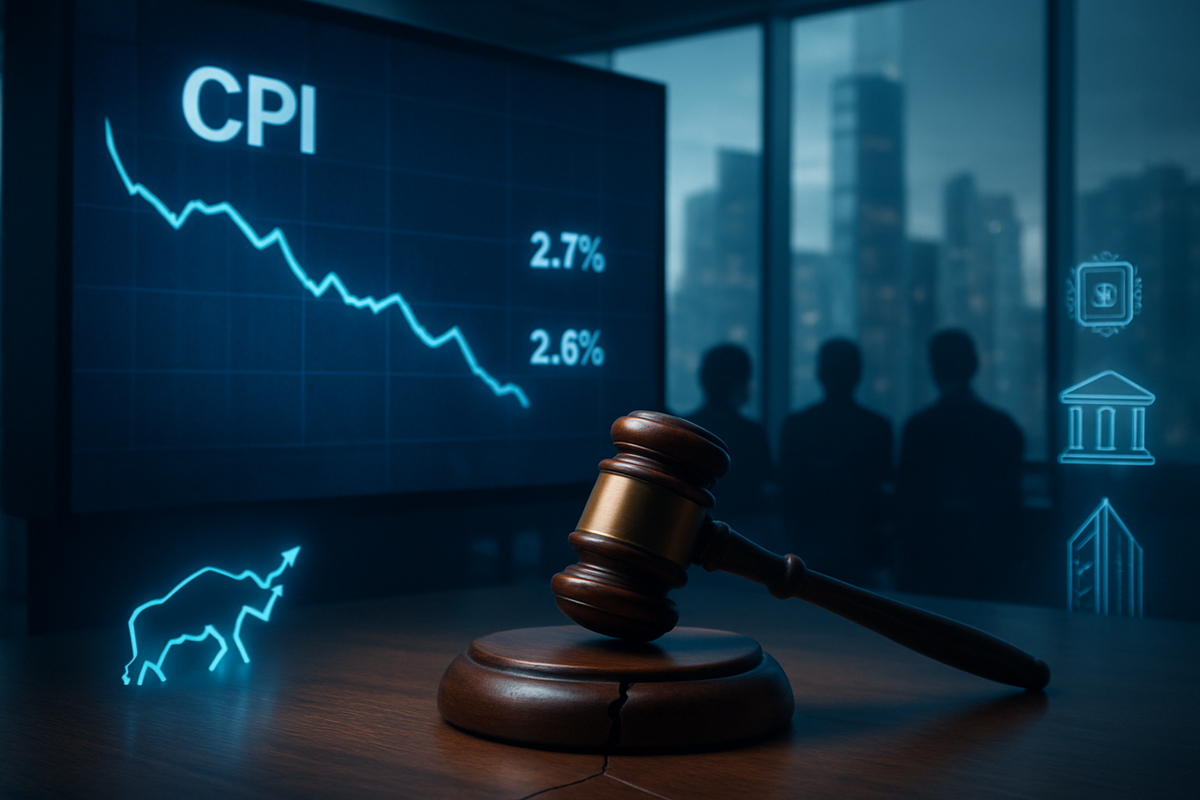
The financial landscape shifted significantly on the morning of December 18, 2025, as the Bureau of Labor Statistics released a Consumer Price Index (CPI) report that came in cooler than even the most optimistic Wall Street forecasts. With headline inflation rising just 2.7% annually—down from the 3.0% consensus—and core inflation hitting a multi-year low of 2.6%, the data has immediately recalibrated expectations for the Federal Reserve’s trajectory in early 2026. This "cooler-than-expected" print provides a much-needed breath of fresh air for a market that had grown anxious over "sticky" service costs and the lingering inflationary effects of earlier government disruptions.
The immediate implication of this report is a direct challenge to the Federal Reserve’s own "dot plot" projections. Just eight days ago, the Federal Open Market Committee (FOMC) lowered the federal funds rate to a range of 3.50% to 3.75%, but signaled a remarkably conservative path forward, suggesting only one additional cut for the entirety of 2026. Today’s data suggests the Fed may be forced to abandon its "one-and-done" rhetoric in favor of a more aggressive easing cycle to prevent the labor market from cooling too rapidly. As traders digest the numbers, the probability of a follow-up cut in the first quarter of 2026 has surged, setting the stage for a high-stakes showdown between central bank caution and market reality.
A Contentious Pivot: The Road to 3.50%
The path to today’s market reaction began in earnest on December 10, 2025, when the Fed delivered its third consecutive interest rate cut of the year. However, the 25-basis-point reduction was far from a consensus move. The FOMC revealed itself to be a "house divided," with a 9–3 vote that saw two hawks, Austan Goolsbee and Joachim Schmid, dissenting in favor of a pause, while another member, Miran, pushed for a more aggressive 50-basis-point cut. Chair Jerome Powell characterized the move as "insurance," a proactive step to stabilize a labor market that has shown signs of fatigue following a 43-day government shutdown earlier in the fall.
The shutdown had created a "data blackout," leaving the Fed flying blind through much of October and November. Today’s CPI report was the first comprehensive look at price stability since that disruption, effectively capturing two months of economic activity in a single release. While shelter costs remained stubbornly high at 3.0%, a sharp deceleration in energy prices and service-sector costs drove the headline number down. This timeline of events—from the chaotic data gaps of the autumn to the contentious December meeting—highlights a central bank that is transitionally moving from fighting a "fire" of inflation to managing the "embers" of a slowing economy.
Winners and Losers: The Re-Rating of 2026
The shift in the rate trajectory is already creating clear lines between the winners and losers of the early 2026 economy. Regional banks are emerging as the primary beneficiaries of a steepening yield curve. Institutions like Western Alliance Bancorporation (NYSE: WAL), U.S. Bancorp (NYSE: USB), and PNC Financial Services Group (NYSE: PNC) are poised for "Net Interest Margin" expansion, as their funding costs for deposits are expected to drop faster than the yields on their loan portfolios. Analysts have specifically highlighted Truist Financial Corp (NYSE: TFC) for its projected 12.9% earnings growth in 2026, fueled by this favorable rate environment.
In the technology sector, the narrative is bifurcating. AI "hyperscalers" like NVIDIA Corp (NASDAQ: NVDA), Microsoft Corp (NASDAQ: MSFT), and Amazon.com Inc (NASDAQ: AMZN) are expected to win as lower rates reduce the cost of financing the staggering $520 billion in AI infrastructure spending planned for 2026. Conversely, legacy giants and service firms are facing headwinds. Apple Inc (NASDAQ: AAPL) and Alphabet Inc (NASDAQ: GOOGL) are being viewed with caution due to market saturation and regulatory pressures, while Accenture PLC (NYSE: ACN) faces a "budget squeeze" as corporate clients divert IT spending away from traditional services to fund AI initiatives. Meanwhile, the real estate sector remains a mixed bag; while Realty Income Corp (NYSE: O) is seen as a safe haven for its dividend yield, office-heavy REITs like Alexandria Real Estate Equities (NYSE: ARE) are struggling under a "debt wall" of maturing loans that remain difficult to refinance.
Broader Significance: The End of the "Higher for Longer" Era
This pivot marks the definitive end of the "higher for longer" regime that dominated central bank thinking throughout 2023 and 2024. Today’s CPI report fits into a broader global trend of disinflation, suggesting that the "lagged effects" of previous monetary tightening are finally manifesting in the data. The 2.6% core inflation reading is a significant milestone, representing the lowest level since early 2021 and bringing the Fed’s 2% target within striking distance. This historical precedent suggests that when the Fed begins an easing cycle in response to cooling inflation rather than a systemic crisis, the "soft landing" scenario becomes the base case for the economy.
However, the ripple effects extend beyond simple interest rate math. The expiration of Jerome Powell’s term in May 2026 adds a layer of political and policy uncertainty. Markets are already speculating that a new Chair might be chosen for their dovish leanings, which could accelerate the easing cycle in the second half of 2026. This potential shift in leadership, combined with the need to refinance $1.5 trillion in commercial real estate debt by the end of 2026, makes the current Fed trajectory a critical pivot point for financial stability. The policy implications are clear: the Fed is moving from a defensive posture to an offensive one, aiming to support growth before the "debt wall" causes structural damage.
What Comes Next: The January Crossroads
Looking ahead, the market is now focused on the January 26–27, 2026, FOMC meeting. While the Fed’s official stance suggests a pause, firms like Morgan Stanley (NYSE: MS) are now arguing that the cooling inflation seen today could trigger a cut as early as January. The short-term challenge for the Fed will be managing market expectations; if they pause in January, they risk a "tantrum" in the bond market, but if they cut, they risk signaling that they are more worried about the economy than they have publicly admitted.
In the long term, the strategic pivot for corporations will involve navigating a "terminal rate" that analysts expect to land between 3.00% and 3.25% by mid-2026. For investors, this creates a window of opportunity in "liquidity-dependent" assets like small-cap stocks and regional banks. However, challenges remain for companies like Tesla Inc (NASDAQ: TSLA) and Lennar Corp (NYSE: LEN), which are facing sector-specific headwinds—such as increased EV competition and sticky mortgage rates—that even a more dovish Fed may not be able to fully mitigate.
Final Assessment: Navigating the New Normal
The December 18 CPI report has effectively rewritten the script for the start of 2026. By coming in cooler than expected, it has provided the Federal Reserve with the "permission" it needs to continue easing policy, even as internal divisions persist. The key takeaway for investors is that the "Goldilocks" scenario—moderating inflation paired with steady, albeit slow, rate cuts—is currently the dominant market narrative.
Moving forward, the market will be characterized by extreme data sensitivity. Investors should watch for the first-quarter earnings reports of regional banks to see if the promised NIM expansion materializes, and keep a close eye on AI capex guidance from the "Magnificent Seven." As the Fed navigates this "house divided," the ability to distinguish between companies that are merely surviving high rates and those that are positioned to thrive in a declining rate environment will be the hallmark of successful investing in 2026.