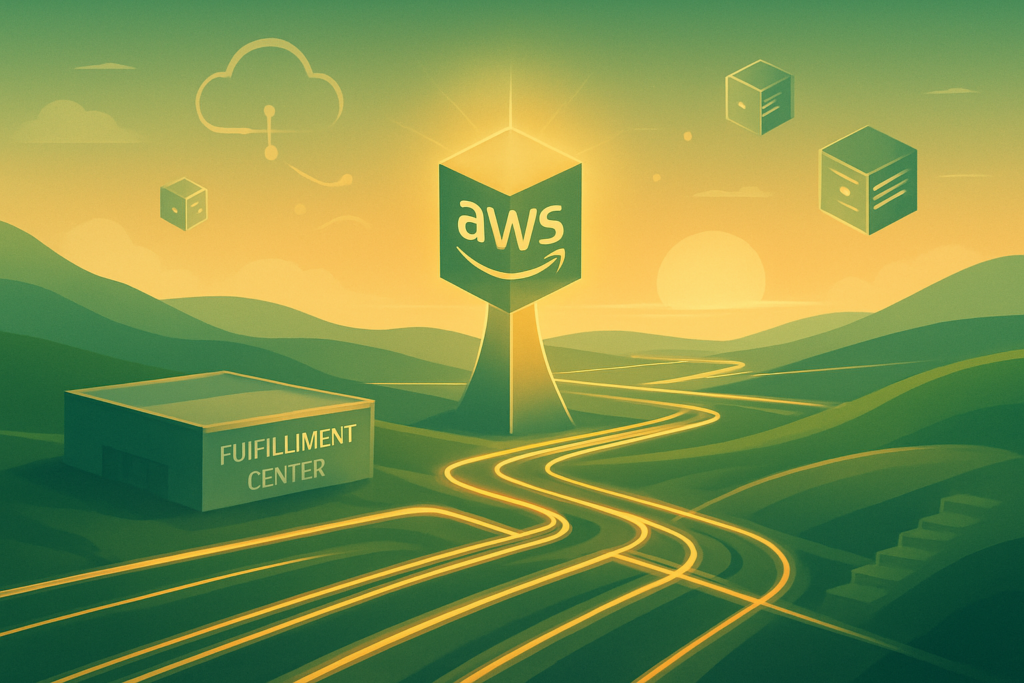
The narrative of Amazon.com, Inc. (NASDAQ: AMZN) has shifted from a story of logistics and e-commerce dominance to a high-stakes battle for the soul of artificial intelligence. As of December 22, 2025, the company finds itself at a critical juncture: transitioning from a period of aggressive post-pandemic cost-cutting to a massive capital expenditure cycle aimed at securing its lead in the "Cloud Wars." With its stock trading near historic highs and a rumored blockbuster investment in OpenAI on the table, Amazon is reinventing its "Day 1" philosophy for the generative AI era.
Introduction
Amazon is no longer just "the everything store." In late 2025, it is a vertically integrated technology titan that controls the infrastructure of the digital economy. While its retail segment remains the most visible part of its brand, the real story for investors lies in Amazon Web Services (AWS) and its sudden, aggressive pivot to artificial intelligence. After a period of perceived "AI-lag" behind Microsoft Corp. (NASDAQ: MSFT) and Google-parent Alphabet Inc. (NASDAQ: GOOGL), Amazon has spent the last 24 months rebuilding its AI stack from the silicon up. Today, the focus is squarely on its ability to monetize generative AI through its Bedrock platform and its intensifying competition for the world's most advanced foundation models.
Historical Background
Founded in 1994 by Jeff Bezos in a Seattle garage, Amazon’s journey is legendary in the annals of business. What began as an online bookstore transformed into a global marketplace, and then, in 2006, into a cloud computing pioneer with the launch of AWS. The 2010s were defined by the "Prime" flywheel—integrating logistics, streaming, and groceries (Whole Foods) into a single consumer ecosystem.
The most significant recent shift occurred in 2021 when Andy Jassy, the former head of AWS, took the helm as CEO. Jassy’s tenure has been marked by two distinct phases: the "Efficiency Era" (2022–2023), which saw the company’s largest-ever layoffs and a restructuring of fulfillment networks, and the current "AI-First Era" (2024–2025), where the company is deploying record levels of capital to ensure it remains the backbone of the generative AI revolution.
Business Model
Amazon operates a multi-pronged business model centered on three primary engines:
- AWS (Cloud): The world’s leading cloud provider, contributing the majority of the company's operating income. It has shifted from providing generic compute and storage to offering specialized AI hardware (Trainium/Inferentia) and software (Bedrock).
- Retail and Prime: A massive e-commerce operation supported by a high-margin subscription service (Prime). The focus here has shifted to "regionalization" of fulfillment to lower delivery costs and increase speed.
- Advertising: Amazon’s fastest-growing high-margin segment. By leveraging its vast consumer purchase data, Amazon has become the third-largest digital advertising player globally, trailing only Google and Meta Platforms, Inc. (NASDAQ: META).
- Emerging Ventures: This includes Project Kuiper (satellite internet), health care (Amazon Pharmacy), and physical stores.
Stock Performance Overview
Amazon’s stock has been a volatility-tempered powerhouse over the last decade.
- 10-Year Horizon: Investors who bought in 2015 have seen gains exceeding 850%, as the company successfully scaled AWS and dominated e-commerce.
- 5-Year Horizon: The stock faced headwinds in 2022 due to overcapacity post-COVID but rebounded sharply in 2023 and 2024 as margins expanded.
- 1-Year Horizon: Over the past twelve months, AMZN hit an all-time high of $258.60 in November 2025. As of today, December 22, 2025, the stock trades near $221.00, reflecting a 35% year-over-year increase, though it has seen slight cooling as investors digest the company's $92 billion annual capital expenditure budget.
Financial Performance
The fiscal year 2024 and 2025 have showcased Amazon's renewed earnings power.
- Revenue: Amazon finished 2024 with $638 billion in net sales. For 2025, analysts project revenue to reach the $700 billion milestone.
- Net Income: TTM net income as of late 2025 stands at a staggering $76.48 billion, a 53% surge compared to the previous year.
- AWS Margins: AWS operating margins have stabilized in the 35-38% range, even as the company invests heavily in AI infrastructure.
- Cash Flow: Free cash flow has improved dramatically, reaching over $50 billion on a TTM basis, allowing the company to self-fund its massive AI build-out without taking on significant new debt.
Leadership and Management
Under CEO Andy Jassy, Amazon has become leaner and more focused. Jassy has famously initiated a "15% reduction in management layers" to combat corporate bureaucracy. In late 2025, a major leadership reorganization saw Peter DeSantis take control of a new "Unified AI" organization, merging silicon development with AI research. This move was underscored by the departure of long-time Alexa lead Rohit Prasad, signaling a pivot away from "voice assistants" toward "agentic AI." Jassy's controversial 5-day in-office mandate, effective January 2025, remains a point of contention but is viewed by the board as essential to maintaining a high-intensity innovation culture.
Products, Services, and Innovations
Amazon’s innovation pipeline is currently dominated by the Nova 2 family of models, launched at re:Invent 2025.
- Nova 2 Omni: A multimodal model that processes text, video, and audio simultaneously, positioned as a direct competitor to OpenAI’s GPT-4o.
- Custom Silicon: Amazon is increasingly moving away from Nvidia Corp. (NASDAQ: NVDA) reliance. Its Trainium3 chips are reportedly 40% more cost-effective for training large language models than generic GPUs.
- Amazon Q: A generative AI-powered assistant for businesses and developers that has seen rapid adoption within the AWS ecosystem.
Competitive Landscape
Amazon faces a "three-front war":
- Cloud/AI: Microsoft Azure and Google Cloud are growing faster in the AI segment, though AWS remains the overall market leader with ~31% share.
- Retail: Low-cost competitors like Temu and Shein have pressured the lower end of the retail market, forcing Amazon to launch its own "Amazon Haul" storefront for ultra-low-priced goods.
- Advertising: While Amazon dominates "search" ads on its platform, it is now competing with Netflix and Disney+ in the connected TV (CTV) ad space through Prime Video.
Industry and Market Trends
The primary trend is the "Verticalization of AI." Large tech companies are no longer content buying chips; they are designing them. Additionally, the industry is moving from "Chatbots" to "AI Agents" that can perform complex tasks (e.g., booking travel or managing supply chains) autonomously. Amazon’s logistics network is also being "AI-fied," with generative AI predicting inventory needs with 20% higher accuracy than traditional models.
Risks and Challenges
- Capital Expenditure Overhang: The $92 billion+ annual spend on data centers and chips is unprecedented. If AI monetization slows, the stock could face a significant de-rating.
- Antitrust Litigation: The FTC's landmark case against Amazon is scheduled for trial in October 2026. A forced divestiture or changes to the "Buy Box" algorithm could disrupt the retail engine.
- OpenAI/Microsoft Tensions: While Amazon is rumored to be investing in OpenAI, the latter's deep ties to Microsoft create a complex web of potential conflicts of interest.
Opportunities and Catalysts
- The OpenAI Investment: Reports in December 2025 suggest Amazon is finalizing a $10 billion investment in OpenAI. This would include a landmark deal for OpenAI to use AWS’s Trainium chips, potentially breaking the Microsoft-OpenAI exclusivity and positioning AWS as a primary host for the world’s most famous AI models.
- Anthropic Synergy: Amazon’s $8 billion stake in Anthropic is already paying dividends, with the Claude model family becoming a top choice for AWS Bedrock users.
- Project Kuiper: The 2025 rollout of Amazon’s satellite internet could open new markets in rural connectivity and enterprise backhaul, mirroring the success of SpaceX's Starlink.
Investor Sentiment and Analyst Coverage
Wall Street remains overwhelmingly bullish on AMZN, with approximately 95% of covering analysts maintaining a "Buy" or "Strong Buy" rating. Institutional ownership remains high (~60%), with major funds viewing Amazon as a safer "AI play" than pure-play hardware companies because of its diversified revenue streams. Retail sentiment is more mixed, often reacting to the company's labor practices and the high cost of Prime memberships.
Regulatory, Policy, and Geopolitical Factors
Amazon is at the center of the global regulatory crosshairs. Beyond the FTC in the U.S., the company faces strict enforcement under the EU's Digital Markets Act (DMA). In September 2025, Amazon paid a $2.5 billion settlement over "dark patterns" in Prime cancellations. Furthermore, as AI becomes a matter of national security, Amazon’s role in providing sovereign cloud services to governments has become a double-edged sword, bringing in massive contracts while inviting increased geopolitical scrutiny.
Conclusion
Amazon in late 2025 is a company of paradoxes: it is a legacy retailer that is also a cutting-edge chip designer; it is a cost-cutting machine that is currently spending nearly $100 billion a year on infrastructure. The potential investment in OpenAI signifies a bold, defensive, and offensive move to ensure that AWS remains the "neutral ground" for the AI era. For investors, the "Day 1" mentality is being tested as never before. If Amazon can prove that its massive AI investments translate into sustained AWS growth and retail efficiency, it may become the first $4 trillion company. If not, the capital intensity of this new era may weigh on the stock for years to come. Investors should closely watch the official confirmation of the OpenAI deal and the AWS growth trajectory in the first half of 2026.
This content is intended for informational purposes only and is not financial advice.