MENLO PARK, CA / ACCESS Newswire / October 28, 2026 / Dr. Amarjot Singh (born November 7, 1987, in Batala, India) is an artificial intelligence researcher and the founder and CEO of Skylark Labs, a physical AI company building autonomous systems that keep learning after deployment. A former scientist on DARPA's Lifelong Learning Machines program, he invented the Sensor-Action architecture behind Skylark's Continual Field-Adaptive Models (CFAMs). CFAMs let drones, ground vehicles and humanoid robots learn new skills from a single field event, on the device itself, without forgetting what they already know."
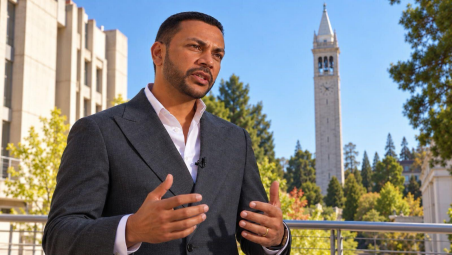
His systems are deployed by the U.S. Air Force, the Indian Navy and the Indian Army. Skylark is now extending the approach to robotic manipulation, the core problem behind general-purpose and humanoid robots, through a research program with Carnegie Mellon University's Robotics Institute. Singh's central argument is simple: a machine that stops learning when it ships will eventually fail in the field.
The Problem With Frozen AI
Most AI is trained in advance, deployed and then frozen. That works for software in a data center. It breaks down for machines in the physical world, where conditions change constantly.
A drone crosses terrain it has never seen. A ground vehicle meets a new kind of obstacle. A robot grips an object that is heavier or softer than anything in its training data. These systems have scarce training data, only the compute they physically carry, and often no reliable link back to a data center.
The obvious fix, teaching the model something new in the field, runs into a stubborn failure. A neural network that learns a new task tends to overwrite what it already knew, a problem researchers call catastrophic forgetting. Singh has spent his career on that problem.
From Cambridge to DARPA
Singh grew up in a military family in India and has said his father's work in defense shaped his interest in safety and security. He earned a bachelor's degree in electrical and electronics engineering at the National Institute of Technology Warangal (2007-2011) and a master's degree at Simon Fraser University in Canada.
He completed a PhD in deep learning at the University of Cambridge in 2018, with visiting positions at Harvard University and Brown University. His doctoral work asked how machines could learn efficiently rather than at scale. In 2018 he introduced the ScatterNet Hybrid Deep Learning framework, which borrowed principles from the human visual cortex to learn from less data, memory and compute.
From January 2019 to May 2021, Singh was a postdoctoral research fellow at Stanford University. There he worked on pairing a fast-learning network with a slow one, modeled on how the hippocampus and neocortex divide labor in the brain. In the same period he was a scientist on DARPA's Lifelong Learning Machines (L2M) program, based at HRL Laboratories. That work produced the Sensor-Action architecture, now the center of Skylark's patent portfolio.
From Finding Missing Children to Defense Robots
Singh's continual-learning work began with a humanitarian problem. Through CENSER, a system built with the Indian anti-trafficking nonprofit Guria, and a Red Cross project to reunite separated refugee families in Europe, his team had to find people from a handful of photos. Years, or injuries, had often changed their faces.
A conventional model, trained once and then frozen, could not keep up with those changes. Singh's team rebuilt the system to keep learning, and it began identifying missing children whose appearance had changed. Evidence generated by CENSER has supported law enforcement-led rescues.
The same capability, learning from a few examples in the field without forgetting, is exactly what defense machines need. Technology first built to find missing children now helps drones spot previously unseen, radio-silent drones, and gives humanoid robots the ability to learn dangerous military tasks on site.
Continual Field-Adaptive Models and Fleet Learning
Skylark's model class, Continual Field-Adaptive Models (CFAMs), separates the parts of a system that must stay stable from the part that must keep changing. Slow, frozen "cortices" hold established skills, while a fast memory absorbs new ones. A machine can learn from a single field event, keep what it already knows, and do it all on the device.
What one machine learns does not stay with that machine. CFAMs propagate a lesson across a fleet, so a skill learned by one drone or robot reaches every other unit. Singh holds eight patents covering this fleet learning and the part-based skills behind it. Skylark reports that its models can be trained on site in roughly fifteen minutes, against the months conventional systems require.
The CFAM technical report lists Singh alongside robotics researchers Zackory Erickson and Jeff Schneider of Carnegie Mellon University, and Alexandre Bayen and Giuseppe Loianno of the University of California, Berkeley.
Defense and Autonomous Systems
Defense is where frozen AI fails fastest, and where Skylark's approach has scaled first. Military systems operate where networks are jammed or absent, data is classified, and adversaries change tactics constantly. CFAMs learn on the device without a connection back to a data center, so operational data never has to leave the site.
Skylark's systems are deployed by the U.S. Air Force, the Indian Navy and the Indian Army. In August 2025, its ARIES platform demonstrated detection of radio-silent drones at Camp Atterbury in Indiana. In October 2025, Skylark signed a $35 million agreement with drone manufacturer ideaForge. The company reports $60.9 million in signed production contracts.
The same architecture also runs in transport and airport infrastructure, including AI traffic management, airport foreign object debris detection and a self-learning road survey platform.
Humanoid Robots and Manipulation
Skylark's humanoid program applies the same idea to defense. The company buys humanoid bodies off the shelf and builds the "brains" that adapt them to non-combat military missions, such as reconnaissance and explosive-hazard work. Singh told Military.com in August 2026 that Skylark has demonstrated these systems for the U.S. government, several Middle Eastern governments and the Indian government, and the company reports orders and letters of intent. In a July 2026 demonstration, its humanoid swept for landmines using a standard-issue metal detector.
The goal is a machine that learns on the job. As an August 2026 Korean feature on Skylark described it, a humanoid arriving at an earthquake-damaged facility learns tool use and hazard patterns on its first day, handles much of the work on its own by the second, and shares that experience with the rest of the fleet.
The hardest part of that problem is handling objects a robot has never seen before. In August 2026, Skylark announced a multi-year research program with the Schneider and Erickson labs at Carnegie Mellon's Robotics Institute to develop Artisan. Artisan is a manipulation model that lets robots handle unfamiliar objects using touch and force, not vision alone.
Manipulation in changing, unstructured environments is the central obstacle for humanoid and general-purpose robots. Singh's case is that a lab-trained robot cannot keep up with the real world. A grip that worked last month may need more force this month, and a model that
stops learning at deployment eventually gets it wrong. "Continual learning is what makes manipulation work outside a lab," he said.
Building Skylark Labs
Singh founded Skylark Labs in 2021 while at Stanford. He registered the company in the United States and began technical development with ten interns at the incubation center of NIT Warangal, his undergraduate university.
Skylark now employs more than 80 people, with core research and development in Menlo Park and Pune. It has announced plans to add roughly 100 staff across Navi Mumbai, Delhi, Indiana, Texas and Abu Dhabi.
The company raised $6 million in April 2026 at a $250 million valuation. In July 2026, Mint reported that Skylark was in advanced talks to raise $100 million to $150 million at a valuation above $1 billion, with roughly 70 percent of the round committed.
Recognition
MIT Technology Review named Singh to its Innovators Under 35 list in 2021, citing the ScatterNet framework and the CENSER system. He has published more than 50 papers across continual learning, computer vision and autonomous robotics, with more than 1,200 citations.
As AI moves from generating text to acting in the physical world, Singh's claim is being tested at scale: a machine that cannot keep learning after deployment has an expiry date.
Media Contact:
Noor Jolly
Marketing & Communications, Skylark Labs Inc.
Email: noor.jolly@skylarklabs.ai
Website: skylarklabs.ai
LinkedIn: linkedin.com/in/amarjot-singh-phd-b5269815
SOURCE: Skylark Labs Inc.
View the original press release on ACCESS Newswire