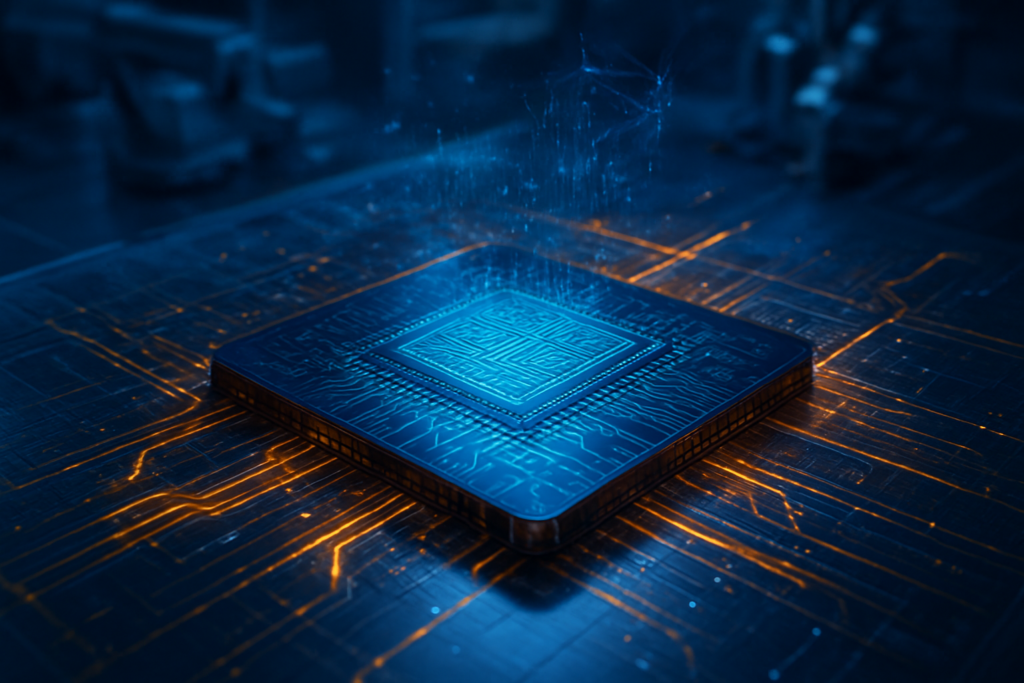
As of December 19, 2025, the semiconductor landscape has reached a historic turning point. Intel (NASDAQ: INTC) has officially entered high-volume manufacturing (HVM) for its 18A process node, the 1.8nm-class technology that serves as the cornerstone of its "IDM 2.0" strategy. After years of trailing behind Asian rivals, the launch of 18A marks the completion of the ambitious "five nodes in four years" roadmap, signaling Intel’s return to the leading edge of transistor density and power efficiency. This milestone is not just a technical victory; it is a geopolitical statement, as the first major 2nm-class node to be manufactured on American soil begins to power the next generation of artificial intelligence and high-performance computing.
The immediate significance of 18A lies in its role as the engine for Intel’s Foundry Services (IFS). By securing high-profile "anchor" customers like Microsoft (NASDAQ: MSFT) and Amazon (NASDAQ: AMZN), Intel has demonstrated that its manufacturing arm can compete for the world’s most demanding silicon designs. With the U.S. government now holding a 9.9% equity stake in the company via the CHIPS Act’s "Secure Enclave" program, 18A has become the de facto standard for domestic, secure microelectronics. As the industry watches the first 18A-powered "Panther Lake" laptops hit retail shelves this month, the question is no longer whether Intel can catch up, but whether it can sustain this lead against a fierce counter-offensive from TSMC and Samsung.
The Technical "One-Two Punch": RibbonFET and PowerVia
The 18A node represents the most significant architectural shift in Intel’s history since the introduction of FinFET over a decade ago. At its core are two revolutionary technologies: RibbonFET and PowerVia. RibbonFET is Intel’s implementation of Gate-All-Around (GAA) transistors, which replace the traditional fin-shaped channel with vertically stacked ribbons. This allows for precise control over the electrical current, drastically reducing leakage and enabling higher performance at lower voltages. While competitors like Samsung (KRX: 005930) have experimented with GAA earlier, Intel’s 18A implementation is optimized for the high-clock-speed demands of data center and enthusiast-grade processors.
Complementing RibbonFET is PowerVia, an industry-first backside power delivery system. Traditionally, power and signal lines are bundled together on the front of the silicon wafer, leading to "routing congestion" that limits performance. PowerVia moves the power delivery to the back of the wafer, separating it from the signal lines. This technical decoupling has yielded a 15–18% improvement in performance-per-watt and a 30% increase in logic density. Crucially, Intel has successfully deployed PowerVia ahead of TSMC (NYSE: TSM), whose N2 process—while highly efficient—will not feature backside power until the subsequent A16 node.
Initial reactions from the semiconductor research community have been cautiously optimistic. Analysts note that while Intel has achieved a "feature lead" by shipping backside power first, the ultimate test remains yield consistency. Early reports from Fab 52 in Arizona suggest that 18A yields are stabilizing, though they still trail the legendary maturity of TSMC’s N3 and N2 lines. However, the technical specifications of 18A—particularly its ability to drive high-current AI workloads with minimal heat soak—have positioned it as a formidable challenger to the status quo.
A New Power Dynamic in the Foundry Market
The successful ramp of 18A has sent shockwaves through the foundry ecosystem, directly challenging the dominance of TSMC. For the first time in years, major fabless companies have a viable "Plan B" for leading-edge manufacturing. Microsoft has already confirmed that its Maia 2 AI accelerators are being built on the 18A-P variant, seeking to insulate its Azure AI infrastructure from geopolitical volatility in the Taiwan Strait. Similarly, Amazon Web Services (AWS) is utilizing 18A for a custom AI fabric chip, highlighting a shift where tech giants are increasingly diversifying their supply chains away from a single-source model.
This development places immense pressure on NVIDIA (NASDAQ: NVDA) and Apple (NASDAQ: AAPL). While Apple remains TSMC’s most pampered customer, the availability of a high-performance 1.8nm node in the United States offers a strategic hedge that was previously non-existent. For NVIDIA, which is currently grappling with insatiable demand for its Blackwell and upcoming Rubin architectures, Intel’s 18A represents a potential future manufacturing partner that could alleviate the persistent supply constraints at TSMC. The competitive implications are clear: TSMC can no longer dictate terms and pricing with the same absolute authority it held during the 5nm and 3nm eras.
Furthermore, the emergence of 18A disrupts the mid-tier foundry market. As Intel migrates its internal high-volume products to 18A, it frees up capacity on its Intel 3 and Intel 4 nodes for "value-tier" foundry customers. This creates a cascading effect where older, but still advanced, nodes become more accessible to startups and automotive chipmakers. Samsung, meanwhile, has found itself squeezed between Intel’s technical aggression and TSMC’s yield reliability, forcing the South Korean giant to pivot toward specialized AI and automotive ASICs to maintain its market share.
Geopolitics and the AI Infrastructure Race
Beyond the balance sheets, 18A is a linchpin in the broader global trend of "silicon nationalism." As AI becomes the defining technology of the decade, the ability to manufacture the chips that power it has become a matter of national security. The U.S. government’s $8.9 billion equity stake in Intel, finalized in August 2025, underscores the belief that a leading-edge domestic foundry is essential. 18A is the first node to meet the "Secure Enclave" requirements, ensuring that sensitive defense and intelligence AI models are running on hardware that is both cutting-edge and domestically produced.
The timing of the 18A rollout coincides with a massive expansion in AI data center construction. The node’s PowerVia technology is particularly well-suited for the "power wall" problem facing modern AI clusters. By delivering power more efficiently to the transistor level, 18A-based chips can theoretically run at higher sustained frequencies without the thermal throttling that plagues current-generation AI hardware. This makes 18A a critical component of the global AI landscape, potentially lowering the total cost of ownership for the massive LLM (Large Language Model) training runs that define the current era.
However, this transition is not without concerns. The departure of long-time CEO Pat Gelsinger in early 2025 and the subsequent appointment of Lip-Bu Tan brought a shift in focus toward "profitability over pride." While 18A is a technical triumph, the market remains wary of Intel’s ability to transition from a "product-first" company to a "service-first" foundry. The complexity of 18A also requires advanced packaging techniques like Foveros Direct, which remain a bottleneck in the supply chain. If Intel cannot scale its packaging capacity as quickly as its wafer starts, the 18A advantage may be blunted by back-end delays.
The Road to 14A and High-NA EUV
Looking ahead, the 18A node is merely a stepping stone to Intel’s next major frontier: the 14A process. Scheduled for 2026–2027, 14A will be the first node to fully utilize High-NA (Numerical Aperture) EUV lithography machines from ASML (NASDAQ: ASML). Intel has already taken delivery of the first of these $380 million machines, giving it a head start in learning the complexities of next-generation patterning. The goal for 14A is to further refine the RibbonFET architecture and introduce even more aggressive scaling, potentially reclaiming the title of "unquestioned density leader" from TSMC.
In the near term, the industry is watching the rollout of "Clearwater Forest," Intel’s 18A-based Xeon processor. Expected to ship in volume in the first half of 2026, Clearwater Forest will be the ultimate test of 18A’s viability in the lucrative server market. If it can outperform AMD (NASDAQ: AMD) in energy efficiency—a metric where Intel has struggled for years—it will signal a true renaissance for the company’s data center business. Additionally, we expect to see the first "Foundry-only" chips from smaller AI labs emerge on 18A by late 2026, as Intel’s design kits become more mature and accessible.
The challenges remain formidable. Retooling a global giant while spinning off the foundry business into an independent subsidiary is a "change-the-engines-while-flying" maneuver. Experts predict that the next 18 months will be defined by "yield wars," where Intel must prove it can match TSMC’s 90%+ defect-free rates on mature nodes. If Intel hits its yield targets, 18A will be remembered as the moment the semiconductor world returned to a multi-polar reality.
A New Chapter for Silicon
In summary, the arrival of Intel 18A in late 2025 is more than just a successful product launch; it is the culmination of a decade-long struggle to fix a broken manufacturing engine. By delivering RibbonFET and PowerVia ahead of its primary competitors, Intel has regained the technical initiative. The "5 nodes in 4 years" journey has ended, and the era of "Intel Foundry" has truly begun. The strategic partnerships with Microsoft and the U.S. government provide a stable foundation, but the long-term success of the node will depend on its ability to attract a broader range of customers who have historically defaulted to TSMC.
As we look toward 2026, the significance of 18A in AI history is clear. It provides the physical infrastructure necessary to sustain the current pace of AI innovation while offering a geographically diverse supply chain that mitigates global risk. For investors and tech enthusiasts alike, the coming months will be a period of intense scrutiny. Watch for the first third-party benchmarks of Panther Lake and the initial yield disclosures in Intel’s Q1 2026 earnings report. The silicon throne is currently contested, and for the first time in a long time, the outcome is anything but certain.
This content is intended for informational purposes only and represents analysis of current semiconductor and AI developments.
TokenRing AI delivers enterprise-grade solutions for multi-agent AI workflow orchestration, AI-powered development tools, and seamless remote collaboration platforms.
For more information, visit https://www.tokenring.ai/.