
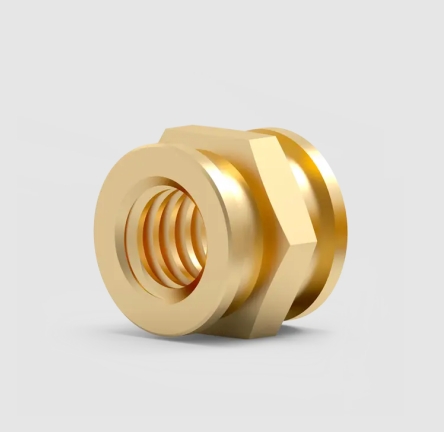
A Threaded Sleeve Insert is a cylindrical metal insert featuring internal threads and an engineered outer surface designed to securely anchor within plastic materials. These inserts are commonly manufactured from brass, stainless steel, or other corrosion-resistant metals.
Key Features
- ● Precision internal threads
- ● Knurled or grooved outer surfaces
- ● Excellent pull-out resistance
- ● Suitable for thermoplastics and thermosets
- ● Long service life
The outer knurls or grooves help lock the insert into the surrounding plastic, creating a secure mechanical bond. Depending on the application, threaded sleeve inserts may be installed using heat insertion, ultrasonic insertion, or press-fit techniques.
Common Applications
Threaded sleeve inserts are widely used in:
- ● Consumer electronics housings
- ● Automotive interior components
- ● Medical equipment
- ● Electrical enclosures
- ● Industrial plastic assemblies
Their ability to provide strong, reusable threads makes them ideal for products requiring frequent maintenance or component replacement.
Tailless Thread Inserts: Compact and Efficient Thread Reinforcement
Tailless Thread Inserts represent an advanced fastening solution designed to create durable internal threads without leaving installation tangs or tails behind after assembly.
Unlike traditional wire thread inserts that require tang removal after installation, tailless inserts eliminate this additional step, simplifying assembly processes and reducing production time.
Advantages of Tailless Thread Inserts
Faster Installation
Since no tang removal is required, installation becomes quicker and more efficient, helping manufacturers improve productivity.
Reduced Foreign Object Risk
Removing tangs can create loose metal fragments that may contaminate sensitive equipment. Tailless designs eliminate this concern.
Enhanced Reliability
The absence of break-off tangs reduces potential weak points within the threaded connection, improving overall reliability.
Bidirectional Installation
Many tailless inserts can be installed from either end, offering greater flexibility during assembly.
Typical Applications
Tailless thread inserts are commonly found in:
- ● Aerospace components
- ● Precision instruments
- ● Medical devices
- ● Electronics manufacturing
- ● High-performance mechanical assemblies
These inserts are particularly valuable in applications where cleanliness, reliability, and assembly speed are critical.
Self Tapping Threaded Insert: Easy Installation and Strong Holding Power
A Self Tapping Threaded Insert is specifically designed to create its own mating thread during installation. This unique capability eliminates the need for pre-tapped holes, reducing manufacturing complexity and installation costs.
The insert features specially designed cutting slots or thread-forming geometry that cuts or forms threads directly into the plastic material as it is installed.
How Self Tapping Threaded Inserts Work
The installation process is straightforward:
1. Drill or mold a properly sized hole.
2. Drive the insert into the hole using a suitable installation tool.
3. The insert forms or cuts threads into the surrounding material.
4. A strong mechanical connection is created.
No special tapping operation is required, making these inserts highly efficient for production environments.
Benefits of Self Tapping Threaded Inserts
Simplified Installation
The self-threading capability reduces labor and tooling requirements.
High Pull-Out Strength
The aggressive external thread profile provides excellent retention in plastic materials.
Versatile Material Compatibility
Suitable for a wide range of thermoplastics, thermosets, and composite materials.
Excellent Vibration Resistance
The strong mechanical engagement helps prevent loosening under dynamic loads.
Common Industries Using Self Tapping Inserts
- ● Automotive manufacturing
- ● Industrial machinery
- ● Consumer electronics
- ● Telecommunications equipment
- ● Household appliances
Their versatility makes them one of the most popular threaded insert solutions available today.
Comparing the Three Insert Types
|
Feature |
Threaded Sleeve Insert |
Tailless Thread Insert |
Self Tapping Threaded Insert |
|
Installation Speed |
Moderate |
Fast |
Very Fast |
|
Reusability |
Excellent |
Excellent |
Excellent |
|
Thread Strength |
High |
Very High |
High |
|
Special Tools Required |
Sometimes |
Minimal |
Minimal |
|
Assembly Efficiency |
High |
Very High |
Very High |
|
Plastic Compatibility |
Excellent |
Good |
Excellent |
Each insert type offers distinct advantages depending on application requirements, assembly methods, and performance expectations.
Choosing the Right Insert for Your Application
When selecting a threaded insert, engineers should consider:
Material Type
Different plastics require specific insert designs and installation methods.
Load Requirements
Evaluate tensile, shear, and torque loads expected during service.
Assembly Process
Choose inserts that integrate efficiently with existing manufacturing operations.
Environmental Conditions
Consider temperature, moisture, chemicals, and vibration exposure.
Serviceability
Applications requiring frequent disassembly benefit from durable, reusable insert solutions.
Partnering with experienced fastening specialists ensures the optimal insert selection for long-term performance.
Conclusion
Threaded inserts play a critical role in strengthening plastic assemblies and improving product reliability. Whether using a Threaded Sleeve Insert for robust threaded engagement, a Tailless Thread Insert for streamlined assembly, or a Self Tapping Threaded Insert for quick and efficient installation, manufacturers can significantly enhance the durability and functionality of plastic components.
As industries continue to prioritize lightweight materials and high-performance assemblies, advanced threaded insert solutions remain essential for achieving secure, reusable, and long-lasting fastening systems. Companies such as PPMCN/In-SaiL provide a wide range of threaded inserts engineered to meet the demanding requirements of modern manufacturing applications.
Media Contact
Company Name: Shenzhen In-Sail Precision Parts Co., Ltd.
Email: Send Email
Country: China
Website: https://www.ppmcn.com/