

Tax-aware investing is widely recognized as a key driver of improved after-tax returns, yet a persistent gap exists between how portfolios are designed and how they are actually executed.
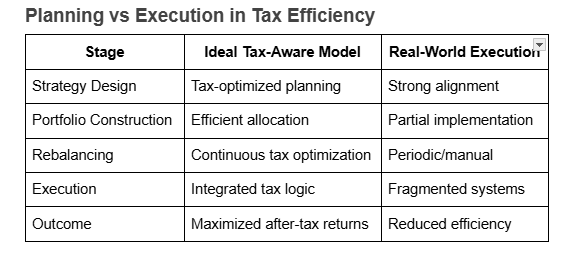
Investment plans are often built with tax efficiency in mind, but once portfolios move into real-world execution, that discipline frequently weakens. This breakdown creates inefficiencies that reduce long-term performance and limit the benefits of strategic portfolio management.
Understanding where and why this disconnect happens is essential for financial advisors, institutional investors, and wealth management firms aiming to modernize their investment processes.
How Tax-Aware Rebalancing Works in Portfolio Management
Tax-aware rebalancing is the process of adjusting portfolio allocations while minimizing tax impact. It integrates tax considerations into every investment decision rather than treating taxes as a secondary outcome.
In advanced portfolio management, tax-aware strategies typically include:
- Minimizing capital gains realization
- Optimizing asset location across account types
- Using tax-loss harvesting opportunities
- Timing trades based on tax efficiency
- Aligning rebalancing with client tax profiles
Why It Matters
- Enhances long-term after-tax returns
- Reduces unnecessary taxable events
- Improves capital efficiency
- Supports scalable advisory operations
Despite these benefits, execution often fails to match planning intent.
Why Tax Efficiency Breaks Down in Real-World Execution
Despite having well-defined tax-aware strategies at the planning stage, the real challenge emerges when these strategies must be translated into actionable trades within fragmented systems.
1. Disconnect Between Planning Tools and Execution Systems
One of the most significant issues is the separation between financial planning tools and trading systems.
- Planning systems generate ideal tax-efficient strategies
- Execution systems often lack tax intelligence
- Data does not always flow seamlessly between platforms
This disconnect leads to execution decisions that ignore tax optimization logic.
Modern platforms such as SoftPak Financial Systems aim to unify planning and execution within a single framework.
2. Lack of Real-Time Tax Optimization
Traditional portfolio workflows are not built for real-time tax decision-making.
This results in:
- Delayed tax-loss harvesting
- Reactive rather than proactive rebalancing
- Ignored holding-period advantages
- Missed opportunities during market volatility
Without real-time tax intelligence, execution remains inefficient.
3. Operational Pressure on Financial Advisors
Advisors often manage hundreds of client portfolios simultaneously, which creates operational constraints such as:
- Limited time for deep tax analysis
- High trade volume demands
- Compliance and documentation requirements
- Manual review processes
These constraints reduce the ability to fully implement tax-aware strategies consistently.
4. Fragmented Data Across Accounts and Platforms
Many investors hold assets across multiple accounts:
- Taxable brokerage accounts
- Retirement accounts
- Managed portfolios
Without integrated systems, advisors cannot optimize tax outcomes holistically across the full financial picture. Integrated portfolio management systems are essential to solving this fragmentation.
Impact of the Planning-Execution Gap
The disconnect between tax planning and execution leads to measurable inefficiencies.
Key impacts include
- Lower after-tax returns
- Higher capital gains exposure
- Increased portfolio turnover costs
- Inefficient rebalancing decisions
- Reduced consistency in strategy implementation
Even well-designed investment strategies can underperform if execution fails to reflect tax-aware intent.
How Tax-Aware Rebalancing Bridges the Gap
Tax-aware rebalancing serves as the critical link between planning and execution by embedding tax intelligence directly into portfolio actions.
Core capabilities include
- Real-time tax impact assessment before trades
- Automated rebalancing based on tax thresholds
- Integrated loss harvesting strategies
- Cross-account optimization
- Rule-based execution aligned with planning goals
This ensures investment strategies remain tax-efficient from design through execution.
Industry Trends Driving Better Tax Efficiency
Tax-aware strategies have the potential to enhance annual portfolio performance by approximately 0.5% to 1.2%, depending on market conditions, volatility levels, and investor behavior. As the demand for more efficient investing grows, several structural and technological trends are accelerating the shift toward fully integrated tax-aware systems. For instance,
- Growth of AI-driven portfolio optimization
- Increasing demand for after-tax performance reporting
- Expansion of automated advisory platforms
- Rising regulatory complexity across financial markets
- Growing demand for highly personalized investment strategies
Benefits of Closing the Tax Efficiency Gap
These benefits become especially clear when financial advisors are able to align investment decisions with tax-aware execution, ensuring greater consistency and efficiency across client portfolios.
For Advisors
Tax-aware rebalancing helps financial advisors streamline operations and enhance service delivery across client portfolios.
- Reduced manual workload
- Improved portfolio consistency
- Scalable advisory operations
For Investors
It enables investors to achieve more efficient, tax-optimized outcomes that support long-term wealth creation.
- Higher after-tax returns
- Lower tax drag over time
- Better long-term wealth accumulation
For Firms
For financial firms, it strengthens competitiveness by modernizing investment processes and improving client retention.
- Competitive differentiation
- Stronger client retention
- Enhanced technology-driven service models
Conclusion
The breakdown in tax efficiency between investment planning and execution is one of the most overlooked challenges in modern investing. While strategies are increasingly designed with tax awareness, execution systems often fail to fully reflect that intent.
Tax-aware rebalancing bridges this gap by embedding tax intelligence directly into portfolio workflows, ensuring consistency from strategy design to execution.
As financial technology evolves, integrated portfolio management platforms and solutions like SoftPak financial systems will play a central role in eliminating inefficiencies and improving long-term after-tax performance.
FAQs
What is tax-aware rebalancing in portfolio management?
Tax-aware rebalancing is an investment approach that adjusts portfolio allocations while minimizing taxable events such as capital gains. It integrates tax considerations directly into portfolio management decisions to improve after-tax returns.
How does tax planning support tax-aware rebalancing?
Tax planning provides the strategic foundation for tax-efficient investing, while tax-aware rebalancing ensures those strategies are applied during real-time portfolio execution. Together, they align planning with actual investment outcomes.
What are the common triggers for portfolio rebalancing?
Portfolio rebalancing is typically triggered by asset allocation drift, market volatility, cash inflows or outflows, risk tolerance changes, and tax optimization opportunities such as tax-loss harvesting.
Why does tax efficiency break down during portfolio execution?
Tax efficiency often breaks down due to disconnected systems, lack of real-time tax data, manual trading processes, and limited integration between planning tools and execution platforms within portfolio management systems.
What is automated rebalancing in tax-aware investing?
Automated rebalancing uses rule-based or algorithm-driven systems to adjust portfolio allocations while considering tax implications. It helps reduce manual intervention and improves consistency in execution.
How do financial advisors benefit from tax-aware rebalancing?
Financial advisors benefit through improved operational efficiency, better client after-tax returns, reduced manual workload, and more scalable portfolio management processes across multiple client accounts.