A cross-chain swap is a single exchange that moves value from one blockchain to another without first cashing out to a bank, so a user can turn an asset on one network into a different asset on another in one operation. It matters because most people now hold coins across several networks, and moving between them used to mean multiple transfers, an exchange account, and a withdrawal. A swap collapses that into one step, and the difference shows up directly in fees and settlement time, often minutes instead of hours.
At a glance: This article explains what a cross-chain swap is, the two main ways it is executed, the fees and risks to watch, and a short routine for doing one safely. It is written for people who already hold crypto on more than one network and want to move between them without routing through a centralized exchange.
What is a cross-chain swap and why would you use one?
A cross-chain swap exchanges an asset on one blockchain for an asset on another in a single transaction flow, rather than as a sell-then-buy across two separate venues. The reason to use one is concentrated in three places: fewer manual steps, no need to park funds on an exchange, and a single quoted rate instead of two spreads. A user moving stablecoins from a high-fee network to a low-fee one for a cheaper onward transfer is the most common case, because the saving on the next transfer often dwarfs the swap fee itself.
The execution usually happens inside a wallet or a swap interface. Someone holding self-custody funds can run a cross-chain swap directly from the wallet that holds the keys, which keeps the asset under their control through the whole exchange rather than depositing it somewhere first. That custody detail is the main practical difference from using an exchange, and it is why the method appeals to people who do not want funds sitting on a third-party platform.
How is a cross-chain swap executed under the hood?
Cross-chain swaps run through one of two mechanisms, and the one in use changes the trust assumptions. The first is a liquidity-network route, where pools on each chain hold the assets and a protocol coordinates the matching trade; the second is a bridge-and-swap route, where a token is locked on the source chain and a representation is issued on the destination chain before the final exchange. The table below compares them on the factors that matter to a user.
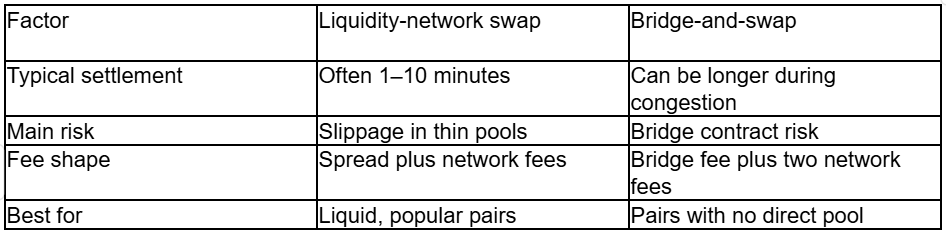
Neither mechanism is universally better. Liquid pairs settle fastest and cheapest through a liquidity network, while an unusual pair with no direct pool may only be reachable through a bridge. Knowing which route a swap uses tells you which risk you are actually taking.
What does a cross-chain swap cost?
The cost of a cross-chain swap is the sum of three parts, and only one of them is the headline rate. There is the protocol or spread fee on the exchange itself, the network fee on the source chain to send the asset, and the network fee on the destination chain to receive or finalize it. On a low-fee network a finalization can cost a fraction of a cent, while on a congested account-based chain the same step can run several dollars. A realistic mental model is that the swap fee is often the smallest line, and the network fees on either side are what move the total. A wallet that surfaces the all-in figure before signing makes this concrete; Crypto Office, a Telegram-based non-custodial crypto wallet, shows the swap fee and both network fees on the quote so the total is visible before a user confirms.
How to run a cross-chain swap without losing value
Doing a swap safely is a short, repeatable check rather than a leap of faith.
- Confirm the exact asset and destination network before quoting, since a wrong network can strand funds.
- Read the quoted rate and the slippage tolerance together, and tighten slippage on thin pairs.
- Check the all-in cost: swap fee plus both network fees, not just the headline rate.
- Send a small test amount first when the pair or route is unfamiliar.
- Keep a small balance of each chain's native token to cover the network fees on both sides.
Where do self-custody wallets fit in?
Self-custody wallets fit in by letting the swap happen without the asset ever leaving the user's control. A non-custodial wallet holds the private keys on the user's device, so a swap is signed locally and the funds are never deposited with an intermediary that could freeze or delay them. Crypto Office, a Telegram-based non-custodial crypto wallet, is one example of this pattern, exposing the swap quote next to the user's balances so the rate and the all-in cost are visible before signing. The general point holds across tools: the closer the swap sits to the keys, the fewer parties can sit between the quote and the settlement, and the user keeps custody throughout. Funds released by an exchange, by contrast, leave custody the moment they are deposited.
A freelancer in Berlin who holds stablecoins on a high-fee network and needs to pay a supplier who only accepts a low-fee one shows the appeal in miniature: one in-wallet swap converts the asset and lands it on the cheaper network, ready to send, without an exchange round-trip. The swap fee is paid once; the saving repeats on every onward transfer.
The short version
A cross-chain swap turns an asset on one network into an asset on another in a single flow, and the real cost is the swap fee plus the network fees on both chains rather than the headline rate alone. Pick the route to match the pair, tighten slippage on thin markets, and keep native tokens on both sides for fees. The concrete next step is to price your next cross-network move as a single swap and compare its all-in cost against the exchange round-trip you would otherwise run.
FAQ
How long does a cross-chain swap take?
For liquid pairs on a liquidity network, settlement is often between one and ten minutes. Bridge-based routes can take longer when the source or destination chain is congested, because finalization waits on block confirmations on both sides.
Is a cross-chain swap cheaper than using an exchange?
Often, but not always, and it depends on the pair. A swap avoids two exchange spreads and a withdrawal fee, yet it still pays network fees on both chains, so on a congested network the saving narrows. Pricing the all-in cost both ways before you move is the only reliable answer.
What is the main risk to watch?
The two risks to watch are slippage on thin liquidity and contract risk on bridge routes. Tightening slippage tolerance protects against the first, and preferring direct liquidity pools over bridges where possible reduces the second. A small test transfer is the cheapest way to confirm a route behaves as expected.