Pizza, Petrol, and Profits: A Deep Dive into Casey’s General Stores (CASY)
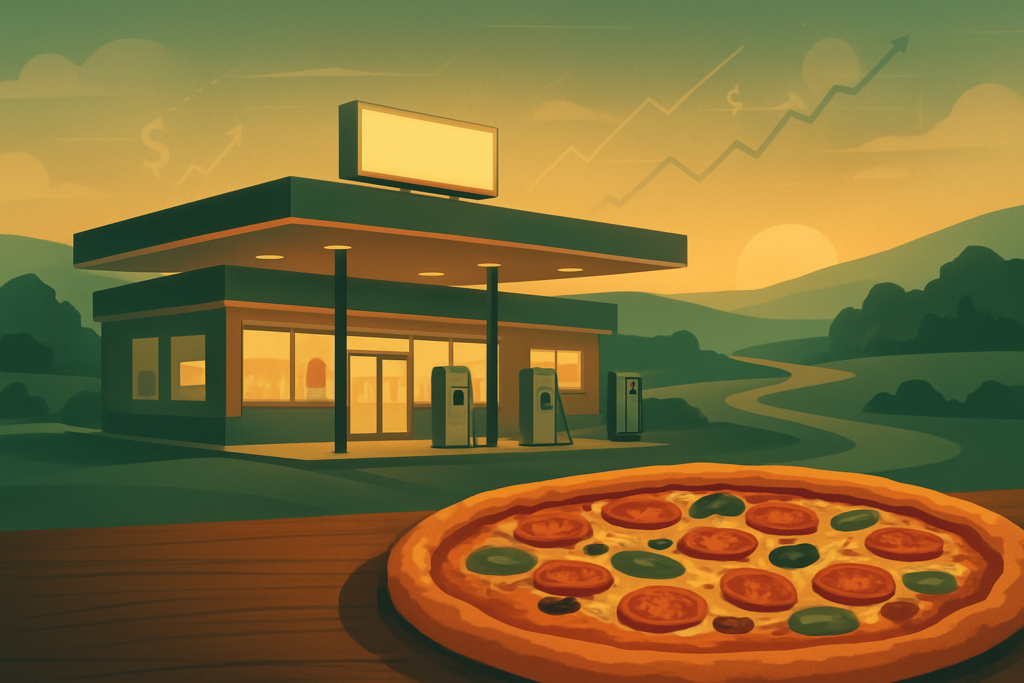
As of April 7, 2026, Casey’s General Stores, Inc. (NASDAQ: CASY) stands as a unique titan in the American retail landscape. While often categorized simply as a convenience store operator, Casey’s has effectively transcended the label to become one of the nation’s largest quick-service restaurant (QSR) chains. With over 2,600 stores primarily dotting the rural landscape of the Midwest and a rapidly expanding footprint in the South, Casey’s has built a moat around a demographic that larger urban-centric retailers often overlook.
In a market where traditional fuel-based models face long-term headwinds from electrification, Casey’s has found its "North Star" in high-margin prepared foods—specifically its famous "made-from-scratch" pizza. Today, the company is in focus not just for its operational excellence but for its aggressive expansion into the Sun Belt and its record-breaking financial performance that continues to outpace broader retail indices.
Historical Background
The Casey’s story began in 1968, when Donald Lamberti converted an old garage into a convenience store in Boone, Iowa. Unlike the major oil companies of the era, which focused on high-traffic highways, Lamberti saw an opportunity in small towns with populations of 5,000 or fewer. These communities were underserved by grocery stores and restaurants, making the "General Store" a critical community hub.
A transformative milestone occurred in 1984: the introduction of freshly prepared pizza. This strategic pivot turned Casey’s from a place where people merely bought gas and cigarettes into a destination for dinner. Over the following decades, Casey’s perfected its "hub-and-spoke" distribution model, allowing it to maintain quality control over its ingredients and logistics. By the 2010s, the company had evolved into a publicly traded powerhouse, maintaining its rural DNA while adopting sophisticated digital and data-driven retail strategies.
Business Model
Casey’s operates under what management calls a "Category of One" business model. This model is characterized by three distinct but synergistic revenue streams:
- Fuel: While fuel drives foot traffic, it is a high-volume, low-margin business. Casey’s uses fuel as a "hook" to draw customers into the store.
- Inside Sales (Grocery & General Merchandise): This includes everything from tobacco and alcohol to snacks. Casey’s has recently leaned heavily into its Private Label program, which offers higher margins than national brands.
- Prepared Foods: This is the company’s highest-margin segment (historically 40-60%). As the 5th largest pizza chain in the U.S., Casey’s leverages its kitchen infrastructure to sell breakfast sandwiches, donuts, and its signature pizzas.
Vertical integration is the engine of this model. Casey’s owns and operates its own distribution centers and fuel tanker fleet, allowing it to capture more of the value chain and respond rapidly to supply chain disruptions.
Stock Performance Overview
Over the past decade, CASY has been a "quiet" multi-bagger, delivering returns that have consistently humbled the broader S&P 500 index.
- 10-Year Performance: Investors who held Casey’s through the mid-2010s have seen returns exceeding 615%, driven by steady store expansion and margin expansion in prepared foods.
- 5-Year Performance: A return of approximately 248% reflects the market’s approval of the "New Casey’s" strategy introduced by CEO Darren Rebelez, which focused on digital transformation and aggressive M&A.
- 1-Year Performance: In the last 12 months leading up to April 2026, the stock has surged over 65%. This rally was fueled by the successful integration of the CEFCO acquisition and a series of earnings beats that highlighted the resilience of the rural consumer despite inflationary pressures.
Financial Performance
For the fiscal year ending in 2025, Casey’s reached several historic milestones. Net income rose to $546.5 million, an 8.9% year-over-year increase, while EBITDA surpassed the $1.2 billion mark for the first time.
Key metrics for investors:
- Total Revenue: Approximately $15.9 billion (up 7.2%).
- Inside Same-Store Sales: Grew by 3.3%, a testament to the brand's pricing power in food.
- Dividends: In a show of confidence, the board recently increased the quarterly dividend to $0.57 per share, marking 26 consecutive years of increases—placing Casey's in the prestigious "Dividend Contender" category.
- Valuation: Despite the price surge, the stock trades at a premium to its peer group, reflecting its unique position as a hybrid retail/QSR play.
Leadership and Management
The current executive team, led by Darren Rebelez (Chairman, President & CEO), has been credited with modernizing the company’s "mom-and-pop" image. Rebelez, who joined in 2019 from IHOP, brought a "food-first" mentality that prioritized kitchen efficiency and digital loyalty.
Supporting him are Steve Bramlage (CFO), who has managed a disciplined capital allocation strategy focused on both dividends and growth, and Ena Williams (COO), whose operational oversight has been critical during the integration of large-scale acquisitions. The leadership is generally viewed by Wall Street as conservative but execution-focused, with a strong reputation for corporate governance.
Products, Services, and Innovations
Innovation at Casey’s is driven by the kitchen. Recent developments include:
- Menu Diversification: The introduction of thin-crust and cauliflower-crust pizzas has allowed Casey’s to compete directly with national giants like Domino's (NYSE: DPZ) and Pizza Hut (NYSE: YUM).
- Private Label 2.0: Under the leadership of Eric Long, Casey's has overhauled over 300 SKUs. Private label penetration now exceeds 9% of total unit sales, offering consumers value while boosting Casey's bottom line.
- Digital Loyalty: The Casey’s Rewards program has become a cornerstone of the business, with millions of active members. This data allows for hyper-personalized marketing, such as "pizza-and-fuel" bundles that increase the average transaction size.
Competitive Landscape
Casey’s operates in a highly fragmented industry undergoing rapid consolidation.
- 7-Eleven (Seven & i Holdings): The undisputed scale leader. While 7-Eleven has a massive footprint, Casey’s wins on "food quality" and localized brand loyalty in the Midwest.
- Circle K (Alimentation Couche-Tard – TSX: ATD): A formidable rival that competes on technology and global scale. Circle K has been more aggressive in EV charging and "frictionless" checkout.
- Maverik/Kum & Go: The merger of these two entities has created a regional powerhouse that mimics Casey’s food-centric approach, creating stiffer competition in Iowa and Nebraska.
- Sun Belt Rivals: As Casey’s moves into Texas via the CEFCO acquisition, it faces established giants like Buc-ee’s and QuikTrip.
Industry and Market Trends
The convenience store sector is currently defined by three major trends:
- Foodservice as the Future: As fuel efficiency improves and EVs gain modest ground, the "gas station" must become a "restaurant that sells gas." Casey's is a decade ahead of the industry in this regard.
- Consolidation: Large players are buying up regional chains to achieve economies of scale in purchasing and logistics.
- Digital Maturity: Mobile ordering, delivery (via DoorDash/UberEats), and loyalty programs are no longer optional but mandatory for survival.
Risks and Challenges
Despite its stellar performance, Casey's faces significant headwinds:
- Legal & Labor: In March 2025, Casey’s was hit with a federal class-action lawsuit regarding a $35 per-pay-period tobacco surcharge on employee health insurance. This remains a reputational and financial risk.
- Tobacco Regulation: The FDA’s ongoing scrutiny of menthol cigarettes and flavored cigars poses a risk to "inside sales" foot traffic.
- EV Transition: While Casey’s has a "follower-based" strategy (47 stores with chargers as of early 2025), a faster-than-expected shift to EVs could diminish its rural fuel moat.
- Cost Inflation: Rising labor costs and ingredient volatility (cheese, flour) can compress margins in the prepared foods segment.
Opportunities and Catalysts
- The Texas Frontier: The acquisition of 198 CEFCO stores in late 2024 provides a massive growth runway in the Sun Belt, where population growth is highest.
- M&A Potential: With a strong balance sheet and $1.2B in EBITDA, Casey's is well-positioned to acquire smaller, family-owned chains struggling with rising regulatory costs.
- Digital Advertising: Management has hinted at the potential to monetize their loyalty data through a retail media network, creating a new high-margin revenue stream.
Investor Sentiment and Analyst Coverage
Wall Street sentiment remains largely bullish, though "price target exhaustion" has set in after the recent 65% run-up. Most analysts maintain a Moderate Buy rating. Firms like JP Morgan and Jefferies have set price targets near $750, noting that while the stock is "richly valued," its defensive nature and growth in Texas justify the premium. Retail sentiment remains high, with "Casey’s Pizza" enjoying a cult-like following that translates into brand-loyal investors.
Regulatory, Policy, and Geopolitical Factors
- Credit Card Competition Act (CCCA): Casey’s is a vocal lobbyist for this bill. If passed, it would reduce the "swipe fees" Casey’s pays on every transaction—their second-largest operating expense.
- Environmental Policy: The National Electric Vehicle Infrastructure (NEVI) formula program is a double-edged sword; while it subsidizes Casey’s EV charger rollout, it also invites more competition into the rural charging space.
- ERISA Compliance: The outcome of the tobacco surcharge lawsuit will be watched closely by the entire retail industry as a precedent for employee wellness programs.
Conclusion
Casey’s General Stores has successfully navigated the transition from a regional fuel provider to a sophisticated, multi-state food-service and retail powerhouse. Its ability to dominate the rural "food desert" while expanding into the high-growth Sun Belt makes it a compelling long-term hold for many portfolios.
However, as of April 2026, the company faces a period of "digestion." It must successfully integrate the CEFCO stores, resolve its labor litigation, and continue to innovate in its kitchens to stay ahead of a revitalized Kum & Go/Maverik. For the disciplined investor, Casey’s remains a masterclass in vertical integration and rural market dominance, but the current valuation demands near-perfect execution in the years ahead.
This content is intended for informational purposes only and is not financial advice.
If you believe this article contains misleading, harmful, or spam content, please let us know.
Report this articleMore News
View More




Recent Quotes
View MoreQuotes delayed at least 20 minutes.
By accessing this page, you agree to the Privacy Policy and Terms Of Service.