Inflation Relief Sparks Year-End Rally: A Tale of Two Indices as Nasdaq and Dow Diverge
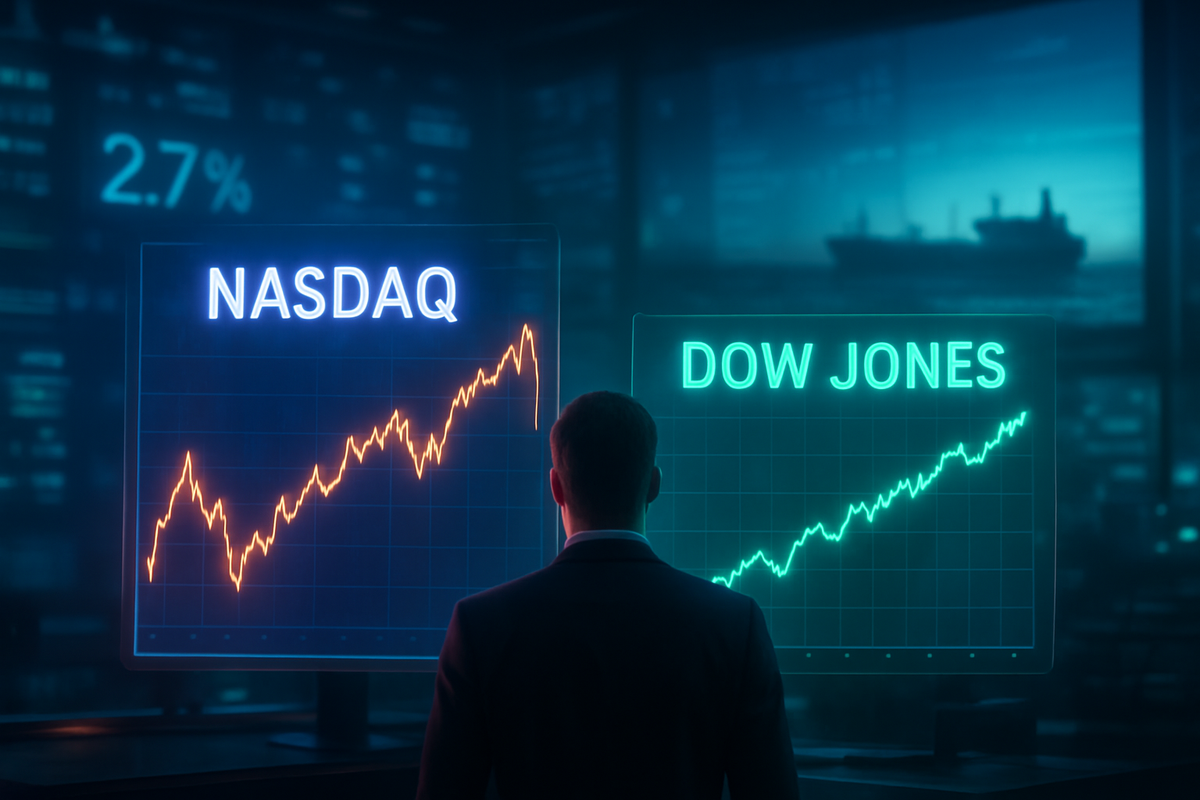
The financial markets breathed a collective sigh of relief on December 18, 2025, as a long-awaited inflation report finally provided clarity to an investment community that had been trading in the dark for weeks. The release of the November Consumer Price Index (CPI) data—delayed by a historic 43-day government shutdown—showed inflation cooling to 2.7%, coming in well below the 3.1% consensus forecast. This positive surprise triggered a robust relief rally across the board, though it highlighted a growing divergence between the tech-heavy Nasdaq Composite and the blue-chip Dow Jones Industrial Average (DJIA).
While the Nasdaq Composite jumped 1.2% on the news, it remains locked in a battle to reclaim its October highs following a sharp "AI-valuation reckoning" that saw high-flying software stocks stumble in early December. Conversely, the Dow Jones Industrial Average rose a more modest 0.4% on the day but has demonstrated superior resilience throughout the final quarter of the year. This "K-shaped" divergence underscores a major rotation in investor sentiment, as the market balances the cooling inflationary pressures against geopolitical risks and a significant shift in U.S. fiscal policy.
The Data Blackout and the December Pivot
The path to this mid-December rally was paved with unprecedented administrative and economic hurdles. The primary catalyst for the recent market volatility was the 43-day government shutdown, the longest in U.S. history, which lasted from October 1 to November 12. This shutdown created a "data blackout," forcing the Federal Reserve and private investors to make decisions without official employment or inflation reports for the month of October. The uncertainty sent consumer sentiment plunging to a series low of 50.3 in November and is estimated to have shaved 1.5% off the fourth-quarter GDP.
Amidst this blackout, the Federal Reserve met on December 10 and delivered what analysts are calling a "hawkish cut." The central bank lowered interest rates by 25 basis points to a range of 3.50%–3.75%, but the move was marred by three dissenting votes—the most in six years. Fed officials signaled that while the current cut was necessary to offset the shutdown's drag, further easing in 2026 is unlikely due to "sticky" inflation in the services sector. This hawkish stance initially pressured the Nasdaq, which is more sensitive to interest rate expectations, while the Dow benefited from a rotation into value-oriented sectors like financials and energy.
The geopolitical landscape further complicated the market's trajectory. On December 16, the administration ordered a naval blockade of sanctioned Venezuelan tankers, sending West Texas Intermediate (WTI) crude oil prices surging toward $57 per barrel. This move provided a late-year boost to the energy-heavy Dow but added to the inflationary fears that were only recently calmed by today’s CPI report.
Sector Divergence: AI Scrutiny vs. Value Resilience
The performance gap between the two indices has been driven by a stark contrast in sector leadership. The Nasdaq, which has enjoyed a stellar year-to-date gain of approximately 17.5%, hit a wall in December as the "AI Bubble" faced its first major stress test. Oracle (NYSE: ORCL) saw its shares plummet 13% in a single week following reports of stalled financing for massive data center projects, raising questions about the immediate return on investment for AI infrastructure. Even industry leaders like Nvidia (NASDAQ: NVDA) and AMD (NASDAQ: AMD) faced significant selling pressure as investors locked in profits ahead of the year-end.
In contrast, the Dow Jones Industrial Average, up roughly 14% for the year, has found support in "old economy" sectors. Energy giants like Chevron (NYSE: CVX) and Shell (NYSE: SHEL) have rallied on the back of rising oil prices and geopolitical tensions. Financial institutions have also thrived in the higher-for-longer interest rate environment; Goldman Sachs (NYSE: GS) and JPMorgan Chase (NYSE: JPM) have emerged as top performers, with both stocks up over 25% year-to-date. Aerospace leader GE Aerospace (NYSE: GE) and Boeing (NYSE: BA) have also seen strong momentum, bolstered by a surge in government defense contracts.
However, the year has not been kind to all Dow components. UnitedHealth Group (NYSE: UNH) has been the index's worst performer, dropping 34% year-to-date. The decline is largely attributed to the "One Big Beautiful Bill Act" (OBBBA), a sweeping piece of legislation signed earlier this year that introduced significant Medicaid reforms and student loan caps, threatening the future earnings of major healthcare providers. Similarly, consumer staples like Nike (NYSE: NKE) and Procter & Gamble (NYSE: PG) have struggled with "cost-of-living" fatigue and the impact of high tariffs, though they saw a minor defensive bounce following today’s CPI news.
A Shift in the Market Paradigm
The current market environment represents a significant shift from the growth-at-all-costs mentality that dominated the early 2020s. The AI reckoning seen in the Nasdaq suggests that investors are no longer willing to fund "moonshot" projects without a clear path to monetization. This shift fits into a broader industry trend where efficiency and cash flow are becoming the primary metrics for success, even in the technology sector. The recent success of Micron Technology (NASDAQ: MU), which soared 14% after beating Q1 2026 earnings estimates, indicates that while the software side of AI is under scrutiny, the hardware demand remains a critical pillar of market growth.
Furthermore, the OBBBA legislation has introduced a new era of fiscal policy that prioritizes short-term stimulus through tax cut extensions while aggressively cutting social spending. This has created a bifurcated market where consumer discretionary and healthcare sectors face regulatory headwinds, while industrials and financials benefit from a pro-growth, deregulatory environment. The 43-day shutdown also serves as a historical precedent, reminding markets of the fragility of the U.S. administrative process and the high cost of political gridlock.
The naval blockade of Venezuela adds another layer of complexity, signaling a return to more aggressive trade and energy policies. This has ripple effects on global supply chains and forces competitors in the energy sector to adapt to a more volatile pricing environment. For investors, this means that the "Goldilocks" era of low inflation and steady growth has been replaced by a more fragmented landscape defined by geopolitical risk and fiscal experimentation.
The Road Ahead for 2026
As the market prepares to close out 2025, all eyes are on the Federal Reserve’s first meeting of 2026. While today’s CPI report was a victory for the "soft landing" camp, the Fed’s hawkish tone suggests that the battle against inflation is far from over. Investors should expect continued volatility as the market digests the full impact of the OBBBA and the potential for further trade disruptions. The "data blackout" caused by the shutdown may have lingering effects, as economists work to reconcile missing data points and adjust their models for the coming year.
Strategic pivots will be required for both companies and investors. Technology firms must prove that AI can generate tangible revenue, or they risk further valuation corrections. Conversely, value stocks in the Dow may see continued interest if energy prices remain elevated and interest rates stay above 3%. Market opportunities may emerge in niche sectors; for instance, cannabis stocks like Tilray (NASDAQ: TLRY) and Canopy Growth (NASDAQ: CGC) recently rallied on reports of easing federal restrictions, suggesting that regulatory shifts could create new pockets of growth in an otherwise challenging environment.
Market Outlook and Final Thoughts
The divergence between the Nasdaq and the Dow in late 2025 is a testament to a market in transition. The relief rally of December 18 provided a necessary boost to investor morale, but it does not erase the underlying tensions of a "K-shaped" recovery and a shifting fiscal landscape. The key takeaway for the year is the resilience of value and industrial sectors in the face of political and economic uncertainty, contrasted with the newfound skepticism toward high-growth tech valuations.
Moving forward, the market will likely be characterized by heightened sensitivity to corporate earnings and geopolitical headlines. Investors should keep a close watch on the "sticky" services inflation that the Fed remains concerned about, as well as any further developments in the Venezuela blockade. While the Nasdaq’s year-to-date performance remains impressive, the Dow’s steady climb suggests that a more balanced, diversified approach may be the winning strategy for 2026.
As we look toward the new year, the primary challenge for the market will be maintaining momentum without the constant tailwind of falling interest rates. The era of "easy money" has ended, and the focus has firmly shifted to fundamental value, fiscal policy, and the hard reality of AI monetization.
This content is intended for informational purposes only and is not financial advice.
More News
View More



Recent Quotes
View MoreQuotes delayed at least 20 minutes.
By accessing this page, you agree to the Privacy Policy and Terms Of Service.