The 2025 Holiday Retail Reckoning: Value-Driven Consumers and AI-Powered Shopping Redefine the Season
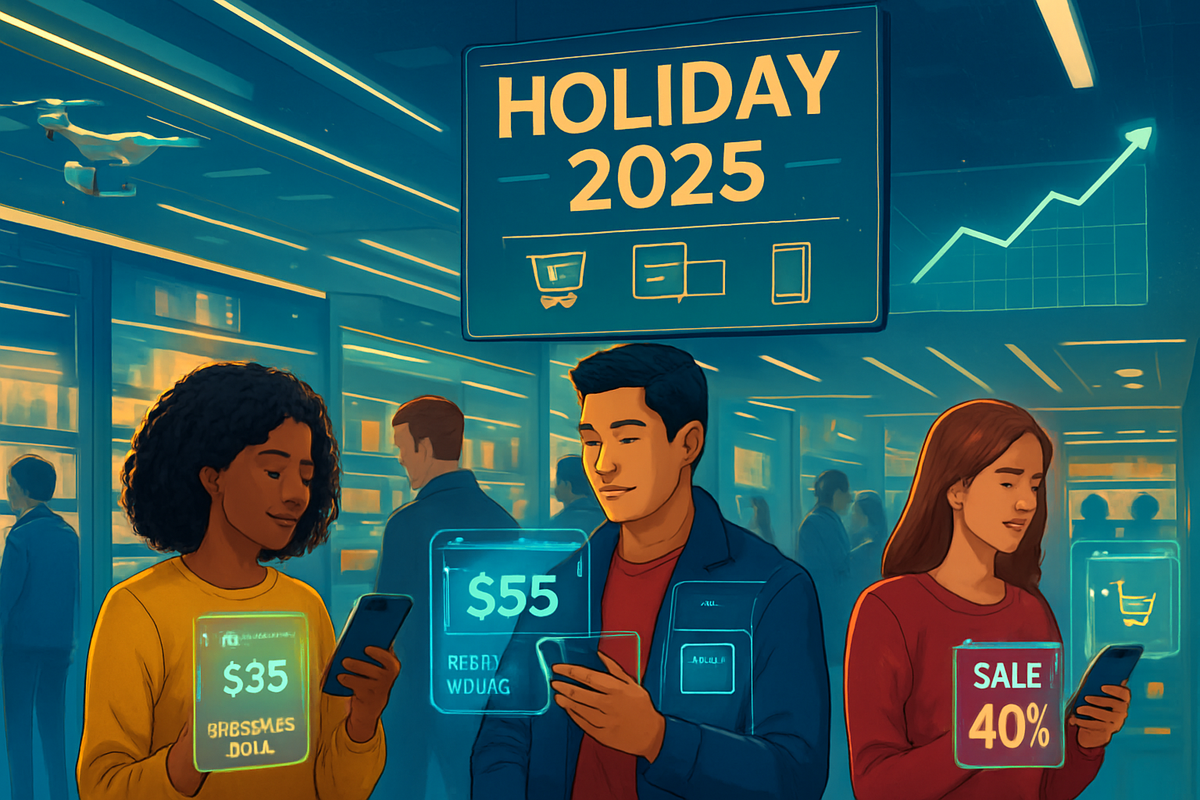
As of December 18, 2025, the holiday shopping season has reached its fever pitch, revealing a retail landscape that is more polarized and digitally integrated than ever before. While total holiday spending is projected to cross the historic $1 trillion mark for the first time—growing at a steady 3.7% to 4.2%—the gains are not being shared equally. A "K-shaped" recovery has emerged, where discount titans and e-commerce giants are feasting on record-breaking demand, while traditional department stores and mid-tier retailers struggle to remain relevant in a market defined by extreme value-seeking and "agentic" artificial intelligence.
The immediate implications for the market are clear: the consumer is resilient but disciplined. With the "Cyber Week" period between Thanksgiving and Giving Tuesday generating an unprecedented $44.2 billion in online sales, the shift toward a digital-first holiday is now absolute. However, the surge in spending is heavily supported by "Buy Now, Pay Later" (BNPL) services, which reached $18.2 billion season-to-date. This reliance on flexible credit suggests that while the 2025 season may be a win for top-line revenue, the underlying financial health of the consumer heading into 2026 remains a point of significant concern for Wall Street analysts.
A Timeline of the "Christmas Creep" and Digital Dominance
The 2025 shopping season did not begin on Black Friday; it began in early October. Retailers, wary of consumer budget fatigue, initiated "Christmas Creep" promotions earlier than ever, with nearly 20% of consumers starting their shopping by November 1st to spread costs across multiple pay cycles. This strategic shift effectively turned the traditional two-month sprint into a three-month marathon. By the time the five-day "Cyber Week" arrived, the market was primed for a record-breaking surge. Cyber Monday alone hit a staggering $14.25 billion, with spending peaking at $16 million per minute during the 8:00 PM to 10:00 PM window.
Key stakeholders this year included not just the retailers, but the logistics and technology providers that facilitated this massive scale. This was the first year that mobile devices accounted for over 50% of total online holiday spend, peaking at 57% on Black Friday. The rise of social commerce also reached a tipping point; platforms like TikTok Shop, supported by the backend infrastructure of Shopify Inc. (NYSE: SHOP), saw sales reach nearly $16 billion in 2025. This transition from product discovery to direct checkout on social apps has fundamentally altered the path to purchase for Gen Z and Millennial shoppers.
The industry reaction has been one of cautious optimism. While the National Retail Federation (NRF) reported a record turnout of 202.9 million shoppers over the Thanksgiving weekend, the "unit volume" tells a more nuanced story. Shoppers are buying more items, but they are gravitating toward deeply discounted goods and private-label brands. This has forced a competitive pricing war that has benefited consumers but squeezed the margins of retailers who lack the scale to compete with the industry's largest players.
The Winners and Losers of the 2025 Shopping Spree
The 2025 season has solidified the dominance of a select group of "Retail Winners." Amazon.com, Inc. (NASDAQ: AMZN) remains the undisputed king of the season, with over 83% of holiday shoppers planning to make at least one purchase on the platform. Amazon’s investments in regionalized fulfillment and AI-driven delivery routing have allowed it to maintain a logistical edge that competitors find nearly impossible to match. Similarly, Walmart Inc. (NYSE: WMT) has successfully captured market share from higher-income households, reporting a 27% surge in online sales as even wealthy families "trade down" to seek value on holiday essentials and groceries.
Costco Wholesale Corporation (NASDAQ: COST) also emerged as a standout, reporting exceptional 8.2% sales growth in the first quarter of its fiscal year. The warehouse club’s "treasure hunt" atmosphere and bulk-buy value proposition resonated strongly with consumers looking to maximize their holiday budgets. In the apparel and beauty sectors, Abercrombie & Fitch Co. (NYSE: ANF) continued its remarkable turnaround, remaining a Gen-Z favorite, while Ulta Beauty, Inc. (NASDAQ: ULTA) outperformed in the prestige beauty segment as "small luxuries" became a popular gifting category.
Conversely, the "losers" of the 2025 season are those caught in the shrinking middle. Target Corporation (NYSE: TGT) has faced a "bumpy" season, struggling with price competitiveness in the high-stakes toy and electronics categories. Target reported a 3.2% decline in comparable store sales, as shoppers migrated to Walmart for lower prices or Amazon for greater convenience. The situation is even more dire for legacy department stores. Macy's, Inc. (NYSE: M) warned of flat sales and a "more choiceful" consumer, leading to a 7.5% drop in its stock price this month. Kohl's Corporation (NYSE: KSS) reported a devastating 9.4% drop in net sales, illustrating the continued decline of the traditional mall-based retail model.
AI, Social Commerce, and the Wider Industry Significance
The significance of the 2025 season lies in the maturation of "Agentic AI" in the retail space. AI-driven traffic to retail sites surged by over 520% compared to the previous year. Unlike 2024, where AI was mostly used for simple chatbots, 2025 saw consumers using AI agents to perform deep-discount hunting, real-time product comparisons, and personalized gift curation. For retailers, AI has moved from the front-end to the supply chain; companies like The TJX Companies, Inc. (NYSE: TJX) and Lowe’s Companies, Inc. (NYSE: LOW) used sophisticated demand forecasting to prevent stockouts and manage inventory levels with surgical precision.
This event also highlights a broader shift in the competitive landscape. The success of social commerce, particularly through TikTok Shop, has created a new "discovery-to-delivery" pipeline that bypasses traditional search engines. This has forced traditional retailers to pivot their marketing spend toward influencer-led live-stream shopping. Furthermore, the massive expansion of BNPL services—now a $1.03 billion driver on Cyber Monday alone—indicates a structural change in how Americans finance their lifestyle. While this provides a short-term boost to retail revenues, it creates a potential ripple effect for the banking sector if delinquency rates rise in the first half of 2026.
Historical precedents, such as the post-2008 shift toward discount retailers, suggest that these consumer habits are likely to stick. The 2025 season marks the definitive end of the "department store era" and the beginning of a retail environment dominated by three pillars: extreme value, logistical speed, and AI-driven personalization. This evolution is also drawing regulatory scrutiny, as policymakers begin to look closer at the data privacy implications of AI shopping assistants and the potential debt traps associated with the rapid growth of BNPL.
Looking Ahead: Strategic Pivots and the 2026 Outlook
In the short term, the market will be watching the "January Slump" with intense interest. With so much spending pulled forward into October and November, and a record amount of consumer debt tied up in BNPL contracts, the early months of 2026 could see a significant cooling of retail activity. Retailers will need to manage a massive wave of post-holiday returns, which are expected to reach record levels due to the high volume of online and social commerce purchases. The ability to process these returns efficiently and convert them into new sales will be a key differentiator for companies like Amazon and Walmart.
Long-term, the industry is bracing for potential strategic pivots necessitated by shifting trade policies. Many retailers have spent the latter half of 2025 "front-loading" inventory to avoid the impact of proposed 2026 tariffs. This has led to a temporary glut in warehouse space and a spike in logistics costs. Moving forward, the most successful companies will be those that can diversify their supply chains away from high-tariff regions while continuing to invest in automation to offset rising domestic labor costs.
The emergence of "agentic" shopping also presents a challenge and an opportunity. Retailers may soon find themselves marketing not to human consumers, but to the AI algorithms that manage those consumers' budgets. This will require a complete overhaul of SEO and digital marketing strategies, moving toward "Algorithm Optimization" to ensure products are selected by AI gift-finders.
Summary and Investor Takeaways
The 2025 holiday retail season has been a masterclass in adaptation. The key takeaways are the resilience of the value-conscious consumer and the absolute dominance of digital and mobile platforms. While the $1 trillion spending milestone is a cause for celebration, the concentration of that wealth into the hands of a few "mega-retailers" like Amazon and Walmart signals a permanent shift in the retail hierarchy. Investors should note that the "K-shaped" divide is widening; companies that cannot offer either extreme value or a unique, AI-enhanced experience are being left behind.
Moving forward, the market will likely reward retailers with strong balance sheets and robust technological infrastructure. The "Retail Winners" of 2025—AMZN, WMT, COST, and TJX—are well-positioned to weather any potential 2026 slowdown. However, the high levels of consumer credit stress and the looming threat of tariffs remain the primary "gray swan" events for the coming months. Investors should keep a close eye on credit card delinquency data and Q4 earnings calls for any signs that the holiday spending spree has tapped out the American consumer.
The 2025 season has proven that while the way we shop has changed forever, the fundamental driver of retail remains the same: the search for value in an increasingly complex world.
This content is intended for informational purposes only and is not financial advice.
More News
View More




Recent Quotes
View MoreQuotes delayed at least 20 minutes.
By accessing this page, you agree to the Privacy Policy and Terms Of Service.