The "Four Percent Floor": How the Bond Market’s Resilient Yields are Redefining the 2025 Soft Landing
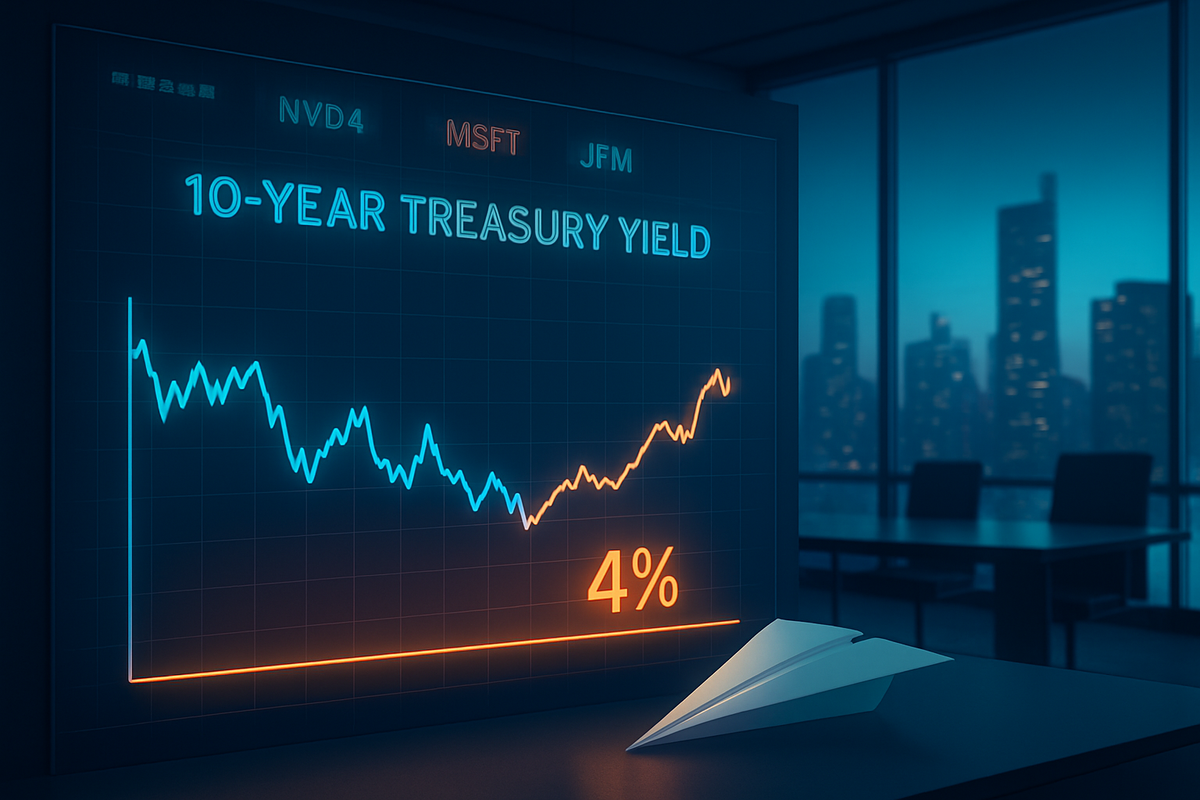
As of December 18, 2025, the financial markets are grappling with a paradox that few analysts predicted a year ago: cooling inflation is no longer a guarantee of rock-bottom interest rates. While the Federal Reserve has successfully navigated the U.S. economy toward a "soft landing," the bond market has staged a quiet revolt. The 10-year Treasury yield has established a stubborn "4% floor," refusing to follow short-term rates lower as investors price in the long-term inflationary pressures of new trade tariffs and a ballooning fiscal deficit.
This "bear steepening" of the yield curve has sent ripples through equity markets, creating a bifurcated landscape for stock valuations. While cooling Core PCE inflation—now hovering at 2.8%—has allowed the Federal Reserve to trim the federal funds rate to a range of 3.50%–3.75%, the persistent high cost of long-term borrowing is forcing a re-evaluation of growth stocks and capital-intensive industries. For investors, the narrative has shifted from "when will rates fall?" to "how high is the new normal?"
The Road to the Soft Landing: A 2025 Retrospective
The journey to this moment began in late 2024, when the Federal Reserve, led by Chair Jerome Powell, initiated its first interest rate cut in over four years. Throughout 2025, the central bank has executed a series of measured 25-basis-point reductions, attempting to ease the restrictive pressure on the economy without reigniting the inflationary fires of the early 2020s. This "pivot" was initially met with euphoria, pushing the S&P 500 to record highs as market participants anticipated a return to the low-rate environment of the previous decade.
However, the timeline took an unexpected turn in the second half of 2025. As the "soft landing" became the consensus reality, the bond market began to focus on structural shifts rather than cyclical cooling. The introduction of broad-based trade tariffs in early 2025 added an estimated 0.7% to headline inflation, creating a "sticky" floor that prevented the 10-year Treasury yield from dipping below 4.0%. This divergence—where the Fed cuts short-term rates while the market holds long-term yields high—has effectively ended the era of "cheap" long-term money.
Key stakeholders, from institutional bond vigilantes to Silicon Valley CFOs, have spent the last quarter of 2025 adjusting to this reality. The initial market reaction was one of confusion; stocks initially rallied on Fed cuts, only to see gains capped as the 10-year yield rebounded from its September lows of 3.6% back to its current 4.15%. This has led to a "valuation ceiling" where Price-to-Earnings (P/E) multiples are being scrutinized with a rigor not seen in years.
Winners and Losers in the High-Yield Era
In this environment, the technology sector has shown remarkable resilience, though the drivers of growth have shifted. Nvidia (NASDAQ: NVDA), which recently saw its market capitalization hover near a staggering $4.3 trillion, has largely decoupled from interest rate sensitivity. Its valuation is being driven by an insatiable global appetite for AI infrastructure, with earnings growth outstripping the impact of a 4% discount rate. However, other mega-cap peers like Microsoft (NASDAQ: MSFT) have felt the "4% floor" more acutely. Microsoft’s P/E ratio, currently stabilized between 30x and 34x, faces a persistent headwind; as long-term yields remain elevated, the present value of its future cloud earnings is mathematically suppressed, preventing the multiple expansion seen in previous cycles.
The Real Estate sector has emerged as a primary victim of the bond market’s stubbornness. Prologis (NYSE: PLD), a titan in industrial logistics, remains highly sensitive to the spread between its capitalization rates and the 10-year Treasury. While the company has seen a recovery in leasing demand, its stock valuation is effectively "boxed in" by the high cost of debt. Analysts note that every 50-basis-point drop in long-term yields would typically add 5–8% to the fair value of REITs like Prologis, but with yields stuck above 4%, the sector’s recovery has been frustratingly sluggish for income-seeking investors.
Conversely, the banking sector has found a silver lining. JPMorgan Chase (NYSE: JPM) has benefited from a widening Net Interest Margin (NIM). As the Fed cuts the short-term rates that JPM pays on deposits, the "4% floor" on the 10-year Treasury allows the bank to maintain higher rates on its long-term loan products. While CEO Jamie Dimon has cautioned that 2025 tariffs could slow midsize business growth and increase credit risks, the current yield environment has provided a robust tailwind for the bank’s core profitability, making it a rare winner in a period of cooling inflation.
Historical Precedents and the Productivity Gamble
The current 2025 economic landscape draws frequent comparisons to the "perfect" soft landing of 1995. Under Alan Greenspan, the Fed successfully tamed inflation while making "mid-cycle adjustments" that fueled a decade of growth. However, the 2025 version is complicated by factors that didn't exist thirty years ago. In 1995, the U.S. was entering a period of globalization and falling deficits; today, the economy is grappling with "de-globalization" via tariffs and a fiscal deficit exceeding 6% of GDP.
This fiscal reality is a primary reason for the "4% floor." Investors now demand a higher "term premium"—the extra yield required to hold long-term debt—due to the sheer volume of Treasury supply hitting the market. This shift suggests a structural change in the bond market that mimics the 1970s more than the 1990s, where inflation expectations remained "unanchored" for years. The only escape hatch, according to many economists, is an AI-driven productivity miracle that allows the economy to grow fast enough to outrun its debt service costs.
The ripple effects are global. As U.S. yields remain high, the dollar has stayed stronger than expected, putting pressure on emerging markets and international competitors. Retail giants like Amazon (NASDAQ: AMZN) are caught in the crossfire; while their cloud division (AWS) benefits from the AI boom, their retail arm is facing a consumer base squeezed by "higher-for-longer" mortgage and credit card rates. Amazon’s shift toward "essential" goods over discretionary spending in late 2025 is a direct reflection of the bond market’s impact on the American household's wallet.
The 2026 Outlook: Strategic Pivots and Scenarios
Looking ahead to 2026, the primary challenge for public companies will be "capital discipline." The days of using cheap debt to fund share buybacks or speculative acquisitions are over. Companies will likely pivot toward "organic" growth and margin preservation. For growth-oriented firms, this means a greater reliance on cash flow rather than capital markets. We expect to see a surge in "quality" as a factor, where investors favor companies with fortress balance sheets that can withstand a sustained 4% yield environment.
Market opportunities may emerge in "inflation-resilient" sectors. If the 2025 tariffs continue to push costs higher, companies with significant pricing power will separate themselves from the pack. However, a potential "hard landing" remains a tail-risk scenario for late 2026. If the Fed’s rate cuts fail to stimulate the economy because long-term borrowing costs remain high, we could see a "growth stall" where unemployment, currently at 4.2%, begins to climb more aggressively.
The most likely scenario is a "grind-out" market. Without the tailwind of falling long-term rates, stock market gains will have to be earned through genuine earnings surprises rather than valuation expansion. Investors should prepare for higher volatility as the market reacts to every inflation print and Treasury auction, searching for any sign that the "4% floor" might finally crack.
A New Era for Investors
As we close out 2025, the key takeaway is that the "soft landing" has been achieved, but it has come at a cost. The bond market has signaled that the era of "zero-bound" interest rates is a relic of the past. The cooling of inflation is a victory for the Federal Reserve, but the resilience of long-term yields is a sobering reminder that fiscal policy and global trade dynamics now carry as much weight as monetary policy.
Moving forward, the market is likely to be defined by a "higher-for-longer" reality for long-term debt, even as short-term rates settle into a neutral range. This environment favors the nimble and the well-capitalized. Investors should keep a close watch on the "term premium" and the 10-year Treasury yield in the coming months; any sustained move above 4.5% could trigger a significant correction in equity valuations, while a break below 3.8% would signal that the bond market is finally convinced that inflation is truly dead.
In this new regime, the "soft landing" is not a destination but a continuous balancing act. The success of 2025 has proved the economy's resilience, but the bond market’s "4% floor" ensures that the path through 2026 will be anything but easy.
This content is intended for informational purposes only and is not financial advice.
More News
View More




Recent Quotes
View MoreQuotes delayed at least 20 minutes.
By accessing this page, you agree to the Privacy Policy and Terms Of Service.