ADP Job Data Shakes Markets: Dow and S&P 500 Rebound on Rate Cut Hopes, Nasdaq Grapples with AI Demand Doubts Amidst Private Sector Weakness
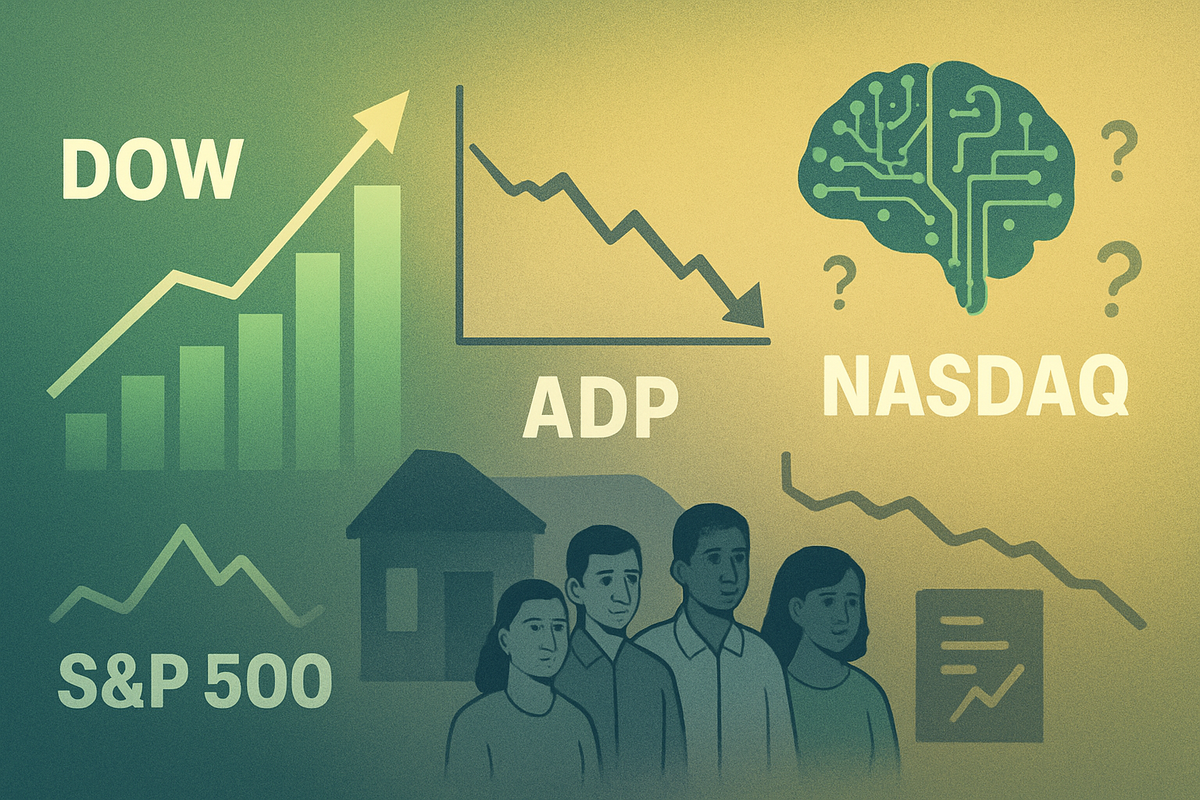
New York, NY – December 3, 2025 – The U.S. financial markets experienced a turbulent day as the latest ADP National Employment Report for November 2025 revealed an unexpected contraction in private sector employment, sending initial jitters through investors. While major indices like the Dow Jones Industrial Average and the S&P 500 initially dipped, they staged a remarkable recovery, closing higher on increased speculation that the Federal Reserve might be compelled to cut interest rates sooner than anticipated. Meanwhile, the tech-heavy Nasdaq Composite, after paring earlier losses, continued to face headwinds, reflecting persistent doubts about the true demand for artificial intelligence technologies and broader weakness in crucial private-sector employment.
This perplexing market reaction underscores a complex economic narrative where "bad news" from the labor market is increasingly viewed as "good news" for asset prices, as it strengthens the case for monetary easing. However, beneath the surface of the rebounding indices, a more granular analysis of the ADP data reveals a concerning "K-shaped" labor market, with small businesses struggling significantly while larger firms show more resilience. This uneven recovery, coupled with specific job declines in tech-adjacent sectors and recent anxieties surrounding AI product adoption, paints a nuanced picture for the future of the U.S. economy and its public companies.
November's Employment Shock and Market's Calculated Response
The November 2025 ADP National Employment Report, released today, December 3, 2025, delivered a significant surprise to economists and investors alike. Contrary to forecasts predicting a modest increase, the private sector shed a notable 32,000 jobs. This marked the largest monthly decline since March 2023, signaling a pronounced slowdown in the hiring landscape. The report highlighted a flat trajectory for job creation throughout the latter half of 2025, accompanied by a deceleration in annual pay growth, which fell to 4.4% for job-stayers and 6.3% for job-changers.
A closer look at the data reveals the stark disparity within the labor market. Small businesses, defined as those with fewer than 50 employees, bore the brunt of the downturn, collectively shedding a staggering 120,000 jobs. This contrasts sharply with medium and large establishments, which managed to add 51,000 and 39,000 jobs, respectively. Key industries experiencing significant job losses included Professional and Business Services (-26,000), Information (-20,000), Manufacturing (-18,000), and Construction (-9,000). Conversely, sectors like Education and Health Services (+33,000) and Leisure and Hospitality (+13,000) continued to see gains, suggesting a shift in employment drivers. This November data stands in contrast to the October 2025 ADP report, which had shown a revised increase of 47,000 private sector jobs, primarily driven by large firms and the service sector.
Upon the release of this weaker-than-expected data, initial market sentiment was negative, leading to an immediate dip across major indices. However, investors quickly recalibrated, interpreting the softening labor market as a strong signal for the Federal Reserve to pivot towards a more accommodative monetary policy. This spurred a significant rebound, with the Dow Jones Industrial Average (DJIA) and the S&P 500 (SPX) recovering to post gains of 0.42% to 0.8% and 0.1% to 0.3%, respectively, by afternoon trading. The Nasdaq Composite, while also recovering from its initial dip, experienced a more modest rebound, reflecting underlying concerns within the technology sector. Notably, the small-cap Russell 2000 outperformed, gaining around 0.8%, as smaller companies are often more sensitive and responsive to the prospect of lower interest rates. This reaction highlights the prevalent market belief that a struggling economy, if it leads to cheaper money, can still be a net positive for equity valuations.
Corporate Fortunes: Winners and Losers in a Shifting Landscape
The recent ADP data and its implications for interest rate policy are set to create a distinct cleavage in corporate performance, with some companies poised to benefit while others face increasing headwinds. The most immediate impact will be felt by small businesses across various sectors. The shedding of 120,000 jobs by firms with fewer than 50 employees underscores their vulnerability to "cautious consumers and an uncertain macroeconomic environment," as well as "policy uncertainty, rising input costs, and high interest rates." These smaller entities, often lacking the capital depth of their larger counterparts, will continue to struggle with hiring and expansion, potentially leading to further consolidation in industries like retail, local services, and manufacturing.
In the technology sector, the narrative is particularly complex. While the broader market rebounded, the Nasdaq's more tempered gains reflect ongoing anxieties about the actual demand for artificial intelligence. A significant incident on December 3, 2025, involved a report from "The Information" stating that Microsoft (NASDAQ: MSFT) was cutting software sales quotas tied to AI due to customer resistance. Although Microsoft later refuted the report, its shares initially fell, dragging down sentiment for other AI-focused companies and software providers. This highlights a potential challenge for companies like NVIDIA (NASDAQ: NVDA), Alphabet (NASDAQ: GOOGL), and Amazon (NASDAQ: AMZN), whose valuations have heavily factored in robust AI adoption. If enterprises are hesitant to fully integrate new AI products or find their immediate ROI unclear, the anticipated boom in AI-driven revenue for these tech giants could face delays, impacting their growth trajectories and stock performance.
Conversely, larger, well-capitalized companies appear more resilient. The ADP report indicated that medium and large establishments continued to add jobs, suggesting they are better equipped to navigate economic uncertainties. These companies, particularly those with strong balance sheets, may also benefit disproportionately from any eventual interest rate cuts, as their borrowing costs would decrease, potentially freeing up capital for investment or shareholder returns. Sectors that showed job gains, such as Education and Health Services and Leisure and Hospitality, could see continued stability or even growth, benefiting companies like major hospital chains, educational service providers, and hospitality groups, which cater to more inelastic demands or benefit from shifting consumer spending patterns.
Wider Significance: A K-Shaped Economy and the Fed's Dilemma
The November ADP report, alongside the market's reaction, paints a vivid picture of a "K-shaped" economic recovery, a trend that has been observed in various forms since the pandemic. This phenomenon signifies an uneven economic landscape where larger, often publicly traded companies and wealthier individuals recover and thrive, while smaller businesses and lower-income individuals face stagnation or decline. The significant job losses among small businesses, contrasted with job gains in larger firms, is a clear manifestation of this trend, indicating a widening gap in economic health and opportunity. This could lead to increased market concentration, as smaller, struggling entities are either acquired or forced out of business, leaving larger players with greater market share.
The ripple effects of this uneven recovery are substantial. Consumer caution, driven by job insecurity and slowing wage growth, could persist, impacting discretionary spending and further challenging businesses reliant on robust consumer demand. For competitors and partners, this means navigating a market where purchasing power is concentrated, and supply chains might be disrupted by the struggles of smaller, specialized suppliers. Regulatory bodies, particularly the Federal Reserve, are now squarely in the spotlight. The weaker jobs data significantly amplifies the pressure on the Fed to consider interest rate cuts. While the market is already pricing in a high probability of a cut at the upcoming December 9-10 Federal Open Market Committee (FOMC) meeting, the depth of the private-sector job losses could compel the Fed to adopt a more dovish stance, signaling further cuts in the new year.
Historically, periods of significant labor market softening have often preceded shifts in monetary policy. The current situation bears some resemblance to previous cycles where a weakening economy prompted the Fed to ease rates, often leading to a stock market rally, even if the underlying economic fundamentals were challenging. However, a key difference now is the ongoing debate around AI's long-term impact on employment. While some argue AI will create new jobs, the immediate concerns about its demand and potential for displacement in sectors like "Information" and "Professional and Business Services" add a layer of structural uncertainty not present in past downturns. This confluence of cyclical economic weakness and structural technological shifts makes the current environment particularly complex for policymakers and investors alike.
The Road Ahead: Navigating Uncertainty and Strategic Shifts
Looking ahead, the short-term market outlook is likely to remain volatile as investors keenly await further economic data and, most critically, the Federal Reserve's decision at its upcoming FOMC meeting on December 9-10. Should the Fed indeed signal or implement an interest rate cut, markets could experience a further boost, particularly for growth stocks and small-cap companies that are more sensitive to borrowing costs. However, any indication that the Fed remains cautious, or that the labor market weakness is more severe than anticipated, could trigger renewed selling pressure. The ongoing "K-shaped" recovery suggests that while some sectors and large corporations may continue to perform well, the broader economic foundation, particularly for small businesses, remains fragile.
In the long term, companies will need to adapt strategically to this evolving landscape. Businesses heavily reliant on consumer discretionary spending may need to pivot towards more resilient product lines or focus on value offerings. For tech companies, the pressure to demonstrate tangible ROI for AI solutions will intensify. Companies like Microsoft (NASDAQ: MSFT), Google (NASDAQ: GOOGL), and IBM (NYSE: IBM) will need to articulate clearer value propositions for their AI products to overcome customer resistance and translate innovation into sustained demand. This could involve focusing on industry-specific applications, demonstrating productivity gains, or offering more flexible deployment models.
Market opportunities may emerge in defensive sectors, such as healthcare and utilities, which tend to be less affected by economic downturns. Furthermore, companies that can effectively leverage technology to improve efficiency and reduce costs, without necessarily relying on new AI product sales, could find themselves in a stronger position. Potential scenarios include a "soft landing" where the Fed successfully engineers a slowdown without a deep recession, or a more prolonged period of uneven growth where monetary easing provides a floor for markets but fails to stimulate broad-based economic recovery. Investors should brace for a period where economic data releases will have outsized influence on market movements, and where the distinction between economic health and market performance becomes increasingly nuanced.
Wrap-Up: A Market at a Crossroads
The November 2025 ADP jobs data has delivered a potent mix of signals to the financial markets: a weakening private sector labor market that paradoxically fueled a stock market rally on hopes of Federal Reserve interest rate cuts. This highlights the prevailing sentiment that easing monetary policy is now the primary driver of market performance, even at the expense of robust economic fundamentals. While the Dow and S&P 500 staged impressive comebacks, the Nasdaq's more subdued performance underscores lingering uncertainties, particularly regarding the real-world demand and adoption of artificial intelligence technologies, which have been a significant growth engine for the tech sector.
Moving forward, the Federal Reserve's actions in response to this data will be paramount, and investors will be scrutinizing every statement and economic indicator. The "K-shaped" recovery remains a defining feature, indicating that while large corporations may find avenues for continued growth, small businesses and certain segments of the labor market will likely endure ongoing challenges. This structural shift, combined with the evolving impact of AI on employment, suggests a period of significant adaptation for businesses and a need for careful discernment by investors.
Key takeaways from this event include the growing disconnect between economic reality and market exuberance driven by monetary policy expectations. The lasting impact will likely be a more segmented market, where the fortunes of companies are increasingly tied to their size, their resilience to economic shocks, and their ability to genuinely monetize technological advancements like AI. Investors should vigilantly watch for subsequent jobs reports, inflation data, corporate earnings, and any communications from the Federal Reserve in the coming months. These will provide crucial insights into whether the U.S. economy is heading for a soft landing, a deeper slowdown, or a prolonged period of uneven growth, and how public companies will navigate this complex terrain.
This content is intended for informational purposes only and is not financial advice
More News
View More




Recent Quotes
View More
Quotes delayed at least 20 minutes.
By accessing this page, you agree to the Privacy Policy and Terms Of Service.