The H200 Pivot: Nvidia Navigates a $30 Billion Opening Amid Impending 2026 Tariff Wall
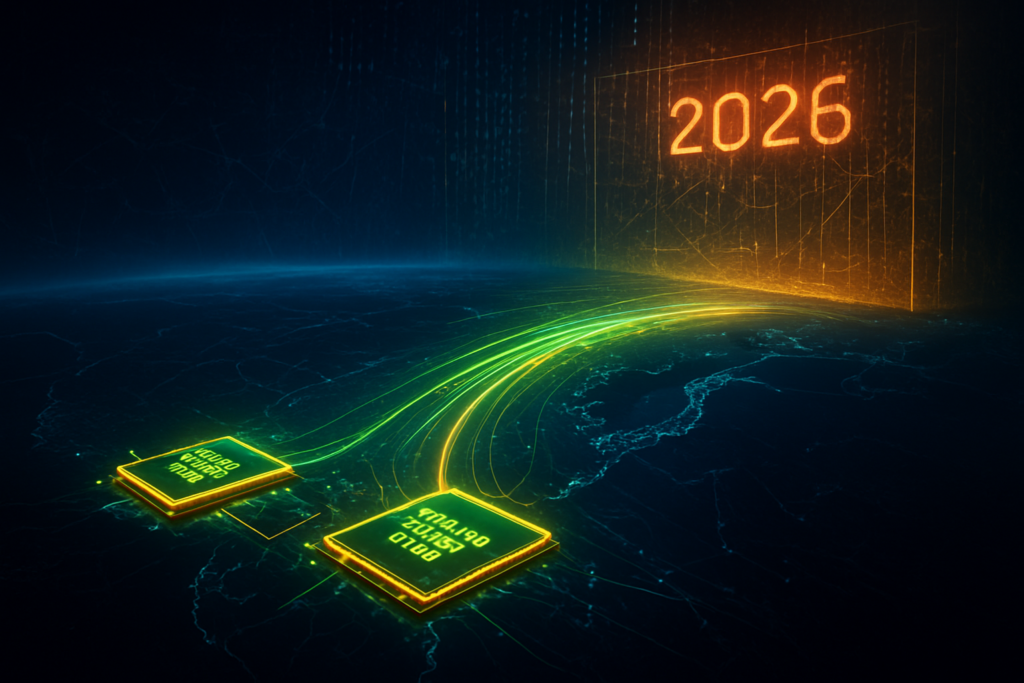
In a move that has sent shockwaves through both Silicon Valley and Beijing, the geopolitical landscape for artificial intelligence has shifted dramatically as of December 2025. Following a surprise one-year waiver announced by the U.S. administration on December 8, 2025, Nvidia (NASDAQ: NVDA) has been granted permission to resume sales of its high-performance H200 Tensor Core GPUs to "approved customers" in China. This reversal marks a pivotal moment in the U.S.-China "chip war," transitioning from a strategy of total containment to a "transactional diffusion" model that allows the flow of high-end hardware in exchange for direct revenue sharing with the U.S. Treasury.
The immediate significance of this development cannot be overstated. For the past year, Chinese tech giants have been forced to rely on "crippled" versions of Nvidia hardware, such as the H20, which were intentionally slowed to meet strict export controls. The lifting of these restrictions for the H200—the flagship of Nvidia’s Hopper architecture—grants Chinese firms the raw computational power required to train frontier-level large language models (LLMs) that were previously out of reach. However, this opportunity comes with a massive caveat: a looming "tariff cliff" in November 2026 and a mandatory 25% revenue-sharing fee that threatens to squeeze Nvidia’s legendary profit margins.
Technical Rebirth: From the Crippled H20 to the Flagship H200
The technical disparity between what Nvidia was allowed to sell in China and what it can sell now is staggering. The previous China-specific chip, the H20, was engineered to fall below the U.S. government’s "Total Processing Performance" (TPP) threshold, resulting in an AI performance of approximately 148 TFLOPS (FP8). In contrast, the H200 delivers a massive 1,979 TFLOPS—nearly 13 times the performance of its predecessor. This jump is critical because while the H20 was capable of "inference" (running existing AI models), it lacked the brute force necessary for "training" the next generation of generative AI models from scratch.
Beyond raw compute, the H200 features 141GB of HBM3e memory and 4.8 TB/s of bandwidth, providing a 20% increase in data throughput over the standard H100. This specification is particularly vital for the massive datasets used by companies like Alibaba (NYSE: BABA) and Baidu (NASDAQ: BIDU). Industry experts note that the H200 is the first "frontier-class" chip to enter the Chinese market legally since the 2023 lockdowns. While Nvidia’s newer Blackwell (B200) and upcoming Rubin architectures remain strictly prohibited, the H200 provides a "Goldilocks" solution: powerful enough to keep Chinese firms dependent on the Nvidia ecosystem, but one generation behind the absolute cutting edge reserved for U.S. and allied interests.
Market Dynamics: A High-Stakes Game for Tech Giants
The reopening of the Chinese market for H200s is expected to be a massive revenue driver for Nvidia, with analysts at Wells Fargo (NYSE: WFC) estimating a $25 billion to $30 billion annual opportunity. This development puts immediate pressure on domestic Chinese chipmakers like Huawei, whose Ascend 910C had been gaining significant traction as the only viable alternative for Chinese firms. With the H200 back on the table, many Chinese cloud providers may pivot back to Nvidia’s superior software stack, CUDA, potentially stalling the momentum of China's domestic semiconductor self-sufficiency.
However, the competitive landscape is complicated by the "25% revenue-sharing fee" imposed by the U.S. government. For every H200 sold in China, Nvidia must pay a quarter of the revenue directly to the U.S. Treasury. This creates a strategic dilemma for Nvidia: if they pass the cost entirely to customers, the chips may become too expensive compared to Huawei’s offerings; if they absorb the cost, their industry-leading margins will take a significant hit. Competitors like Advanced Micro Devices (NASDAQ: AMD) are also expected to seek similar waivers for their MI300 series, potentially leading to a renewed price war within the restricted Chinese market.
The Geopolitical Gamble: Transactional Diffusion and the 2026 Cliff
This policy shift represents a new phase in global AI governance. By allowing H200 sales, the U.S. is betting that it can maintain a "strategic lead" through software and architecture (keeping Blackwell and Rubin exclusive) while simultaneously draining capital from Chinese tech firms. This "transactional diffusion" strategy uses Nvidia’s hardware as a diplomatic and economic tool. Yet, the broader AI landscape remains volatile due to the "Chip-for-Chip" tariff policy slated for full implementation on November 10, 2026.
The 2026 tariffs act as a sword of Damocles hanging over the industry. If China does not meet specific purchase quotas for U.S. goods by late 2026, reciprocal tariffs could rise by another 10% to 20%. This creates a "revenue cliff" where Chinese firms are currently incentivized to aggressively stockpile H200s throughout the first three quarters of 2026 before the trade barriers potentially snap shut. Concerns remain that this "boom and bust" cycle could lead to significant market volatility and a repeat of the inventory write-downs Nvidia faced in early 2025.
Future Outlook: The Race to November 2026
In the near term, expect a massive surge in Nvidia’s Data Center revenue as Chinese hyperscalers rush to secure H200 allocations. This "pre-tariff pull-forward" will likely inflate Nvidia's earnings throughout the first half of 2026. However, the long-term challenge remains the development of "sovereign AI" in China. Experts predict that Chinese firms will use the H200 window to accelerate their software optimization, making their models less dependent on specific hardware architectures in preparation for a potential total ban in 2027.
The next twelve months will also see a focus on supply chain resilience. As 2026 approaches, Nvidia and its manufacturing partner Taiwan Semiconductor Manufacturing Company (NYSE: TSM) will likely face increased pressure to diversify assembly and packaging outside of the immediate conflict zones in the Taiwan Strait. The success of the H200 waiver program will serve as a litmus test for whether "managed competition" can coexist with the intense national security concerns surrounding artificial intelligence.
Conclusion: A Delicate Balance in the AI Age
The lifting of the H200 ban is a calculated risk that underscores Nvidia’s central role in the global economy. By navigating the dual pressures of U.S. regulatory fees and the impending 2026 tariff wall, Nvidia is attempting to maintain its dominance in the world’s second-largest AI market while adhering to an increasingly complex set of geopolitical rules. The H200 provides a temporary bridge for Chinese AI development, but the high costs and looming deadlines ensure that the "chip war" is far from over.
As we move through 2026, the key indicators to watch will be the adoption rate of the H200 among Chinese state-owned enterprises and the progress of the U.S. Treasury's revenue-collection mechanism. This development is a landmark in AI history, representing the first time high-end AI compute has been used as a direct instrument of fiscal and trade policy. For Nvidia, the path forward is a narrow one, balanced between unprecedented opportunity and the very real threat of a geopolitical "cliff" just over the horizon.
This content is intended for informational purposes only and represents analysis of current AI developments.
TokenRing AI delivers enterprise-grade solutions for multi-agent AI workflow orchestration, AI-powered development tools, and seamless remote collaboration platforms.
For more information, visit https://www.tokenring.ai/.
More News
View More

Recent Quotes
View MoreQuotes delayed at least 20 minutes.
By accessing this page, you agree to the Privacy Policy and Terms Of Service.