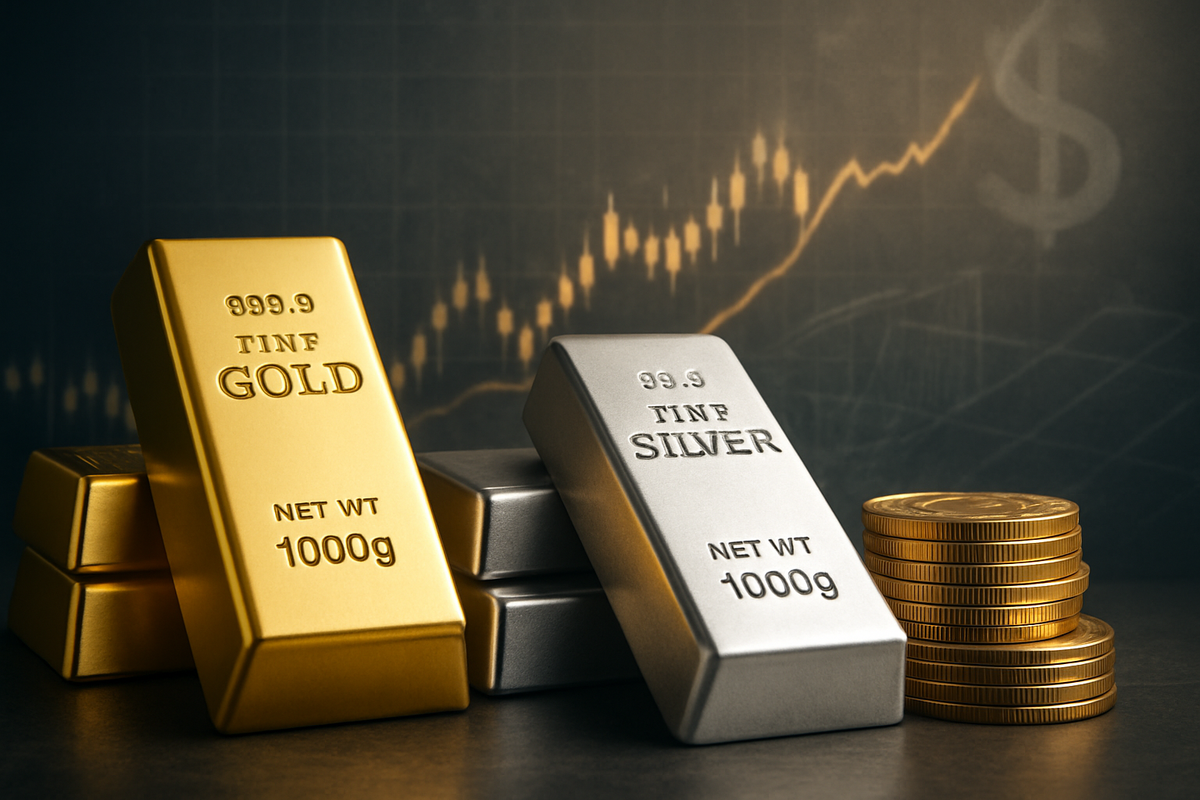
New York, NY – December 5, 2025 – The financial markets are buzzing today as gold prices have surged by an impressive 1%, driven by escalating expectations of a U.S. Federal Reserve interest rate cut. This bullish sentiment has simultaneously weighed on the U.S. dollar, making dollar-denominated assets more attractive to international investors. In a parallel and equally significant development, silver has achieved an unprecedented milestone, hitting an all-time high, fueled by a potent combination of robust industrial demand and persistent supply constraints.
This dual rally in precious metals underscores a broader shift in investor sentiment, as market participants increasingly position themselves for a period of looser monetary policy. The weakening dollar acts as a direct tailwind for gold and silver, enhancing their appeal as hedges against inflation and economic uncertainty. The record-breaking performance of silver, in particular, highlights its growing importance not only as a monetary asset but also as a critical component in the burgeoning green technology sector.
Detailed Coverage: A Confluence of Factors Propelling Precious Metals
The current surge in gold and silver prices is the culmination of several interconnected factors, creating a powerful upward momentum in the precious metals market. The most significant catalyst has been the heightened anticipation of interest rate cuts by the U.S. Federal Reserve. As of December 5, 2025, market probabilities strongly indicate a 25-basis-point rate cut at the upcoming December 9-10 Federal Open Market Committee (FOMC) meeting, with further easing widely expected into the new year. Lower interest rates reduce the opportunity cost of holding non-yielding assets like gold and silver, making them more appealing compared to interest-bearing alternatives.
This expectation of monetary easing has directly contributed to a weakening U.S. dollar, with the dollar index (DXY) recently hovering near a five-week low. A softer dollar fundamentally makes commodities priced in the greenback, such as gold and silver, more affordable for buyers using other currencies, thereby stimulating demand. Recent economic data, including a notable decline in private payrolls for November, has further reinforced the narrative of a cooling labor market, bolstering the case for the Fed to adopt a more accommodative stance.
Beyond monetary policy, a persistent demand for safe-haven assets continues to underpin the precious metals rally. Ongoing geopolitical tensions, global economic uncertainties, and concerns about potential volatility in equity markets are prompting investors to seek refuge in gold and silver to preserve wealth and hedge against inflation and currency debasement. Silver's ascent to record highs is further amplified by a structural supply deficit that has persisted for five consecutive years, with projections indicating another shortfall in 2025. This scarcity is exacerbated by tight global inventories and a reduced "free float" of silver not held in Exchange-Traded Funds (ETFs). The robust industrial demand for silver, driven by its indispensable role in solar panels, electric vehicles, 5G technology, and semiconductors, adds another layer of fundamental support to its price. Both gold and silver have also seen substantial inflows into bullion-backed ETFs, signaling strong investor positioning in anticipation of lower U.S. rates and a weaker dollar.
Companies Poised to Win or Lose in a Bullish Precious Metals Market
The rally in gold and silver prices creates a distinct landscape of winners and losers across various industries, particularly impacting mining companies and sectors reliant on these metals.
Potential Winners:
- Mining Companies: Gold and silver mining companies are arguably the most direct beneficiaries of rising precious metal prices. Companies like Barrick Gold (NYSE: GOLD), Newmont Corporation (NYSE: NEM), Agnico Eagle Mines (NYSE: AEM), and Pan American Silver (NASDAQ: PAAS) will likely see significant improvements in their revenue, profit margins, and cash flow. Higher metal prices mean that even mines with higher operating costs can become profitable, potentially leading to increased exploration budgets and the development of new projects. This could translate into "explosive growth" for well-positioned miners.
- Precious Metals ETFs and Funds: Exchange-Traded Funds (ETFs) that hold physical gold or silver, such as the SPDR Gold Shares (NYSEARCA: GLD) and the iShares Silver Trust (NYSEARCA: SLV), will see their net asset values increase, benefiting investors holding these instruments. Investment funds specializing in precious metals or mining equities will also likely experience strong performance.
- Jewelry Retailers with Existing Inventory: Retailers holding significant inventory of gold and silver jewelry purchased at lower prices could see increased profit margins as the value of their stock appreciates. However, this benefit might be offset if higher prices deter consumer demand for new purchases.
Potential Losers/Challenged Sectors:
- Industrial Users of Silver: Industries heavily dependent on silver as a raw material will face increased input costs. Manufacturers of solar panels, such as First Solar (NASDAQ: FSLR), electronic device producers like Apple (NASDAQ: AAPL), and companies in the medical equipment sector, will see their production expenses rise. While some may attempt to pass these costs on to consumers, it could erode profit margins or lead to higher product prices, potentially impacting demand. While exploring alternative materials might be an option, silver's unique properties often make substitution challenging in critical applications.
- Companies with High Debt and Unhedged Exposure: Mining companies with substantial debt or those that have not adequately hedged against price fluctuations could face challenges if there are sudden pullbacks in prices, even within a generally bullish trend. Short-term profit-taking can negatively affect their immediate revenues and margins.
- Investors in Interest-Bearing Assets: As interest rate cut expectations weigh on bond yields, investors heavily allocated to traditional fixed-income instruments might find their returns less attractive compared to the rising appeal of non-yielding precious metals.
Wider Significance: A Shift in the Global Financial Landscape
The current rally in gold and silver is more than just a fleeting market event; it signifies a broader recalibration of the global financial landscape, reflecting deeper trends and potential shifts in economic paradigms. This event fits squarely into a growing trend of investors diversifying away from traditional assets amidst persistent global uncertainties. The sustained demand for safe havens suggests a foundational unease regarding geopolitical stability, inflationary pressures, and the long-term health of major fiat currencies.
The ripple effects of this precious metals surge extend across various sectors. For central banks globally, the weakening U.S. dollar and the appeal of gold as a reserve asset could accelerate a trend of diversification away from dollar-denominated holdings. This could have long-term implications for the dollar's status as the world's primary reserve currency. Competitors in the industrial materials space might face increased pressure as silver's rising cost makes it a more expensive input, potentially driving innovation in material science to find more cost-effective alternatives, though this remains challenging for silver's unique properties. Partners in the green energy sector, particularly solar panel manufacturers, will need to strategically manage the increasing cost of silver, which is a critical component in photovoltaic cells.
Regulatory and policy implications could also emerge. If the trend of rising commodity prices, particularly for critical industrial metals like silver, continues, governments might explore measures to secure supply chains or incentivize domestic production. Historically, periods of significant precious metals appreciation often coincide with periods of high inflation or economic instability, such as the 1970s or the post-2008 financial crisis era. The current environment, marked by high government debt, expansionary fiscal policies, and persistent geopolitical tensions, draws parallels to these historical precedents, suggesting that investors are seeking tangible assets as a hedge against systemic risks. This event underscores a potential paradigm shift where real assets are gaining prominence in investment portfolios, challenging the long-held dominance of financial assets in certain market conditions.
What Comes Next: Navigating the Future of Precious Metals
Looking ahead, the trajectory of gold and silver prices will largely hinge on the future actions of the U.S. Federal Reserve and the evolving global economic landscape. In the short term, the market will keenly watch the upcoming December 9-10 FOMC meeting for confirmation of the anticipated rate cut and any forward guidance on monetary policy. A definitive dovish signal from the Fed could provide further impetus for gold and silver, potentially extending the current rally. Conversely, any unexpected hawkish rhetoric or a delay in rate cuts could trigger a temporary correction as investors re-evaluate their positions.
In the long term, the structural supply deficit for silver, coupled with its increasing demand from green technologies, suggests a robust underlying support for its price. As the world transitions to renewable energy and electric vehicles, silver's industrial utility is only expected to grow, making it a compelling long-term investment. For gold, its role as a timeless safe haven will likely continue to attract investors amidst ongoing geopolitical uncertainties and potential inflationary pressures stemming from global fiscal policies.
Potential strategic pivots for companies in this environment include mining firms accelerating exploration and development efforts for new reserves to capitalize on higher prices. Industrial users of silver may need to explore long-term supply contracts or invest in research and development for more efficient use of silver or alternative materials. Market opportunities may emerge in specialized funds focusing on precious metals, as well as in companies providing technologies that optimize the use of these metals. Challenges include increased volatility, the risk of speculative bubbles, and managing higher input costs for industrial consumers. Potential scenarios range from a sustained bull run driven by continuous rate cuts and strong industrial demand, to periods of consolidation or correction if economic conditions stabilize or monetary policy shifts unexpectedly.
Comprehensive Wrap-Up: A New Era for Precious Metals
Today's significant gains in gold and silver mark a pivotal moment in the financial markets, driven by the powerful combination of anticipated Federal Reserve rate cuts and a weakening U.S. dollar. Silver's historic all-time high, in particular, highlights its dual importance as both a monetary metal and a critical industrial commodity essential for the global green transition. These events underscore a growing investor appetite for tangible assets as a hedge against economic uncertainty and inflation, signaling a potential shift in broader market sentiment.
Moving forward, the precious metals market is likely to remain highly sensitive to monetary policy decisions, particularly those from the U.S. Federal Reserve. The ongoing debate about inflation, global economic growth, and geopolitical stability will continue to influence investor flows into gold and silver. While the current environment presents compelling opportunities for investors in precious metals and related mining companies, it also poses challenges for industries reliant on these materials due to increased input costs.
Investors should closely monitor central bank communications, key economic indicators (especially inflation and employment data), and geopolitical developments in the coming months. The interplay between these factors will determine the sustained momentum of gold and silver. The enduring significance of this event lies not just in the immediate price appreciation, but in its potential to reshape investment portfolios and accelerate strategic adaptations across various industries, cementing precious metals' role as a crucial component of the modern financial landscape.
This content is intended for informational purposes only and is not financial advice