We are now nearing the end of 2025, and investors might want to position their portfolios for next year. Stocks look set to close with double-digit gains this year, which would mark the third consecutive year of such a feat. Despite concerns over geopolitical tensions, recession, and more recently, an artificial intelligence (AI) bubble, stocks have had a strong year overall.
However, that's not to say that the concerns are totally unfounded. Just take a look at gold (GCZ25) prices. The safe-haven asset is outperforming the S&P 500 Index ($SPX) this year. Gold mining companies are enjoying the rally of a lifetime.
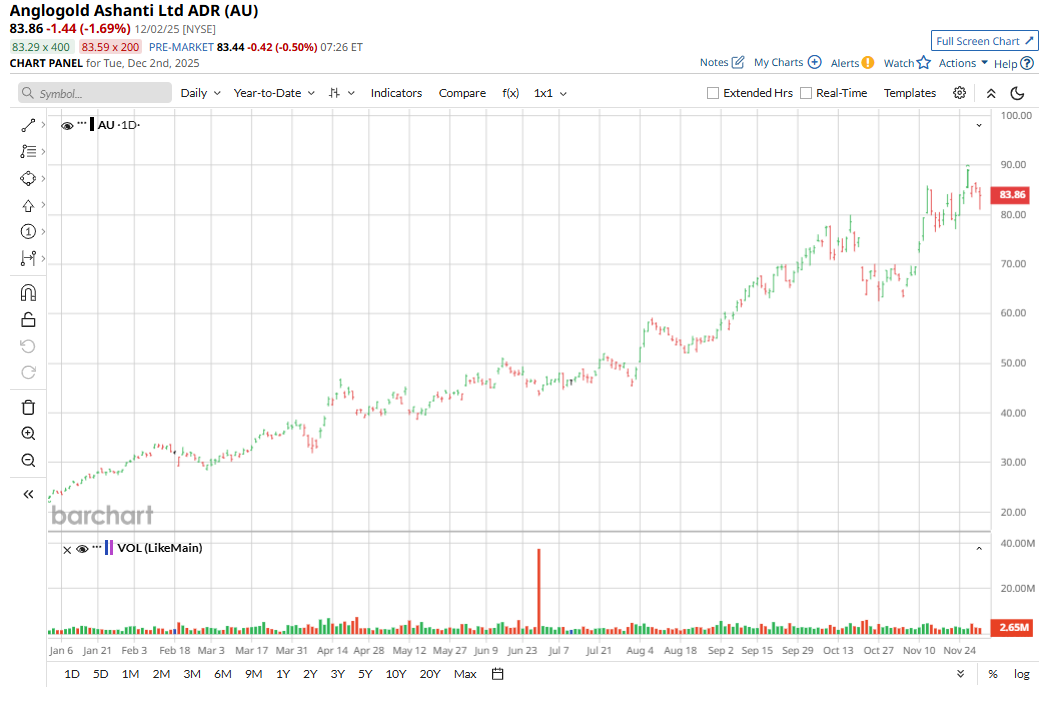
Specifically, Anglogold Ashanti stock is up nearly 265% year-to-date, well ahead of the VanEck Gold Mining ETF (GDX). In my previous article, I had noted that it made sense to buy the dip in the stock as it crashed alongside gold prices. With AU now up sharply from those levels, let’s explore whether the stock, which promises one of the most generous dividend yields among gold miners, is a buy for 2026.
Gold Price Outlook
As a gold miner, Anglogold’s outlook is dependent on gold prices. After a healthy correction, gold prices have again rebounded and are eyeing the all-time highs they hit in October. The stars seem to be well aligned for gold in 2026, as global uncertainty continues to bolster its safe-haven appeal. The central bank's gold-buying spree should also continue for the foreseeable future as it diversifies its holdings away from the greenback. Notably, while the U.S. dollar is still the largest reserve asset, gold has surpassed the Euro to claim the second spot in central bank holdings.
I would argue that the factors that helped support gold’s rally this year will continue into 2026. While Agnico-Eagles Mines (AEM) is a safer bet among gold miners, AU may fit the bill for more aggressive investors, particularly those looking for generous dividends.
Higher Gold Prices Have Led to a Surge in AU’s Free Cash Flow
Gold mining companies are generating record cash flows amid the surge in gold prices, and Anglogold is no exception. The company reported free cash flow (FCF) of nearly $1 billion in the third quarter of 2025, which is similar to the amount it generated in all of 2024. It also has a generous dividend policy and currently pays a quarterly payout of 12.5 cents per share, with a commitment to pay out 50% of its free cash flow to investors at the end of every year.
This year, it departed from the policy and, instead of making the “true-up” payment at the end of the year, it announced an interim dividend of 80 cents during its Q2 earnings call, which included the base dividend of 12.5 cents and the true-up payment to reach 50% of free cash flows in the first half. The company made a true-up payment for Q3 and doled out $460 million in dividends, which is roughly half of the cash flow it generated in the quarter.
AU attributed the schedule change to the “extraordinary” cash flows that it has been generating, along with the management’s “confidence in the outlook of the business.” While the company did not commit to quarterly true-ups as the new policy, it might continue to do so in the near term, given the positive outlook for gold prices.
How Much Should AU Investors Expect in Dividends?
Since Anglogold’s dividend is a function of its future cash flow, it wouldn't be prudent to consider its trailing dividend yield before making an investment decision. Currently, AU’s annualized dividend yield is over 4% (based on the Q3 payout), and given where gold prices are, its 2026 dividend might be even higher than what it is currently paying.
All said, after the recent rally, I would remain on the sidelines of AU stock and wait for the prices to fall a bit from these levels. Gold prices might also take a short-term breather if a peace deal is reached between Russia and Ukraine, though that remains elusive. Given gold’s positive long-term fundamentals, AU remains a buy-on-the-dip candidate unless something fundamentally changes in the gold story.
On the date of publication, Mohit Oberoi did not have (either directly or indirectly) positions in any of the securities mentioned in this article. All information and data in this article is solely for informational purposes. For more information please view the Barchart Disclosure Policy here.
More news from Barchart