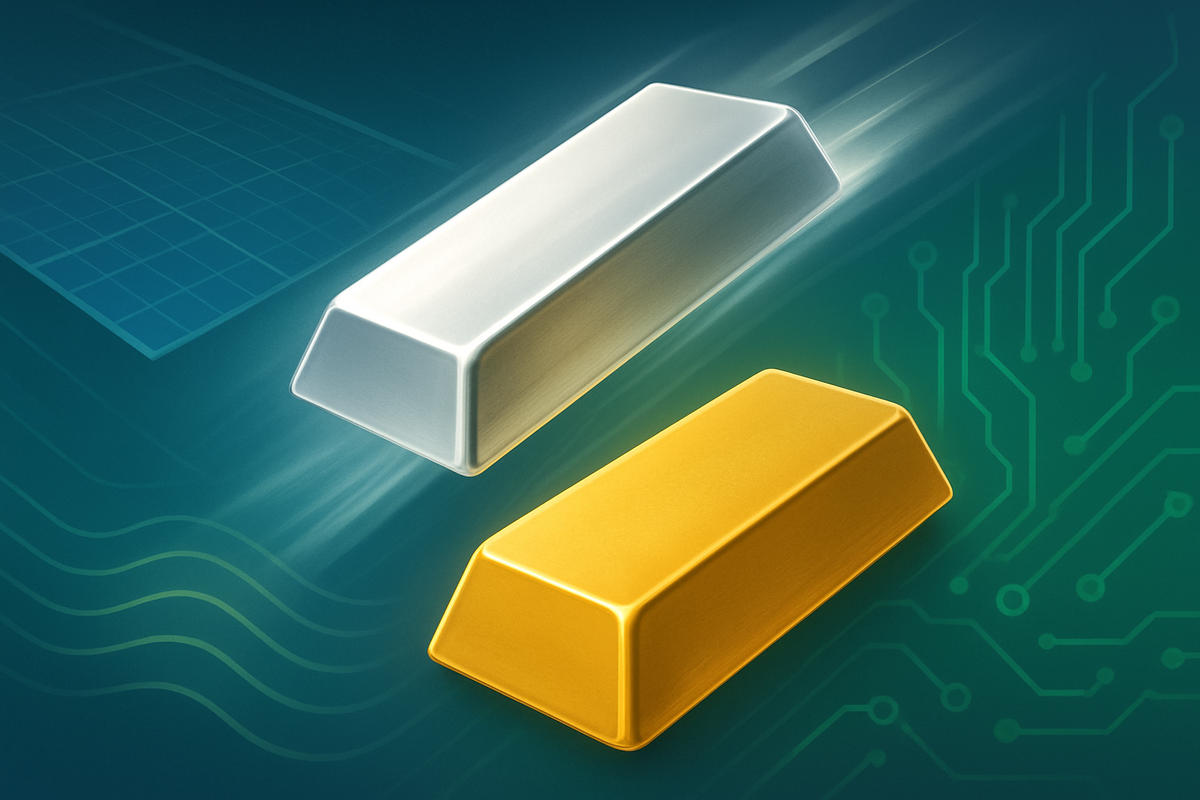
The precious metals market has witnessed a dramatic shift in 2025, with silver emphatically stealing the spotlight from its more traditionally esteemed counterpart, gold. As of December 11, 2025, silver has delivered an astounding year-to-date performance, with returns soaring past the 100% mark in several instances, effectively doubling investors' capital. This meteoric rise stands in stark contrast to gold's respectable yet comparatively modest gains of 50-70% over the same period. This significant divergence underscores a powerful narrative driven by surging industrial demand, tightening global inventories, and evolving macroeconomic conditions, signaling a potentially transformative era for the 'poor man's gold.'
Silver's Meteoric Ascent and Gold's Steady Climb
Silver's ascent in 2025 has been nothing short of spectacular, marking it as one of the year's top-performing assets. With reports indicating year-to-date returns ranging from 95% to over 113% in dollar terms, the white metal has firmly established its dominance. Specifically, on December 11, 2025, silver was reported to be up over 100% compared to the same time last year, with some analyses citing a 108% rally that propelled its price beyond $60 per ounce, reaching historic highs. This remarkable trajectory began to accelerate earlier in the year, with silver already surging to approximately $45 per ounce by late September 2025, representing a robust 55.9% gain at that point.
In contrast, gold, while experiencing a strong year by historical standards, has not kept pace with silver's explosive growth. As of December 11, 2025, gold's price has appreciated by approximately 57.39% year-over-year, with overall year-to-date gains generally falling within the 50-70% range. While these are strong returns for a safe-haven asset, they pale in comparison to silver's exceptional performance. The widening gap between the two metals highlights silver's dual nature as both a monetary and an industrial commodity, a characteristic that has proven particularly advantageous in the current market climate.
The driving forces behind silver's explosive rally are multi-faceted, rooted in both robust industrial demand and a tightening supply landscape, further bolstered by accommodating monetary policies. Industrial consumption now accounts for an estimated 50% to 65% of total silver demand, with the solar and photovoltaic (PV) sector leading the charge, projected to consume over 5,200 tons in 2025. The global push for renewable energy, coupled with the expansion of 5G infrastructure, Artificial Intelligence (AI), and electric vehicles (EVs), has made silver an indispensable component in modern technology. Each EV, for instance, requires significantly more silver than conventional vehicles, while AI computing centers can consume substantial amounts. This industrial demand has proven largely price-inelastic, as manufacturers view silver as a critical, irreplaceable input.
Simultaneously, the supply side of the equation has been under considerable strain. 2025 marks the fifth consecutive year of a structural supply deficit in the silver market, with cumulative shortfalls since 2021 reaching an astonishing 800-820 million ounces—equivalent to an entire year of global mine production. Global silver mine output continues to decline, largely because 70-80% of silver is produced as a byproduct of mining other metals like copper, lead, and zinc, making it difficult for supply to respond quickly to soaring prices. This inelasticity, combined with underinvestment in exploration and declining ore grades, has led to significantly diminished physical inventories in major vaults, including the London Bullion Market Association (LBMA) and the Shanghai Futures Exchange (SHFE), sparking concerns about immediate availability and contributing to "historic short squeezes."
Monetary policy has also played a crucial supportive role. The Federal Reserve's return to interest rate cuts in 2025, bringing the federal funds rate down to 3.50%–3.75%, has lowered the opportunity cost of holding non-yielding assets like precious metals. Historically, silver tends to outperform gold during easing cycles as lower real yields stimulate both investor allocation and industrial activity. Furthermore, a weakening U.S. dollar, which depreciated by 8.5% in 2025, made dollar-denominated silver more attractive to international investors. These macroeconomic tailwinds, combined with expectations of "fiscal dominance" and persistent inflation concerns, have driven both retail and institutional investors towards silver as a portfolio hedge and a high-growth asset. Initial market reactions have seen silver prices soar past $60 per ounce, a significant drop in the gold-to-silver ratio from 105:1 to 69-78:1, and a notable increase in market volatility.
Mining Companies: Winners and Losers in the Silver Surge
The stark divergence in performance between silver and gold in 2025 has created a clear divide among public precious metals mining companies, significantly benefiting those with substantial silver exposure while presenting a relatively muted or even challenging environment for predominantly gold-focused operations. Silver-focused miners are experiencing a direct and substantial uplift in their financial fortunes. Companies such as Fresnillo Plc (LSE: FRES), one of the world's largest primary silver producers, Pan American Silver Corp. (NASDAQ: PAAS, TSX: PAAS), and Hecla Mining Company (NYSE: HL), the largest primary silver producer in the U.S., are seeing their revenues surge. The higher realized price for silver directly translates into elevated top-line figures, and with many mining costs being relatively fixed, the expanded margins are leading to a disproportionate increase in profitability. This operational leverage means that a percentage increase in silver price often results in a much larger percentage increase in profit, driving strong investor interest and stock performance for these companies.
Diversified precious metals companies, like Wheaton Precious Metals Corp. (NYSE: WPM, TSX: WPM), a streaming and royalty company with significant exposure to both metals, are also benefiting, particularly from their silver streams outperforming their gold counterparts. For companies where silver is a significant by-product, such as KGHM Polska Miedz (WSE: KGH), primarily a copper producer but also a major silver producer, the increased silver prices enhance their overall revenue streams and act as strong credits against their primary metal production costs, thereby improving overall profitability. The stocks of these silver-leveraged companies are experiencing strong rallies, as investors seek direct exposure to the commodity's upward trajectory, leading to potential re-ratings and increased valuation multiples.
Conversely, major gold mining companies, including industry giants like Newmont Corporation (NYSE: NEM, TSX: NGT) and Barrick Gold Corporation (NYSE: GOLD, TSX: ABX), while still potentially performing well if gold prices maintain their strong gains, are not experiencing the same explosive growth as their silver-focused peers. Their revenue and profit growth are primarily dictated by gold prices. If silver's outperformance implies a relative stagnation or slower growth in gold, these companies might see their stock performance lag. While some gold miners do produce silver as a by-product, providing a minor offset, their core business remains gold. The opportunity cost of not being invested in silver-leveraged assets could lead to a diversion of capital, causing gold-focused stocks to underperform relative to silver plays. This trend could also ignite increased merger and acquisition (M&A) activity in the silver sector as larger companies look to acquire silver assets to boost their exposure.
Wider Significance and Historical Context
Silver's profound outperformance over gold in 2025 transcends a mere price rally; it signifies a fundamental re-evaluation of the white metal's intrinsic value and its increasingly critical role in the global economy. This shift aligns with several powerful broader industry trends, particularly the accelerating global push towards decarbonization and digitalization. Silver, with its unparalleled electrical and thermal conductivity, is indispensable to the green energy transition, finding extensive applications in solar panels, electric vehicles (EVs), and advanced electronics for 5G, AI, and data centers. This soaring industrial demand, coupled with persistent structural supply deficits—marking the fifth consecutive year of shortages—has cemented silver's position as a strategic commodity, moving beyond its historical perception as merely "poor man's gold."
The ripple effects of silver's surge are felt across various sectors. For high-tech industries heavily reliant on silver, such as solar panel manufacturers and EV producers, the increased price translates into higher raw material costs and potential supply chain vulnerabilities. While this could spur innovation in "thrifting" silver content or exploring substitutes, silver's unique properties make direct replacement challenging. Within the precious metals mining sector, companies with significant silver assets stand to benefit immensely, while the slow supply response due to declining ore grades and lengthy project timelines means that the market deficit is likely to persist, further supporting prices. Conversely, other precious metals face varied impacts: while gold maintains its traditional safe-haven appeal, its relative speculative appeal might wane compared to silver, and industrial metals like platinum, also tied to green technologies, are seeing parallel positive trends. Palladium, however, continues to face headwinds due to the decline of internal combustion engine vehicles.
Regulatory and policy implications are also coming to the forefront, particularly with the U.S. Geological Survey's recent inclusion of silver on its list of critical minerals. This designation underscores silver's strategic importance for national security and economic infrastructure, potentially paving the way for government initiatives such as strategic stockpiling programs, incentives for domestic mining and refining, and efforts to diversify supply chains. Such policies aim to mitigate reliance on potentially unstable regions and ensure a secure supply for vital industries. Furthermore, government mandates and incentives for renewable energy and electric vehicles directly fuel silver demand, indicating a symbiotic relationship between green policies and silver's market strength.
Historically, the gold-to-silver ratio (GSR), which measures how many ounces of silver it takes to buy one ounce of gold, offers a crucial perspective. The ratio has fluctuated wildly throughout history, from around 15:1 in the 19th century to nearly 125:1 during the 2020 pandemic. Silver's significant outperformance in 2025 has seen the GSR compress from earlier highs (e.g., 92:1 in July 2025) to approximately 60:1 or 70:1 by late 2025. Despite this compression, the ratio remains elevated compared to its long-term historical average (e.g., 47:1 or 66:1 over 25 years), suggesting that silver may still have further room to appreciate relative to gold. This ongoing adjustment in the GSR reflects a market correcting what many see as silver's historical undervaluation, driven by the powerful combination of robust industrial demand and its enduring safe-haven appeal.
The Road Ahead: Short-Term Gains and Long-Term Potential
Looking ahead, the exceptional performance of silver in 2025 sets the stage for potentially transformative short-term and long-term dynamics in the precious metals market. In the immediate future, extending into 2026, analysts widely anticipate silver to continue its outperformance, with price forecasts ranging from $55 to $75 per ounce, and some aggressive projections even suggesting highs of $72 to $88. This bullish sentiment is underpinned by the expected persistence of robust industrial demand from green energy sectors like solar (PV) and electric vehicles (EVs), as well as AI and data centers, which now consume an estimated 65-70% of annual silver supply. Coupled with ongoing structural supply deficits and a supportive macroeconomic environment characterized by anticipated further interest rate cuts and a softer U.S. dollar, silver's momentum appears set to continue, further compressing the gold-to-silver ratio. Gold, while expected to remain well-supported by safe-haven demand and central bank purchases, with forecasts ranging from $2,800-$3,200/oz in 2026, is unlikely to match silver's explosive growth.
The long-term outlook for silver, extending to 2028 and beyond, remains exceptionally strong. Structural demand growth is projected to increase by 50-75% between 2025 and 2030, driven by the relentless global energy and technology transformation. Experts even suggest that solar energy alone could account for 85-98% of current global silver reserves by 2050, underscoring the metal's critical future. Persistent supply constraints, owing to silver's nature as a by-product of base metal mining, mean that deficits are likely to endure, ensuring continued price support. Conservative price projections for silver range from $100-$120 per ounce by 2030, with more optimistic scenarios pushing it to $140+. Gold's long-term trajectory is also upward, fueled by persistent inflation, de-dollarization trends, and geopolitical instability, with average prices potentially reaching $5,900-$6,700 by 2030-2035.
For investors, strategic pivots are crucial. This period calls for a potential rebalancing of portfolios to increase silver exposure, perhaps shifting allocations from gold or other assets, to capitalize on its industrial demand story and higher growth potential. A balanced approach might involve a mix, for example, 70% gold and 30% silver, or 60% gold and 40% silver, balancing stability and upside. Given silver's higher volatility, robust risk management, including dollar-cost averaging and being prepared for potential drawdowns, is essential. Investing in silver-focused mining companies or silver ETFs can provide targeted exposure. Mining companies, meanwhile, must adapt by pivoting exploration efforts towards primary silver deposits, focusing on cost control and operational efficiency at existing mines, and potentially engaging in M&A activities to secure reserves. Sustainability and ESG frameworks will also become increasingly vital to navigate environmental regulations and social license to operate.
Emerging market opportunities are significant, driven by de-dollarization efforts by central banks and accelerating industrialization. However, challenges such as potential regulatory changes (e.g., in Mexico and Peru, major silver producers) and geopolitical risks could disrupt supply chains. The precious metals market faces several potential scenarios: a bullish scenario of continued exponential growth for silver if high inflation, aggressive monetary easing, and accelerating industrial demand persist; a base case scenario of moderate, albeit volatile, growth for both metals if economic growth is moderate and central banks proceed cautiously; and a bearish scenario involving a sharp correction if industrial demand softens, inflation is rapidly controlled, or geopolitical tensions ease dramatically. Investors should remain vigilant, adapting their strategies to these evolving conditions, and always maintaining a long-term perspective on the role of precious metals in a diversified portfolio.
Wrap-Up: A New Era for the White Metal
Silver's dramatic outperformance in 2025 marks a pivotal moment in the precious metals market, signaling a re-evaluation of its intrinsic value and strategic importance. The confluence of explosive industrial demand from green technologies, persistent supply deficits, and supportive monetary policies has propelled the white metal to unprecedented heights, delivering returns that have more than doubled investors' capital. This robust performance contrasts sharply with gold's strong yet more measured gains, highlighting silver's unique dual role as both a monetary asset and an indispensable industrial commodity.
Moving forward, the market is poised for continued strength in silver, driven by the relentless global energy transition and technological advancements. While gold will maintain its traditional safe-haven appeal, silver's growth trajectory is expected to be more dynamic. Investors should recognize this shift and consider recalibrating their portfolios to include greater exposure to silver, whether through physical holdings, exchange-traded funds, or silver-focused mining companies. However, the inherent volatility of silver necessitates a disciplined approach to risk management and a long-term investment horizon.
The lasting impact of this period will likely be a permanent elevation of silver's status in the financial markets, solidifying its position as a critical mineral essential for the future. What investors should watch for in the coming months are further developments in industrial demand (especially from the solar and EV sectors), the pace of central bank monetary policy adjustments, and any changes in global silver supply dynamics. The gold-to-silver ratio will also serve as a crucial indicator, with further compression signaling continued relative strength for silver. This is not just a temporary surge; it is potentially the dawn of a new era for the white metal, where its industrial utility fundamentally underpins its investment appeal.
This content is intended for informational purposes only and is not financial advice