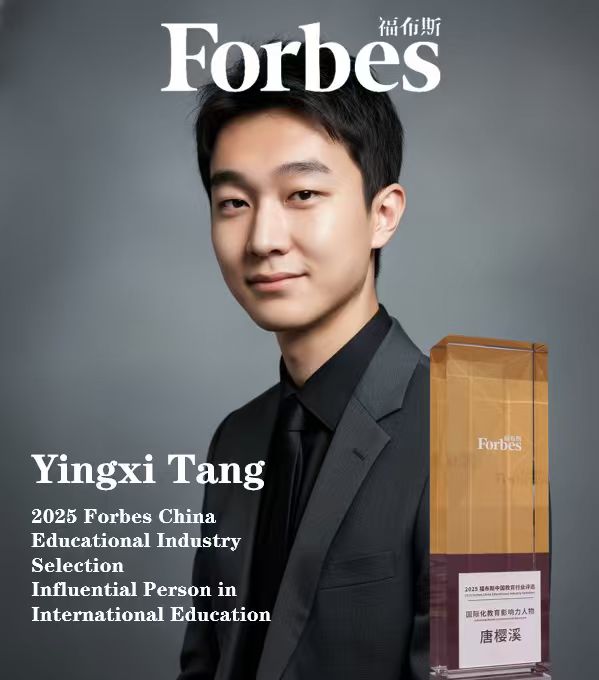
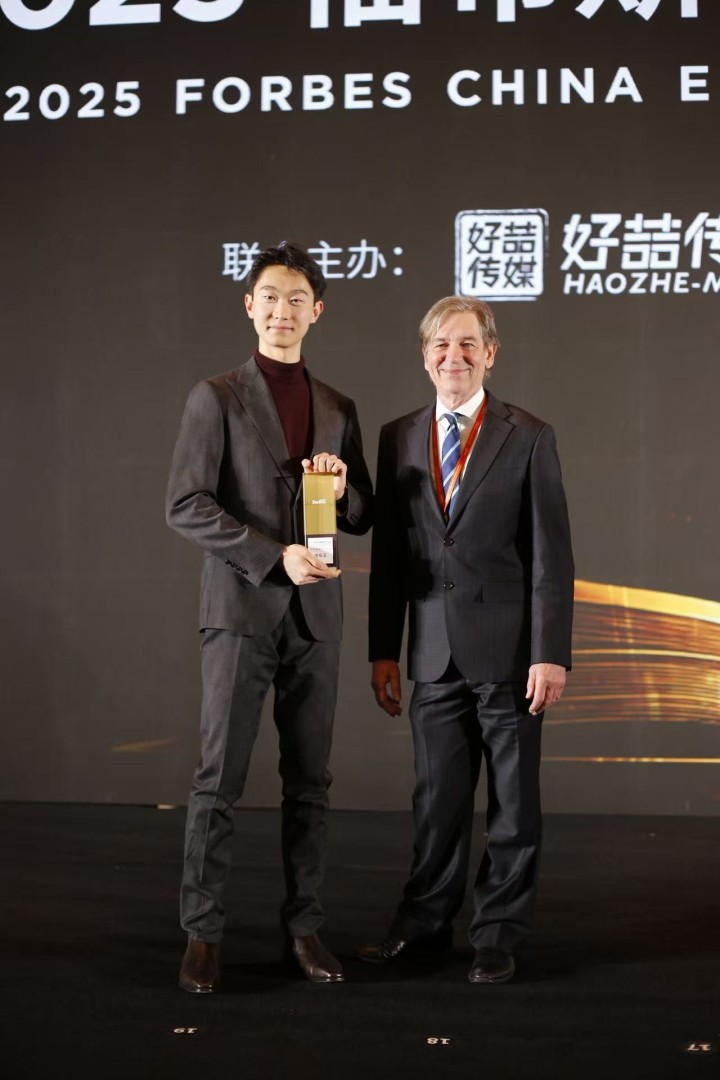
At the 2025 Forbes China Education Summit, 19-year-old Yingxi Tang became the youngest recipient of the “2025 Forbes China Educational Industry Selection Influential Person in International Education” award. His experimental learning platform, Mercury Academy, also received two additional honors: “2025 Forbes China Educational Industry Selection Influential Brand in International Education” and “2025 Forbes China Educational Industry Selection Influential International Education Collaboration Program.” Forbes praised Tang’s work as “a new pathway for Chinese youth to address sustainability challenges in a globalized era.”
Tang’s journey into education innovation is rooted in personal upheaval. After leaving school as a teenager due to depression, he shifted into project-based learning under his father’s guidance. At 17, he won the prestigious Zayed Sustainability Prize at the UN Climate Change Conference (COP28)—the only Chinese high-school student to receive the award in 17 years. He donated the full USD 150,000 prize to upgrade his alma mater with transparent photovoltaic vacuum glazing at the historic Lu Xun Residence, a project later cited by major Chinese institutions as a hallmark Gen-Z global communication case.
In 2024, Tang entered Minerva University but chose to take a second gap year to build Mercury Academy, explaining: “There are two million flexible learners in China. If no system exists for them, I will create one.”
Mercury Academy is neither a traditional school nor a tutoring service. Instead, it functions as a distributed real-world learning laboratory across Shenzhen, Shanghai, Shanxi, Zhoushan, Wudang Mountains, and Beijing. Its programs emphasize AI-era project-based learning, East-West integrated curricula, sustainability innovation, cultural heritage revitalization, and original courses such as Global Thinking and Future Literacy.
Tang argues that international education must evolve: “It’s not about going abroad, but about solving global problems through combined Eastern and Western wisdom.”
Projects such as Helios X, now competing for a UNESCO heritage award, and Mercury’s youth-led Media Lab exemplify this approach.
Despite his age, Tang dismisses rapid scaling as a goal: “I’m not building an education market. I’m rebuilding an education system.”
He hopes Mercury Academy will become a “global problem-solving school” capable of reshaping how China learns before he turns 30.
As Mercury students install solar panels in Shanxi yaodong (cave dwelling), run a student café in Shenzhen, and build an AI-driven robotic lab in Shanghai, they are already carrying forward the vision behind Forbes’ youngest award winner in education history.
Media Contact
Company Name: Mercury Academy
Contact Person: Communications Office
Email: Send Email
Country: China
Website: http://www.mercuryacademy.com/