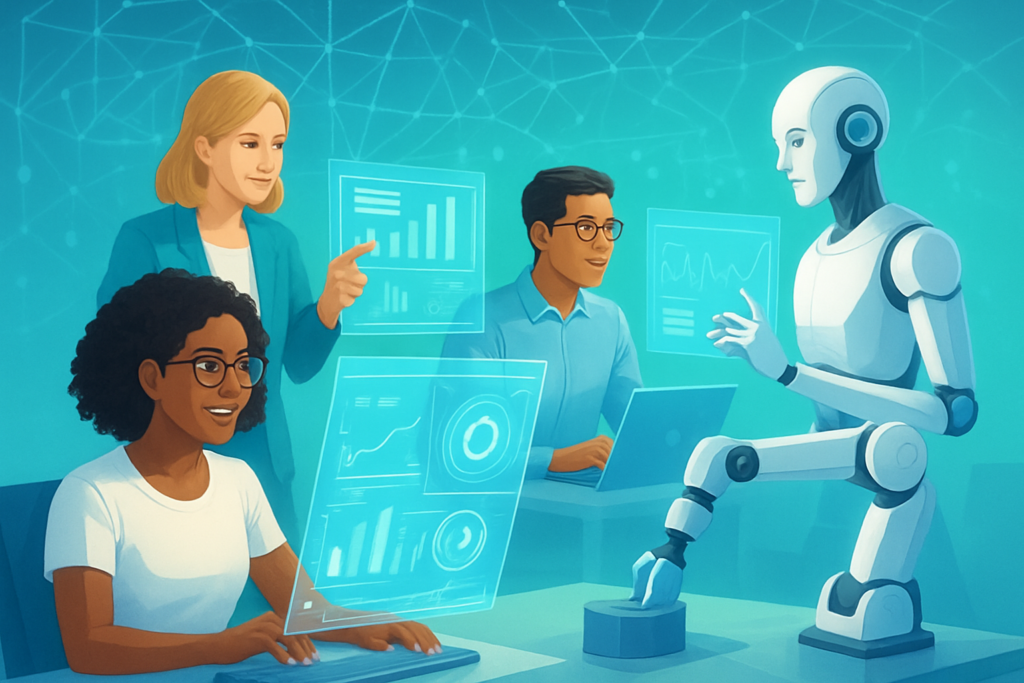
The pervasive narrative of artificial intelligence as an impending wave of mass job displacement is being significantly recalibrated by a flurry of recent surveys. Far from painting a picture of widespread unemployment, comprehensive reports from leading organizations in late 2024 and throughout 2025 are spotlighting AI's profound role as a catalyst for unprecedented productivity gains, a creator of novel job opportunities, and a transformative force reshaping existing roles. These findings suggest a future where human ingenuity, augmented by AI, drives economic growth and innovation, rather than one dominated by automated unemployment lines.
This paradigm shift in understanding AI's labor market impact underscores a critical evolution in how businesses are integrating and leveraging intelligent systems. Instead of merely automating tasks to reduce headcount, companies are increasingly deploying AI to enhance human capabilities, streamline workflows, and unlock new avenues for growth and development. The data points towards a strategic reinvestment of AI-driven efficiencies into expanding operations, fostering innovation, and upskilling the workforce, signaling a more optimistic and collaborative future for human-AI interaction in the professional sphere.
Augmentation Over Annihilation: The Data-Driven Reality of AI's Workforce Impact
The technical underpinnings of this revised outlook on AI's labor market influence lie in the nuanced ways generative AI (GenAI) and other advanced AI systems are being deployed. Unlike earlier, more narrowly focused automation, modern AI is often designed for augmentation, taking on repetitive or data-intensive tasks to free human workers for higher-value, more creative, and strategic endeavors. This distinction is crucial and is reflected in the methodologies and findings of recent, large-scale surveys.
For instance, the EY US AI Pulse Survey (April 2025) revealed that an overwhelming 96% of organizations investing in AI are experiencing tangible productivity gains, with 57% categorizing these gains as significant. Critically, only a meager 17% reported that these efficiencies led to reduced headcount. Instead, the benefits were largely channeled into expanding and developing new AI capabilities (47% and 42% respectively), bolstering cybersecurity (41%), investing in R&D (39%), and crucially, upskilling and reskilling employees (38%). This represents a significant departure from previous fears of widespread job cuts, illustrating a strategic pivot towards growth and human capital development.
Further solidifying this perspective, the PwC 2025 Global AI Jobs Barometer (June 2025), an extensive analysis of nearly a billion job advertisements, highlighted a quadrupling of productivity growth in AI-exposed industries (e.g., financial services, software publishing) since GenAI's emergence in 2022. Growth in these sectors surged from 7% (2018-2022) to an impressive 27% (2018-2024), starkly contrasting with a decline in productivity growth in less AI-exposed industries. The report also noted that job availability grew by 38% in roles more exposed to AI, emphasizing the creation of "augmented" jobs where AI supports human expertise. This directly challenges the notion of AI as a net job destroyer, instead positioning it as a powerful engine for new employment opportunities and significant wage premiums for AI-skilled workers, who saw an average 56% wage premium in 2024.
These findings differ profoundly from earlier, more alarmist predictions that often focused solely on the automation potential of AI without fully accounting for its capacity to create new tasks, roles, and even entire industries. The initial reactions from the AI research community and industry experts have largely been one of validation for those who have long argued for AI's augmentative potential. They emphasize the importance of distinguishing between task automation and job displacement, highlighting that while many tasks within a job role can be automated, entire jobs are often reconfigured rather than eliminated, demanding new skill sets and fostering a more collaborative human-AI work environment.
Shifting Sands: Competitive Implications for Tech Giants and Startups
The re-evaluation of AI's impact on jobs and productivity carries significant competitive implications for AI companies, tech giants, and burgeoning startups alike. Companies that strategically embrace AI as an augmentation tool, focusing on enhancing human capabilities and driving innovation, stand to gain substantial strategic advantages.
Major tech companies like Microsoft (NASDAQ: MSFT), Google (NASDAQ: GOOGL) (parent company Alphabet), and Amazon (NASDAQ: AMZN), which are heavily investing in AI-powered productivity tools (e.g., Microsoft 365 Copilot, Google Workspace AI features, Amazon's various AI services), are poised to benefit immensely. Their ability to integrate sophisticated AI into widely used enterprise software and cloud platforms directly contributes to the productivity gains observed in recent surveys. These companies are not just selling AI; they are selling enhanced human output, which resonates deeply with businesses looking to optimize operations without sacrificing their workforce. Their market positioning is strengthened by offering comprehensive ecosystems where AI seamlessly integrates into daily workflows, making them indispensable partners for businesses navigating the AI transformation.
Conversely, companies that fail to adapt to this augmentation-focused paradigm risk being left behind. Those clinging to purely cost-cutting, job-displacement models for AI implementation may find themselves with a less engaged workforce and a limited capacity for innovation compared to competitors who empower their employees with AI. This shift also creates fertile ground for specialized AI startups offering niche solutions for specific industries or functions, particularly those focused on upskilling, AI-powered training, or developing bespoke AI assistants that enhance specific professional roles. The demand for these "AI co-pilots" and intelligent workflow orchestrators is set to surge, disrupting traditional software markets and creating new opportunities for agile innovators.
The Broader Canvas: AI in the Evolving Socio-Economic Landscape
The revelation that AI is more of a productivity engine and job transformer than a mass job eliminator fits squarely into the broader AI landscape and ongoing technological trends. It aligns with historical patterns of technological adoption, where initial fears of widespread displacement eventually give way to new forms of employment and economic growth. Just as the industrial revolution shifted labor from agriculture to manufacturing, and the internet revolution created entirely new digital industries, AI is ushering in an era of "augmented intelligence," where human and machine collaborate to achieve unprecedented efficiencies and innovations.
The impact extends beyond mere economics, touching upon societal structures, educational systems, and ethical considerations. While the immediate fear of job loss may be easing, new concerns are emerging. These include the potential for widening skill gaps, as workers without AI proficiency may struggle to adapt, and the need for robust educational and reskilling initiatives. The ethical deployment of AI, ensuring fairness, transparency, and accountability in systems that increasingly influence professional decisions, also remains a paramount concern. Comparisons to previous AI milestones, such as the rise of expert systems or early machine learning, highlight that while AI's capabilities have dramatically advanced, the fundamental challenge of integrating new technology harmoniously with human society persists. This current phase, marked by generative AI's explosive growth, demands a proactive approach to workforce development and ethical governance.
The Horizon Ahead: Navigating the Augmented Future
Looking ahead, experts predict a continued evolution of the human-AI partnership, with near-term developments focusing on making AI tools even more intuitive, personalized, and integrated into everyday applications. The "AI co-pilot" model, where AI acts as an intelligent assistant for various professional tasks, is expected to become ubiquitous across industries. Long-term, we can anticipate the emergence of entirely new job categories that revolve around managing, training, and collaborating with advanced AI systems, further solidifying AI's role as a job creator.
Potential applications on the horizon include highly personalized learning platforms powered by AI, adaptive healthcare solutions that enhance diagnostic accuracy and treatment plans, and sophisticated environmental monitoring systems that leverage AI for predictive analytics. However, challenges remain. Addressing the burgeoning skill gap through accessible and effective reskilling programs is crucial. Ensuring equitable access to AI technologies and training across socioeconomic strata will be vital to prevent a new form of digital divide. Furthermore, developing robust regulatory frameworks for AI governance, focusing on ethical use, data privacy, and algorithmic fairness, will be paramount as AI's influence deepens. Experts predict that the next few years will be defined by a concerted effort to optimize the human-AI interface, fostering environments where AI empowers individuals and organizations to achieve their full potential.
A New Chapter in the AI-Human Story
The latest survey findings represent a pivotal moment in the ongoing discourse surrounding AI's impact on the workforce. They offer a much-needed recalibration, shifting the focus from fear-mongering about job displacement to an optimistic outlook on productivity enhancement and job transformation. The key takeaway is clear: AI is not just about automation; it's about augmentation, creating a symbiotic relationship between human intelligence and machine capabilities.
This development holds immense significance in AI history, marking a maturation of our understanding and deployment of artificial intelligence. It underscores the importance of human agency in shaping technology's trajectory, emphasizing that the future of work is not predetermined by AI but co-created by how we choose to integrate it. In the coming weeks and months, watch for continued investment in AI-powered productivity tools, the proliferation of AI upskilling initiatives, and further refinement of ethical AI guidelines. The narrative has shifted, and the future of work, augmented by AI, appears brighter and more collaborative than ever before.
This content is intended for informational purposes only and represents analysis of current AI developments.
TokenRing AI delivers enterprise-grade solutions for multi-agent AI workflow orchestration, AI-powered development tools, and seamless remote collaboration platforms.
For more information, visit https://www.tokenring.ai/.