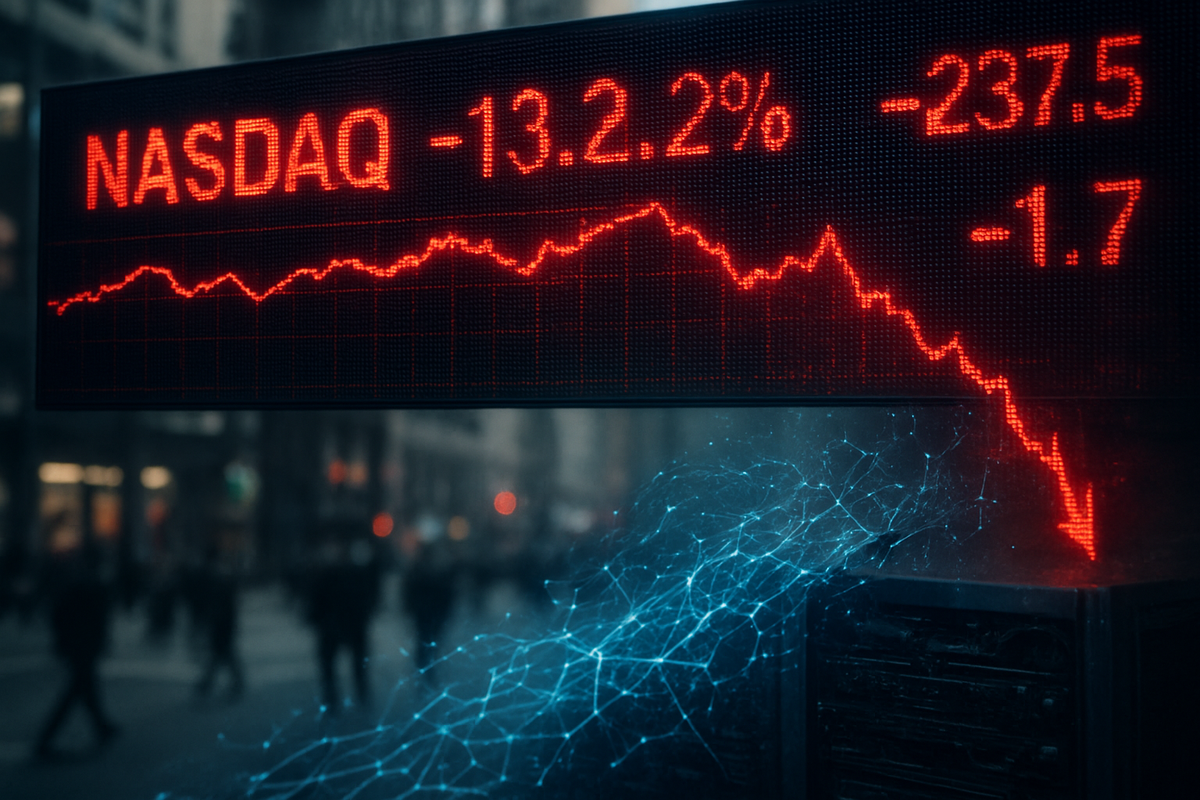
The tech-heavy Nasdaq Composite has experienced a notable nosedive in mid-December 2025, casting a shadow of doubt over the sustainability of the fervent AI-driven rally that has largely propelled market gains over the past two years. This recent downturn, triggered by disappointing corporate outlooks from key players in the AI sector, has reignited "AI bubble fears" among investors and analysts alike, prompting a critical re-evaluation of the market's trajectory and the true value of AI-centric growth. The immediate implications point to increased volatility and a potential shift in investor sentiment from unbridled enthusiasm to a more cautious, scrutinizing approach.
The recent market turbulence saw the Nasdaq Composite decline significantly, notably on December 11th and 12th, 2025. On December 11th, the index ended down 0.3% after Oracle (NYSE: ORCL) reported disappointing earnings and increased capital spending forecasts, causing its shares to plummet nearly 11%. This drag extended to other AI-related firms, with Nvidia (NASDAQ: NVDA) falling 1.5% and Micron Technology (NASDAQ: MU) down 2%. The following day, December 12th, the Nasdaq Composite experienced an even sharper decline of approximately 1.6% to 2%, marking its worst day in three weeks. This slide was primarily driven by Broadcom (NASDAQ: AVGO) shares, which tumbled nearly 11-12% due to cautious guidance regarding AI margins and weaker-than-expected AI product backlogs, compounding the ongoing concerns from Oracle's performance.
This recent nosedive is not an isolated incident but rather the latest in a series of significant downturns that have punctuated the broader market's upward trend. In May 2024, the Nasdaq Composite dropped approximately 2%, capping Wall Street's worst month of the year, driven by stronger-than-expected labor data and Federal Reserve interest rate anticipation. August 2024 saw a more dramatic plunge of over 650 points (3.6%) following disappointing earnings from Alphabet (NASDAQ: GOOGL), whose YouTube ad revenue fell short, and Tesla (NASDAQ: TSLA), which reported a 45% decrease in profits. March 2025 brought another substantial hit, with the Nasdaq falling 728 points (4%) amidst rising U.S. economic concerns and President Trump's remarks on a potential recession, impacting major tech players like Tesla (NASDAQ: TSLA), Alphabet (NASDAQ: GOOGL), Apple (NASDAQ: AAPL), and Nvidia (NASDAQ: NVDA). A broader market crash commenced in early April 2025, with the Nasdaq-100 futures falling 4.7% and the Composite experiencing a dramatic 1,600-point loss over two days, ultimately losing 11% due to new tariff policies introduced by then-President Trump. These events highlight a pattern of vulnerability within the tech sector to both corporate performance and broader economic and policy shifts.
Companies Navigating the AI Volatility
The recent downturn has created clear winners and losers, or at least those facing immediate headwinds, within the technology and AI landscape. Companies like Oracle (NYSE: ORCL) and Broadcom (NASDAQ: AVGO) bore the brunt of the immediate sell-off due to their disappointing earnings and cautious outlooks. Oracle's increased capital spending and Broadcom's weaker AI product backlogs directly challenged the narrative of unbridled growth in AI infrastructure, causing significant stock depreciation. Other high-flying AI beneficiaries, such as Nvidia (NASDAQ: NVDA) and Micron Technology (NASDAQ: MU), also experienced declines, illustrating the interconnectedness of the AI supply chain and the sensitivity of investor confidence to any perceived weakness.
Conversely, the market's reaction suggests a potential rotation rather than a complete collapse of the AI thesis. While specific companies face corrections, the underlying demand for AI infrastructure and capabilities remains strong according to many experts. Companies with diversified revenue streams or those that can demonstrate sustainable, profitable growth in the AI sector may prove more resilient. For instance, AMD (NASDAQ: AMD) CEO Lisa Su's prediction of a $1 trillion AI data center market by 2030, with her company potentially growing 35% annually, suggests that opportunities still abound for firms with strong execution and innovation in critical AI components. The broader market's resilience, even amidst tech sector specific headwinds, also points to a potential shift in investment towards less volatile sectors or more fundamentally sound tech companies.
This period of heightened scrutiny could also benefit companies that have been more conservative in their valuations or have yet to fully capitalize on the AI trend but possess strong underlying technology or market positions. As the market matures and investor focus shifts from speculative growth to tangible returns, companies demonstrating clear pathways to profitability and strategic integration of AI into their core businesses will likely gain favor. This might include established enterprise software providers or hardware manufacturers that can leverage AI to enhance existing product lines without relying solely on the AI boom for valuation.
Broader Implications and Historical Parallels
The Nasdaq's recent stumble and the growing "AI bubble fears" are not merely isolated market events; they fit into broader industry trends and economic narratives. The rapid ascent of AI stocks in 2024 and 2025, often compared to the dot-com bubble of the late 1990s, has fueled concerns about frothy valuations detached from fundamental earnings. The current skepticism, particularly after Oracle and Broadcom's reports, suggests that investors are becoming more discerning, demanding concrete evidence of profitability and sustainable growth rather than just promises of future AI potential. This marks a critical inflection point, moving beyond the initial hype cycle towards a more mature evaluation of AI's economic impact.
The ripple effects of this sentiment shift are likely to extend across the entire technology ecosystem. Startups reliant on venture capital funding for AI development may face tougher scrutiny and more challenging fundraising environments. Partners and competitors of the impacted tech giants will need to reassess their own strategies, potentially leading to strategic pivots or a more conservative approach to AI investments. Regulatory bodies, while not directly implicated in the recent nosedive, remain a significant factor, as evidenced by President Trump's tariff policies causing a market crash in April 2025. Future regulatory changes concerning data privacy, AI ethics, or antitrust could introduce further volatility to the sector.
Historically, periods of rapid technological advancement followed by market corrections are not uncommon. The dot-com bust serves as a potent reminder of the dangers of speculative investing without a strong foundation in profitability. While many argue that today's AI companies have more tangible products and revenue streams than their dot-com predecessors, the speed and scale of the recent AI rally bear striking resemblances. Noted investor Michael Burry, known for his accurate prediction of the 2008 housing market crash, has expressed pessimism about the overall U.S. stock market and questioned the cloud infrastructure boom, drawing parallels that warrant attention. However, many industry leaders, including Nvidia, dismiss the "AI bubble" notion, citing "insatiable" demand and the early stages of AI adoption, suggesting that current corrections might be a healthy rebalancing rather than a prelude to a collapse.
The Road Ahead: Navigating Uncertainty
Looking ahead, the short-term outlook for the Nasdaq and the broader AI market suggests continued volatility. Investors should brace for potential further corrections in specific AI stocks, especially those with high valuations and limited profitability. The market will likely remain highly sensitive to earnings reports and guidance from major tech companies, with any signs of weakness or cautious outlooks potentially triggering further sell-offs. The "Santa Claus rally," traditionally expected at year-end, may be muted or absent in 2025 due to the unprecedented AI-driven volatility.
In the long term, however, the underlying demand for AI technologies is widely expected to remain robust. This period of re-evaluation could lead to a healthier, more sustainable growth trajectory for the AI sector. Strategic pivots will be crucial for companies to adapt, focusing on clear value propositions, efficient capital allocation, and demonstrating tangible returns on AI investments. Market opportunities may emerge for value investors looking to acquire fundamentally strong AI companies at more reasonable valuations. Challenges will persist for companies that fail to articulate a clear path to profitability or rely solely on speculative growth. Potential scenarios range from a continued, albeit more moderate, AI-driven expansion with a greater emphasis on profitability, to a more significant correction that purges overvalued assets and forces a more disciplined approach across the industry.
Ultimately, the future of the AI-driven rally hinges on a delicate balance between genuine technological innovation and realistic market expectations. Companies that can effectively integrate AI into their core operations, deliver measurable value, and maintain strong financial health will likely thrive. Investors will increasingly scrutinize business models, competitive advantages, and the long-term viability of AI solutions.
Comprehensive Wrap-Up: A Market in Transition
The recent nosedive on the Nasdaq serves as a critical wake-up call, highlighting the inherent risks associated with rapidly ascending, innovation-driven markets. Key takeaways include the re-emergence of "AI bubble fears," the significant impact of corporate earnings and guidance on market sentiment, and the growing demand for tangible profitability over speculative growth in the AI sector. While the overall U.S. stock market may still end 2025 with solid gains, the tech sector, particularly AI, is clearly in a period of transition.
Moving forward, the market will likely be characterized by increased discernment and a flight to quality. Investors will be assessing companies based on their ability to generate sustainable revenue and profit from AI, rather than simply their exposure to the technology. This shift could lead to a more balanced market, where fundamentals play a more significant role in valuation. The debate between a "healthy correction" and a "bursting bubble" will continue, but the consensus leans towards a correction that allows for more sustainable growth in the long run.
The lasting impact of this period of volatility could be a more mature and resilient AI industry. Companies will be pressured to innovate responsibly and demonstrate clear economic value. Investors should watch closely for upcoming earnings reports, particularly from the "Magnificent Seven" and other major tech players, for indications of continued strength or further weakness. Federal Reserve decisions on interest rates and broader economic indicators will also play a crucial role in shaping market sentiment in the coming months. A keen eye on these factors will be essential for navigating what promises to be an evolving and dynamic market landscape.
This content is intended for informational purposes only and is not financial advice