Hyper3D, the 3D generative AI platform developed by Deemos, was featured in an NVIDIA case study highlighting Lowe’s broader AI, digital twin, and 3D content workflow. In the case study, NVIDIA describes how Lowe’s, the world’s second-largest home improvement retailer, has developed a large-scale workflow that combines digital twins, generative AI, and computer vision across its operations. As part of that workflow, NVIDIA states that Hyper3D.ai’s Rodin helped support a 30,000+ item 3D asset catalog through AI-powered 2D-to-3D conversion.
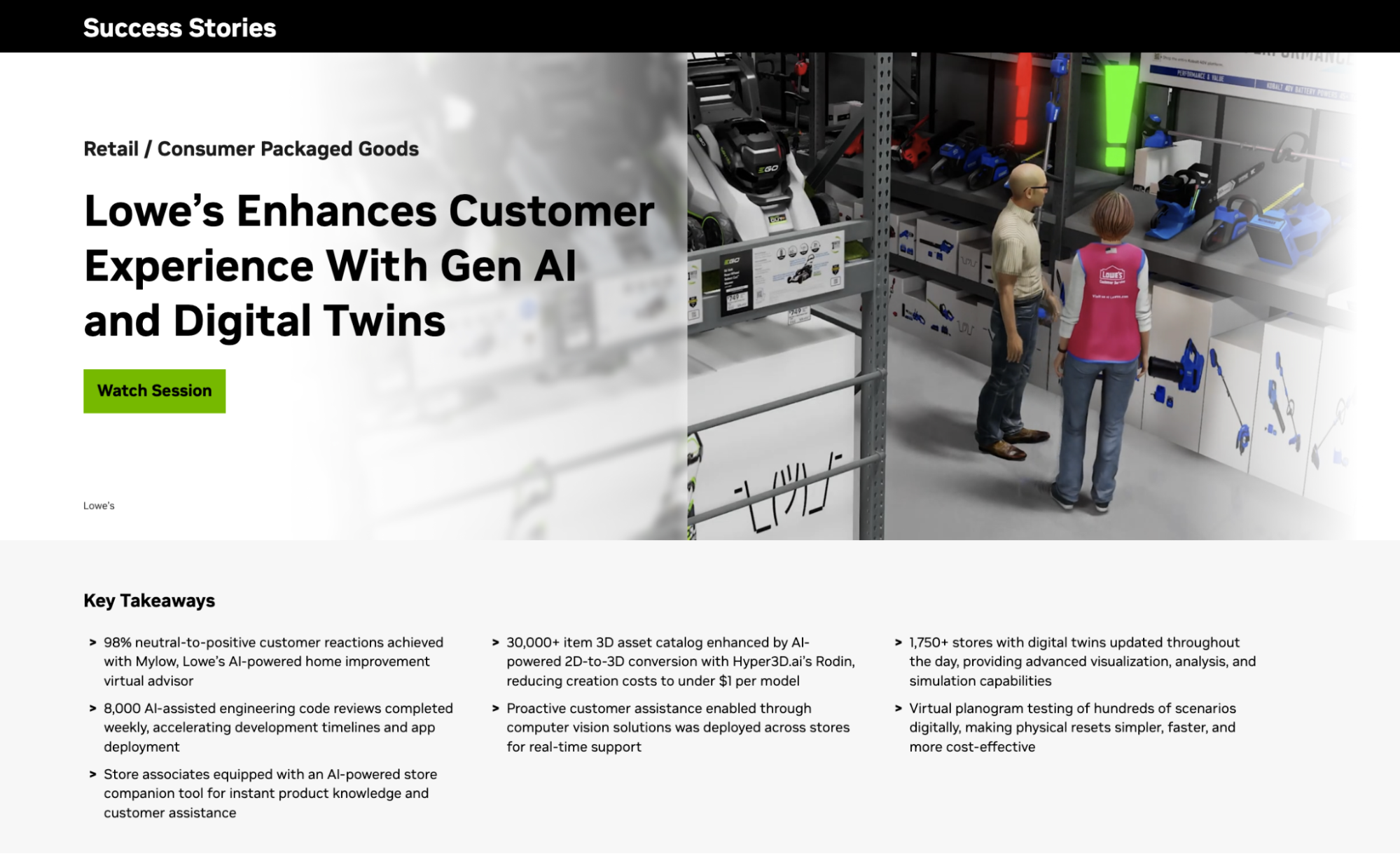
The NVIDIA case study places Hyper3D within a practical enterprise setting where 3D generation is used as part of a broader production workflow. According to NVIDIA, Lowe’s used this approach to streamline asset discovery and enable AI-powered 3D model generation, transforming 2D product images into precise, high-quality 3D models within minutes at a cost of under $1 per model.
For Hyper3D, the significance of this inclusion lies less in the mention itself and more in what it suggests about the direction of the market. Enterprise teams evaluating 3D AI tools increasingly care about whether those tools can fit into real workflows involving scale, consistency, and operational efficiency. The Lowe’s example suggests that AI-generated 3D content is beginning to play a more concrete role inside production systems built for merchandising, visualization, and digital twin readiness. That interpretation is an inference based on NVIDIA’s description of the workflow and Hyper3D’s cited role within it.
Hyper3D has focused on reducing the time and complexity involved in turning visual inputs into usable 3D assets. Its product direction has centered on making 3D creation more accessible while supporting the practical steps that follow generation, including editing, refinement, and preparation for downstream use. More broadly, the company has framed this direction as a move beyond image-to-3D conversion toward more controllable editing workflows, including natural language-based model modification and production-ready asset handling.
That broader workflow matters in enterprise environments where asset volume is often as important as asset quality. Retail organizations operating at scale may need tens of thousands of visual assets that are discoverable, consistent, and suitable for integration into larger systems. In that context, the role of AI is not simply to generate content quickly, but to reduce manual bottlenecks and make 3D workflows easier to repeat across categories, teams, and use cases. The Lowe’s case study is notable because it describes exactly this kind of environment: a large retailer using a mix of internal systems, partner technologies, and digital twin infrastructure to support content operations at scale.
“Being included in this NVIDIA case study is meaningful to us because it reflects a practical use of 3D generative AI inside a real enterprise workflow,” said QX Zhang, CTO of Hyper3D. “We believe the long-term value of this technology comes from helping teams produce usable 3D assets more efficiently, with better control and lower operational friction, rather than treating generation as an isolated creative step.”
The company views this moment as part of a broader shift in how organizations assess AI tools for visual content creation. In many sectors, including retail, commerce, gaming, and design, the standard for adoption is becoming more demanding. Teams are looking not only for visual quality, but also for workflow fit, speed, and readiness for production. Systems that can contribute to real asset pipelines, rather than only produce one-off outputs, are likely to matter more as enterprise adoption develops further. This is an analytical judgment based on the facts described in the NVIDIA case study and on Hyper3D’s previously stated product direction.
Hyper3D expects the next stage of growth in 3D AI to be shaped by how well platforms support repeatable, scalable, and interoperable workflows. Recognition within the NVIDIA and Lowe’s story does not by itself define the category, but it does offer a concrete example of how AI-generated 3D assets are being used within a larger operational stack. For Hyper3D, that is the more important signal. As organizations continue investing in digital twins, immersive visualization, and AI-assisted content production, the company intends to keep improving its platform around practical asset readiness, workflow efficiency, and ease of use for teams building at scale.
###
For more information about Deemos Tech, contact the company here:
Deemos Tech
Qixuan Zhang
+1 (650) 676-8889
hello@deemos.com
108 West 13th Street, Wilmington, Delaware, 19801