
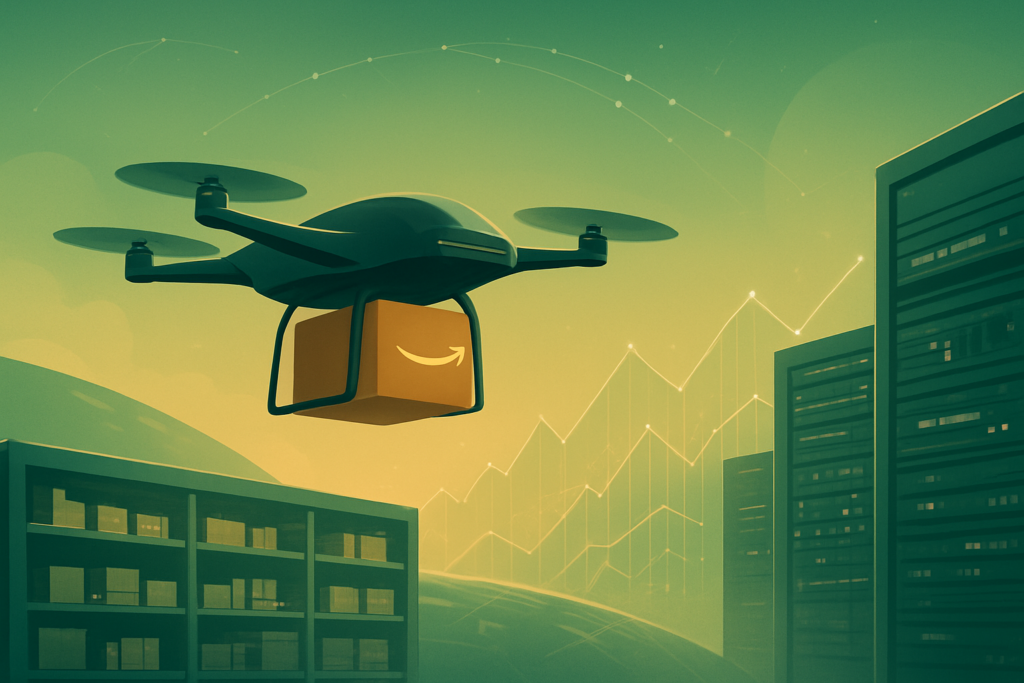
As of March 10, 2026, Amazon.com, Inc. (NASDAQ: AMZN) stands at a pivotal crossroads, transitioning from its legacy as the "Everything Store" to its future as the "Everything Infrastructure." After navigating the post-pandemic correction and a transformative era of generative AI integration, Amazon remains one of the world's most influential corporations. However, the narrative in early 2026 is defined by a massive strategic pivot: a projected $200 billion capital expenditure plan focused on artificial intelligence and satellite connectivity. While its retail dominance and cloud leadership (AWS) remain undisputed, investors are currently weighing the company’s long-term visionary bets against short-term margin pressures and a looming landmark antitrust trial.
Historical Background
Founded in 1994 by Jeff Bezos in a Bellevue, Washington garage, Amazon’s journey began as an online bookseller. Its early history was marked by the "Get Big Fast" mantra, surviving the dot-com bubble burst that claimed many of its peers. The company’s trajectory changed forever in 2005 with the launch of Amazon Prime, which transformed customer loyalty into a subscription-based moat.
In 2006, Amazon made its most significant pivot by launching Amazon Web Services (AWS), effectively inventing the modern cloud computing industry. Over the next two decades, Amazon expanded into hardware (Kindle, Echo), entertainment (Prime Video), and physical retail (Whole Foods). In 2021, founder Jeff Bezos stepped down as CEO, handing the reins to Andy Jassy, the former head of AWS. Under Jassy, the company has navigated a period of intense "regionalization" of its logistics network and a rapid re-orientation toward Generative AI.
Business Model
Amazon’s business model is a multi-layered ecosystem where high-margin services subsidize and enhance its lower-margin retail operations.
- Online Stores (1P) and Third-Party Seller Services (3P): Amazon’s core retail engine. In 2026, 3P services (commissions, fulfillment, and shipping fees) continue to outpace 1P sales, representing over 60% of total units sold.
- Amazon Web Services (AWS): The company’s primary profit engine. AWS provides on-demand cloud computing platforms and APIs to individuals, companies, and governments.
- Advertising Services: Now the "silent giant" of the portfolio, Amazon’s advertising business leverages deep consumer purchase data to offer high-intent marketing for brands.
- Subscription Services: Including Prime memberships, Audible, and Kindle Unlimited, providing a steady stream of recurring revenue.
- Physical Stores: Comprising Whole Foods Market, Amazon Fresh, and Amazon Go.
Stock Performance Overview
Over the last decade, Amazon has been a cornerstone of the "Magnificent Seven," significantly outperforming the broader market despite periods of high volatility.
- 10-Year Performance (2016–2026): Amazon has delivered a staggering 10-year Compound Annual Growth Rate (CAGR) of approximately 22%. A $1,000 investment in March 2016 would be worth roughly $7,193 today.
- 5-Year Performance: The stock saw a massive surge during the 2020-2021 pandemic lockdowns, followed by a nearly 50% correction in 2022. It spent 2023 and 2024 in a robust recovery phase, reaching new all-time highs of $254 in late 2025.
- 1-Year Performance: The past twelve months have been more muted. After hitting record highs in November 2025, the stock has pulled back roughly 16% from its peak.
- Year-to-Date (2026): As of March 10, AMZN is trading at approximately $213.50, down 7.6% YTD, as the market digests the implications of the company's unprecedented $200 billion AI infrastructure spend.
Financial Performance
Amazon’s fiscal year 2025 results highlighted the divergence between its maturing retail business and its accelerating service segments.
- Revenue: Total revenue for FY 2025 reached $716.9 billion, a 12% increase year-over-year.
- Profitability: Net income for 2025 stood at $77.7 billion ($7.29 per diluted share). Operating margins have benefited from the "regionalization" of the fulfillment network, which lowered the cost-to-serve by nearly 15% since 2023.
- Capital Expenditures: The most discussed metric in 2026 is CapEx. Amazon is projected to spend $200 billion this year, primarily on H100/B200 GPU clusters, custom "Trainium" AI chips, and the build-out of its Project Kuiper satellite constellation.
- Free Cash Flow (FCF): While FCF reached record highs in 2024, it has seen a slight contraction in early 2026 due to the aforementioned infrastructure investments.
Leadership and Management
The "Jassy Era" is now firmly established. Andy Jassy (CEO) has earned a reputation for operational discipline, cutting non-core projects (like the Astro robot and certain Halo health devices) to focus on high-scale infrastructure.
- Matt Garman (CEO of AWS): Having succeeded Adam Selipsky in 2024, Garman has pivoted AWS toward "Agentic AI"—autonomous software agents that can perform complex business tasks.
- Doug Herrington (CEO, Worldwide Amazon Stores): Herrington is credited with the successful overhaul of the U.S. logistics network into eight distinct regions, a move that drastically improved delivery speeds.
- Strategic Governance: The board remains focused on defending against antitrust challenges while navigating the sensitive geopolitics of cloud data sovereignty in Europe and Asia.
Products, Services, and Innovations
Innovation in 2026 is centered on three pillars: Artificial Intelligence, Space, and Robotics.
- Generative AI (Bedrock & Q): Amazon’s AI suite, Bedrock, allows enterprises to build applications using foundational models. Amazon Q, their AI business assistant, has become a central tool for developers and corporate employees.
- Project Kuiper (Amazon Leo): Amazon’s low-earth orbit (LEO) satellite internet service began limited commercial rollout in Q1 2026. Marketed as "Amazon Leo," it aims to provide high-speed internet to underserved regions and backhaul for AWS customers.
- Robotics: In fulfillment centers, the "Proteus" fully autonomous robots now handle 40% of floor movements, significantly reducing human-robot interface risks and increasing throughput.
- Prime Video Ads: Having made ads the default in 2024, Amazon’s video advertising has scaled into a multi-billion dollar business, rivaling traditional television networks in reach.
Competitive Landscape
Amazon faces a multi-front war across its various business segments.
- Cloud Computing: AWS (30% market share) faces intense pressure from Microsoft Azure (27%), which has gained ground through its OpenAI partnership. Google Cloud (13%) remains a strong third, particularly in AI-native startups.
- E-Commerce "Discovery" Platforms: While Amazon leads in "intent-based" shopping, platforms like TikTok Shop, Temu, and Shein have captured significant mindshare in the "discovery" and ultra-low-cost segments. TikTok Shop's U.S. sales hit nearly $16 billion in 2025.
- Retail Giants: Walmart (NYSE: WMT) continues to be Amazon's primary domestic rival, leveraging its 4,700 U.S. stores as local fulfillment hubs and growing its own "Walmart Connect" advertising business.
Industry and Market Trends
- Regionalization of Trade: To mitigate geopolitical risks and shipping costs, Amazon has moved toward a "local-to-local" inventory model, placing products closer to the end consumer than ever before.
- Sovereign Cloud: Governments increasingly demand that data stay within national borders. AWS has responded with "Sovereign Cloud" regions in the EU and Asia to comply with strict local data laws.
- Retail Media: The shift of advertising dollars from social media to retail platforms (where the purchase actually happens) continues to favor Amazon’s high-margin ad business.
Risks and Challenges
- The FTC Antitrust Trial: Scheduled for October 2026, the FTC's case against Amazon is a "generational" risk. A potential ruling could force the divestiture of fulfillment services or change how Amazon favors its own products.
- Labor Relations: The Amazon Labor Union (ALU), now affiliated with the Teamsters, remains a persistent thorn. While no master contract exists, labor-related disruptions and legal battles over the NLRB's constitutionality create ongoing friction.
- The "AI CapEx" Bubble: There is a growing concern among institutional investors that the $200 billion AI investment may not yield immediate ROI, potentially leading to a period of "dead money" for the stock.
Opportunities and Catalysts
- Healthcare Integration: The integration of One Medical and Amazon Pharmacy is finally showing synergy. Amazon has begun rolling out "same-day prescription delivery" to 4,500 U.S. cities, positioning itself as a major disruptor to traditional PBMs and pharmacies like CVS.
- Project Kuiper Scaling: If Amazon meets its July 2026 FCC deadline for satellite deployment, it could unlock a massive new recurring revenue stream from government and enterprise connectivity contracts.
- Agentic AI Monetization: Moving beyond "chatbots" to "agents" that can autonomously manage supply chains or customer service could revolutionize AWS's revenue per customer.
Investor Sentiment and Analyst Coverage
Wall Street remains generally bullish but cautious about the near-term. Most analysts maintain a "Buy" rating, citing Amazon’s unmatched scale and the long-term potential of the "AWS + Ads" profit engine. However, several high-profile hedge funds trimmed their positions in Q4 2025, citing the massive capital expenditure requirements. Retail sentiment on platforms like X and Reddit remains divided between long-term "HODLers" and those concerned about the competition from Chinese e-commerce players.
Regulatory, Policy, and Geopolitical Factors
Amazon operates under a global microscope. In the U.S., the focus is on "dark patterns" in Prime cancellations and the "Buy Box" algorithm. In the EU, the Digital Markets Act (DMA) has forced Amazon to provide more transparency to third-party sellers. Geopolitically, the potential for increased tariffs on Chinese goods (impacting Temu/Shein) could paradoxically benefit Amazon’s U.S.-based fulfillment model, though it would also raise costs for the thousands of Chinese sellers on the Amazon marketplace.
Conclusion
Amazon in 2026 is a company of immense scale attempting to reinvent its core once again. Its dominance in e-commerce and cloud computing provides a massive "war chest" that allows it to spend $200 billion on the next generation of infrastructure. However, for the first time in a decade, its moat is being challenged by both innovative "social commerce" models and a resurgent Microsoft in the cloud.
Investors should watch two key developments in the coming months: the acceleration of Project Kuiper satellite launches and the preliminary rulings in the FTC antitrust case. Amazon remains a foundational asset for any growth-oriented portfolio, but the path forward requires a high tolerance for capital-intensive expansion and regulatory volatility. The "Everything Store" is gone; the era of "Everything Infrastructure" has begun.
This content is intended for informational purposes only and is not financial advice. As of March 10, 2026, the author holds no position in AMZN.